The end of the world is upon us. The only chance to survive? Create the strongest and most resilient species of little round aliens by combining different traits and outwitting your opponents. Is this game the dawn of a great new age of gaming, or is it a catastrophe in waiting?
Game Name: Doomlings (2022)
Designer: Justus Meyer, Andrew Meyer
Artist: Justus Meyer
Publisher: Self-Published
Player Count: 2-6 Players
Playing Time: 20-45 minutes
Review Date: 6/6/2025
Reviewed By: Dan
Upfront Disclaimer: Doomlings LLC generously provided me with a copy of “Doomlings” for purposes of testing it out and writing a review. No compensation was provided and I am free to write whatever I want about the game. All opinions contained within are my own unbiased thoughts.
Game Overview
Doomlings, on paper, is a very straightforward game. It’s a card game, created in 2022 by Justus and Andrew Meyer where players are vying to create their own species of aliens, called Doomlings. These species are created by playing one of many different trait cards, which are worth differing numbers of victory points, but often more importantly allow the player to perform actions or add on-going abilities to their species that help them thrive. The game is played in various different ages, each of which slightly modify the rules for all players while that age is active. And then, in the end, there are also catastrophes that occur which typically have negative effects on all players involved. And the third catastrophe to occur each game brings about the end of the world, at which time one last set of rules come into play before end-game scoring takes place.
Perhaps very appropriately to the theme, the card game Doomlings feels like less of a standalone game, and more like an ecosystem that exists in which a game is played. To even begin talking about how the game works, you’d first have to even understand which version of the game someone owns. There is a base game that can be purchased, which is essentially a box with 167 different cards (and I mean different – each and every one entirely unique), and a simple set of rules. This is truly a card game – there are no other components whatsoever. No dice, no game board, no score counters, no meeples, no dials or timers or other gizmos. But then, move beyond the base game, and there is a TON of other expansions and content in the Doomlings universe. At the time of me writing this, there are what appears to be 11 different expansions in existence. You can even buy an “Ultimate Bundle” that includes all of these expansions, a real oak wooden box for the game, neoprene community playmats and individual playmats, and other upgrades for the game. If Doomlings turns out to be a game that you enjoy, you probably won’t run out of content for it any time soon.
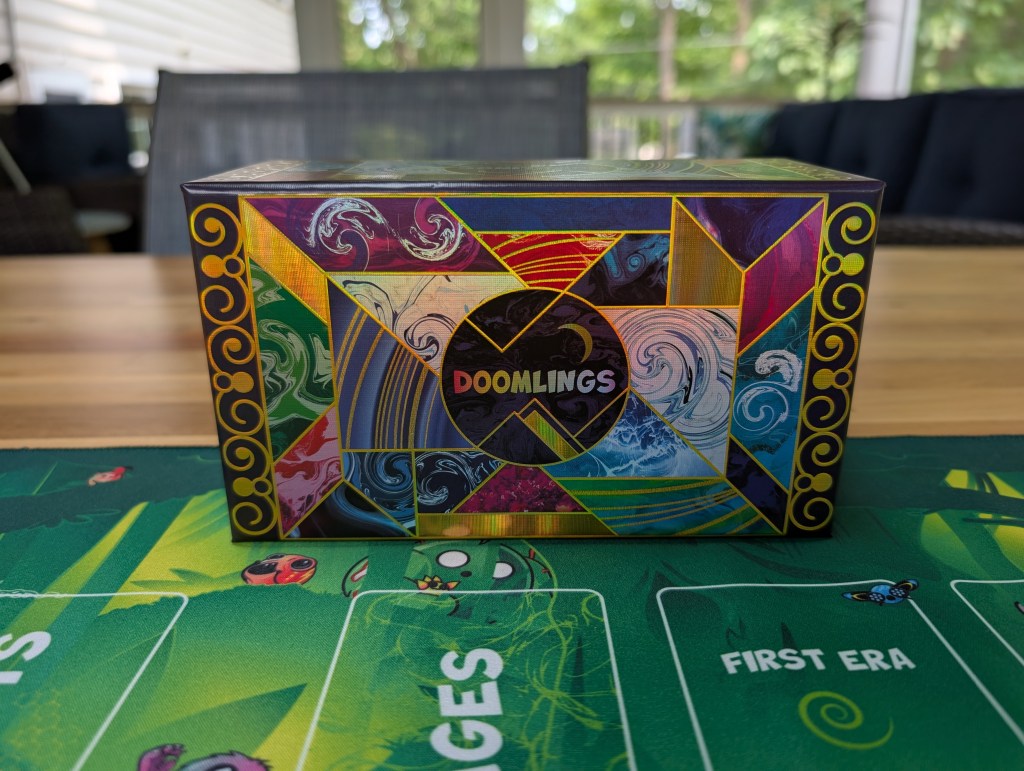
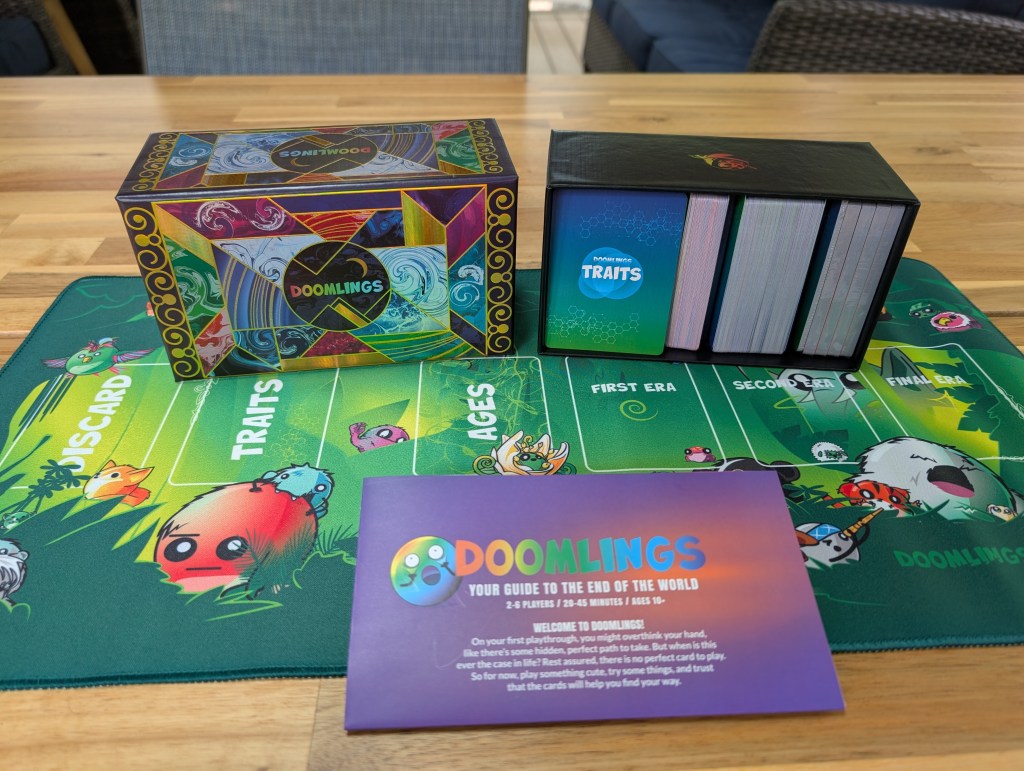
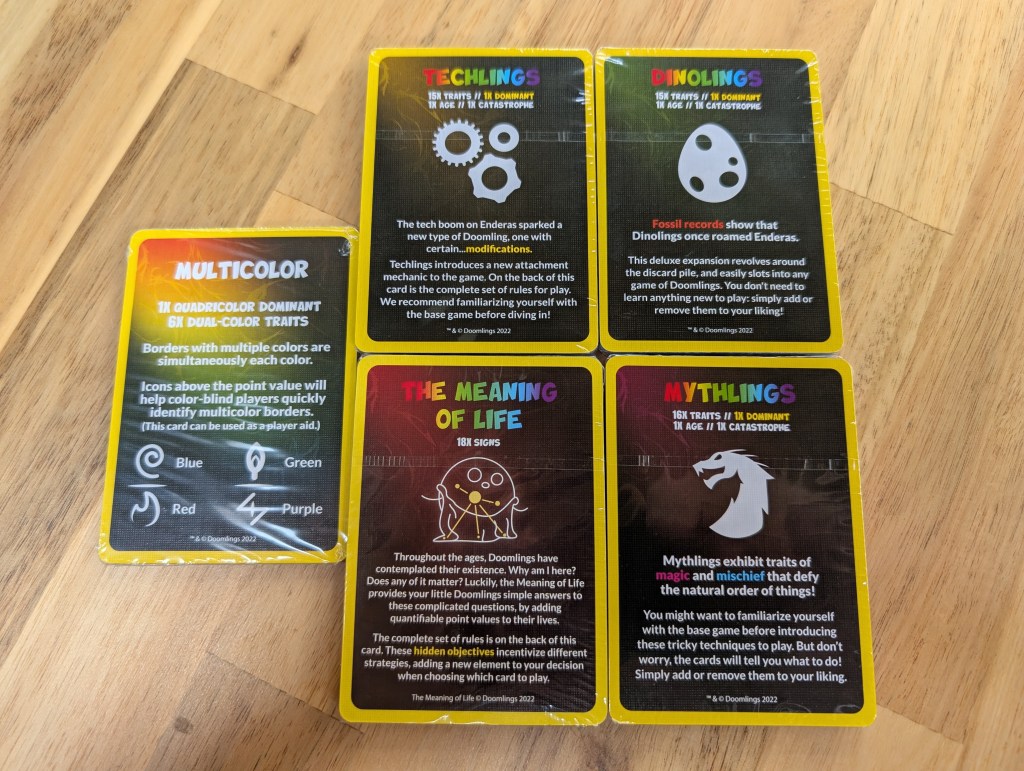
The version I have to review is what Doomlings calls the “Deluxe Bundle”. It includes all 167 cards from the base game, five different expansions that add everything from new traits to special objectives for each player, a nice colorful neoprene community playmat to use in the center of the table for organizing the different piles of cards, and one of the most visually striking game boxes I have ever seen. Let’s talk about the actual exterior box for a minute – the designers refer to it as the “art-deco-meets-Mardi-Gras” box, and that’s pretty much a spot on description. If this box is sitting on someone’s board game shelf or for sale at a gaming store, it’s not going to have a hard time catching your eye. It’s covered with bright colors, angular shapes, different textures, and a whole boatload of gold embossing that reflects light every which way. I have no clue why they did this, but I’m not mad about it either – it’s absolutely stunning. Even as I sit here and write this review I find myself glancing over at the box on my desk every now and then. And thankfully, the cards within are wonderful too. Nice linen texture, good weight and thickness, and very colorfully printed on both sides. I’m not the “sleeve all the cards” type of gamer, and these cards feel like they are super well-made and are a joy to use.
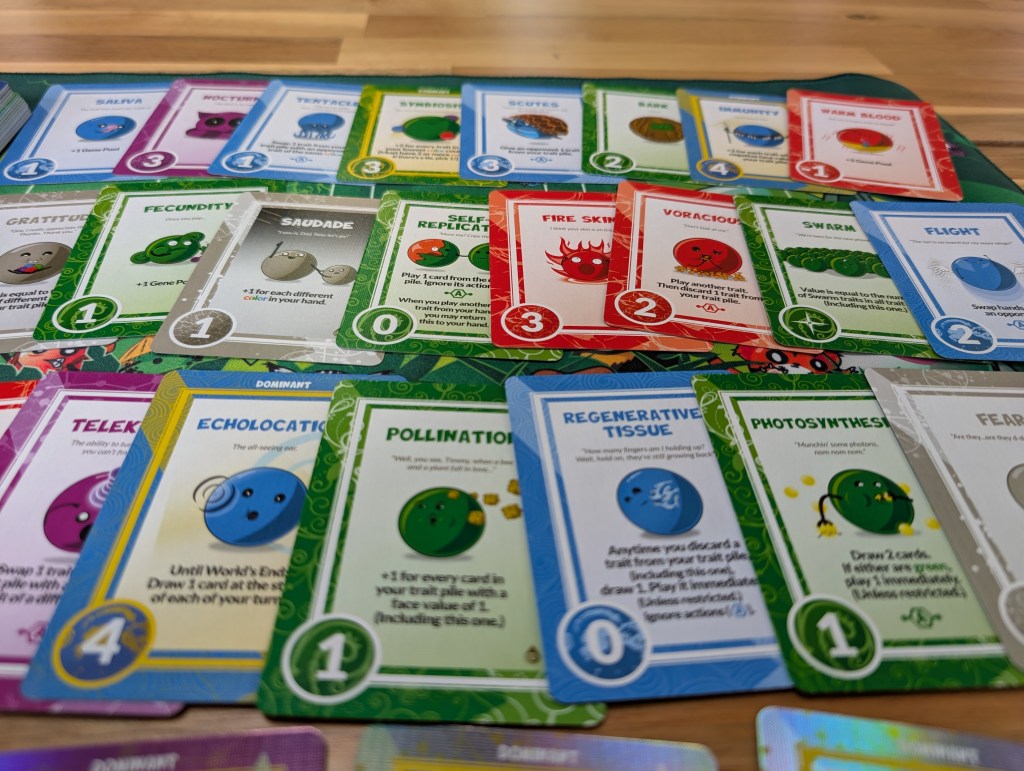
The game is very simple to set up and get playing, even with brand new players – this is one of those card games (similar to Fluxx or Monopoly Deal, for example) where nearly everything you need to know is written on the cards themselves as you play. Each player is dealt 5 “trait” cards as their starting hand. Trait cards make up the bulk of this game – they come in five separate colors (green, blue, purple, red, and “colorless” which is basically gray). Even in the base game with no expansions, there are well over 100 completely unique trait cards. A trait card is how points are scored at the end of the game – each one has a point value (positive, negative, zero, or variable) on the bottom, and some of them also contain either one-time actions or on-going effects that alter the game as you play them. For example – a purple trait called “Impatience” that allows you to steal 2 random cards from an opponent’s hand, or “Overgrowth” which adds an additional point of value to itself for every green trait in your trait pile. A turn is very simple – the player plays one single trait card of their choice face up in front of themselves, performs any immediate actions required by the card played, and then “stabilizes” themselves back up to a certain hand size as illustrated by their current Gene Pool number.
Every player starts the game with a Gene Pool size of 5 (meaning, they will end every turn with exactly 5 cards in their hand, whether that means drawing up to 5 or discarding down to 5), but the gene pool size can change for each player during the game. That’s one of the most unique things about Doomlings – through this Gene Pool mechanic, every single player has their own unique hand size requirement that they can strategically alter during the game. There are cards and actions that may cause it to shrink to as low as 1, or as high as 8, and this is one facet of the game that each player must strategically manage as it progresses.
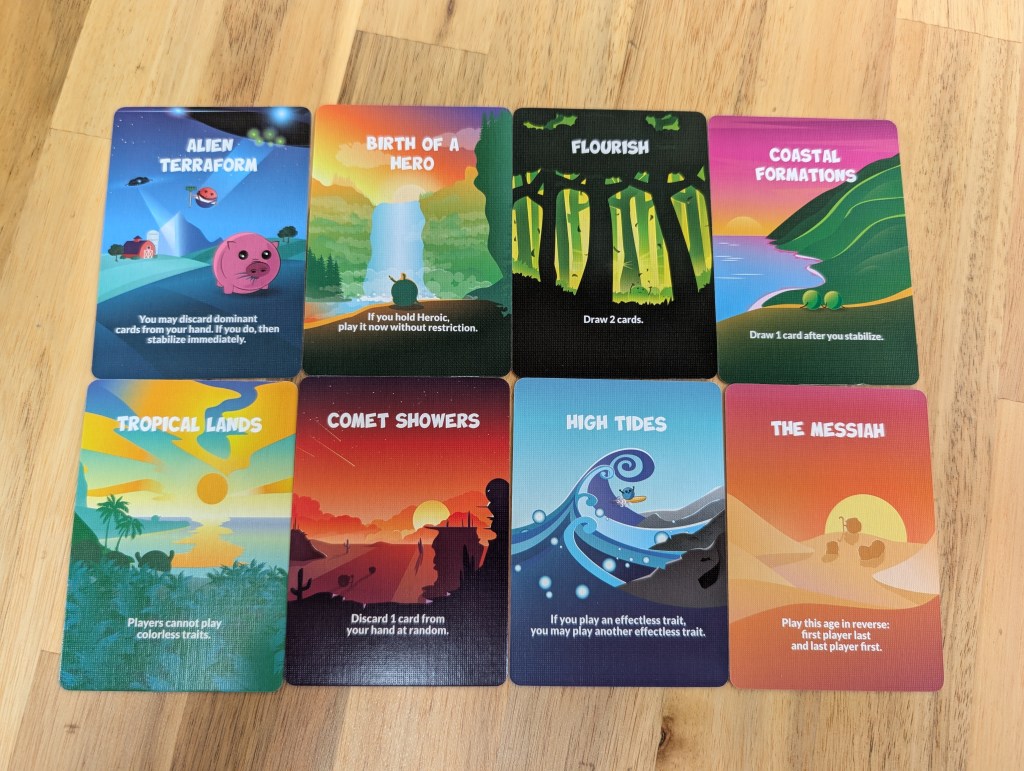
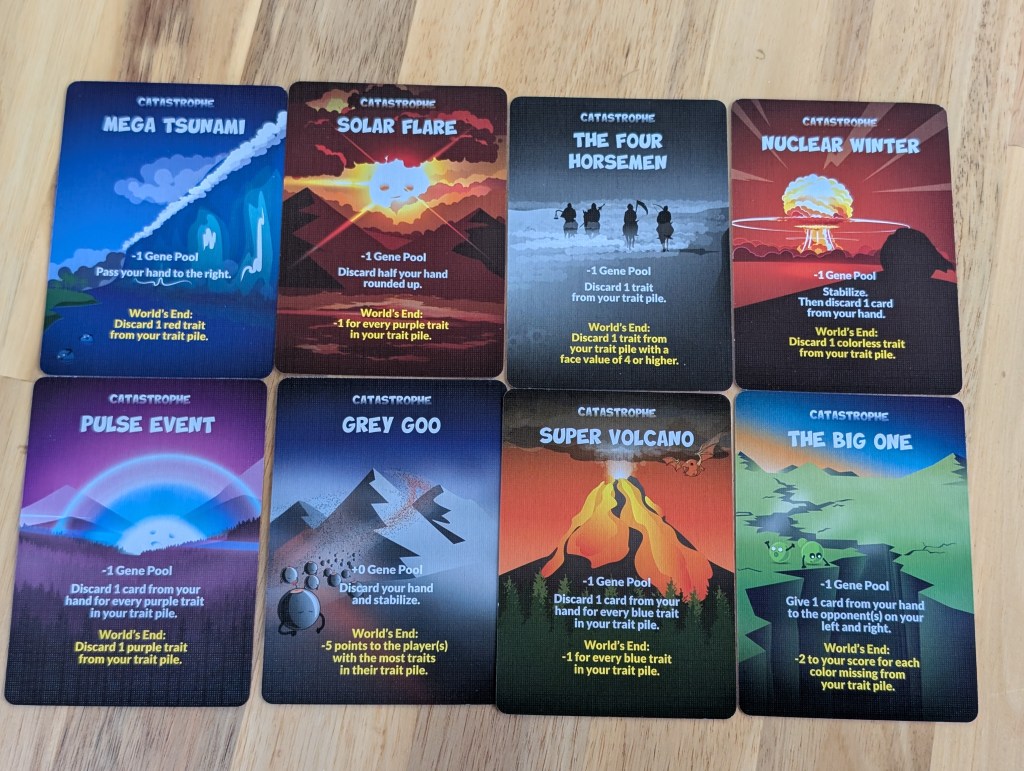
The game is played over three Eras, which each consist of a number of different “ages” that each end with a catastrophe card being drawn. All games begin with an age known as the “Birth of Life”, but after that, players don’t know whether the next age flipped will be a prosperous one or a catastrophe. A new age card is flipped at the end of every round (each player having taken one turn each in a clockwise circle) and this is one of the most exciting parts of the game. The age cards each contain a change to the rules, which applies to all players, but only until a new age occurs. Examples of this include the age of “Tropical Lands”, in which players are forbidden from playing any colorless trait cards; or “Age of Peace”, where all actions are ignored on trait cards played during that round. Catastrophes work similarly, but the effects tend to all be negative. These can be things like “Mega Tsunami” causes every players gene pool size to shrink by 1, and forces them to pass their entire hand to the player on the right; and “AI Takeover”, where gene pools shrink in size by 1, and players need to discard all but 1 card from their hands.
In the end, the scoring is super straight forward, although you may need to grab your own pen and paper as no score tracker is included in the game. Players first sum up the value of all trait cards left played face up in front of them that have a specific number written on them. Once that is done, look at any trait cards that have a variable/bonus/modifier value, and add those into the sum. And there you have it – the player with the highest score total has built the most dominant species, and can face the World’s End knowing that they have the best chance of surviving!
My Thoughts
If this review was solely based on the visual and tangible aspects of a game, then Doomlings is a doing a mic drop and walking off the stage to a never-ending standing ovation from the crowd. I mentioned above how gorgeous the box is, it’s stunning, we can put a giant check mark next to that on the review score sheet. The cards themselves? They are top notch – great texture, great weight, and the printing is super crisp and colorful. But let’s forget about all that for a minute – the thing that I think will blow people away about Doomlings isn’t the physical aspects of the components – it’s the never-ending string of unique cards with unique artwork. I didn’t really know much about the game going into it, and I was surprised to see how many cards were inside the box – and when I opened the shrink wrap on the cards, I was expecting to see a couple different designs, with multiple cards of each design in the set. There are a FEW duplicate cards, but only where they are duplicated for a specific gameplay purpose (like scoring based on collecting a small set of cards). But for ~99% of the cards in the box, they are all individually completely unique. Unique names, unique artwork on each, unique descriptions, and unique functionality. The art work is colorful and fun and cute, and all the cards feel cohesive in design. Bravo to the artist (listed as Justus Meyer) – I have no idea how long this took you to come up with all of the one-off artwork on every single one of these cards, but you have created an absolute joy to behold.
The gameplay is no slouch, either. There is a short rulebook, and you’ll need to give it a read the first time you play – but it’s about a 3-minute task to understand everything in there, and then the overwhelming majority of needed information on actions are written on the cards themselves. I love when I can play a brand-new game like this for the first time, and my first round is starting within a single-digit number of minutes of me cutting into the shrink wrap. The fact that nearly every single card played is unique from every other card, and the fact that there are SO many different ages and catastrophes and various expansions to mix in, means every single turn ends up being exciting and tense. You could play this game hundreds of times in a row and never run into the same exact outcome of a single round once. The designers say it is for ages 10 plus, and you could definitely play with younger kids than age 10 – I’d probably say 7 plus if I were rating it myself (and yes for any parents/family gamers reading this, everything on all of the cards seems completely family appropriate to me, there are no hidden “Cards for Humanity” type moments waiting within).
The uniqueness of every card played is definitely an overall strength in my opinion, but with such diversity of combinations there is inevitably some ambiguity that will occur. I think the designers must have realized this when writing the rulebook, because they even include a section titled “disputes/resolutions” where they recommend how to vote on handling dilemmas. I can surely see this being a turnoff for some potential players; if you’re the type of person who can’t handle any rule disputes at all, this might not be the game for you. But that being said, the overwhelming majority of the time, the game does run super smoothly, and the disputes we have encountered so far have felt inconsequential/minor to me – nothing that has been a game maker or game breaker. This same uniqueness has also led to a few times where players have had active trait cards in front of them, but we have definitely just forgotten about the ongoing ability written on them and missed something that was supposed to occur. Again – this is minor, and has not ruined any games, but I will say that it will likely be inevitable for all gaming groups at some point.
Faults aside, Doomlings overall was one of those games where I had that “this one is a keeper” revelation even during my very first round. It’s not perfect in every single aspect, but it scores where it counts the most – it’s just dang fun to play every single round without exception. This will be on my game table many times in the years to come, and that beautiful box has also probably scored itself a front row spot somewhere on my shelf between games.
Verdict:
Come for the insane amount of wonderful unique artwork on every single card, and stay for the super fun game play that follows. As long as you’re OK with occasional rule ambiguity caused by the endless combination of cards, Doomlings is a super easy thumbs up for gamers of all ages.
Likes:
- So. Much. Amazing. Unique. Artwork. An unbelievably incredible amount of fun artwork on the cards!
- Endless amounts of expansions and content to make the game feel like its own ecosystem (and it all works really well together)
- Simple to teach, most of what you need to know is written on the cards themselves
- One of those games that is just as fun with kids as it is with a group of adults
- Top notch quality from the components (cards, box, playmats, everything)
Dislikes:
- Huge variety of cards and combinations inevitably leads to occasional ambiguity and the need for rule clarifications/house rules
- Can be difficult to remember/track all active abilities on trait cards
- Lower player counts (2-3 people) end up feeling heavily luck based

 Rolling In The Meep
Leave a comment