
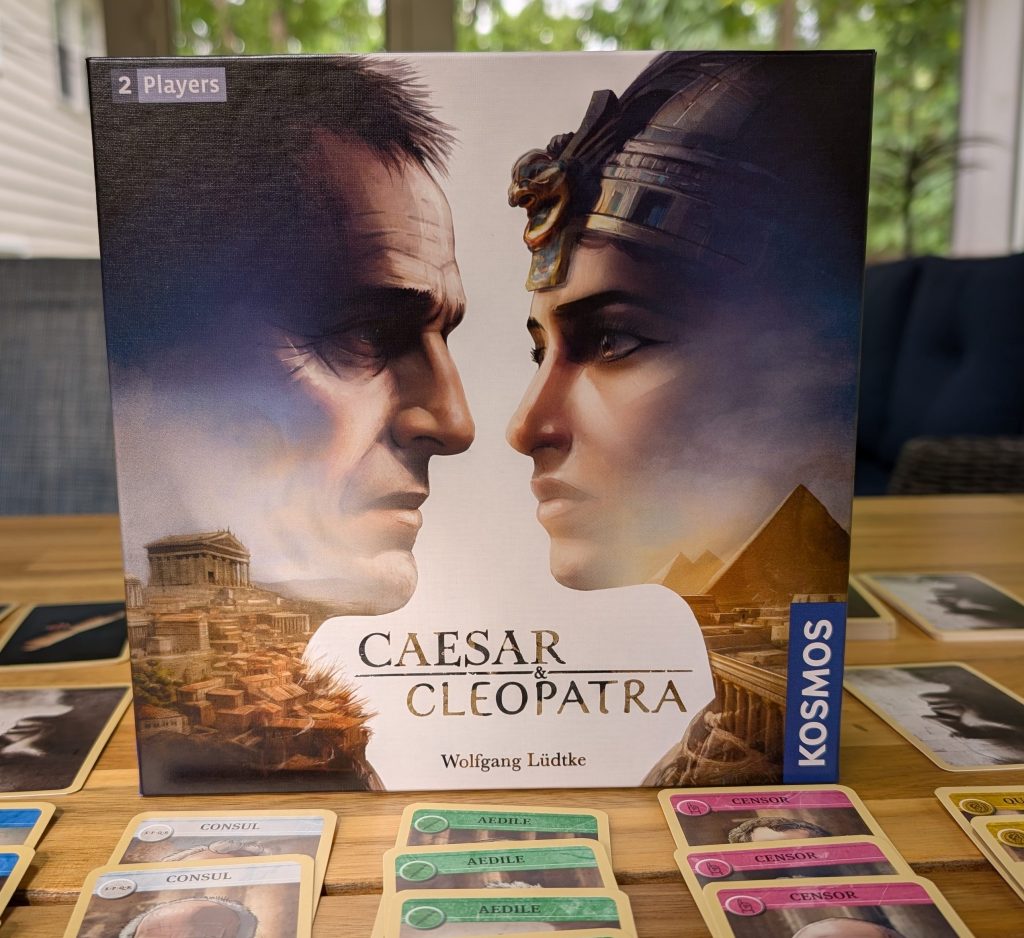
The legendary leaders of Rome and Egypt battle it out to win over the loyalty of Rome’s powerful Patricians. Will Cleopatra successfully secure her country’s independence, or will Caesar manage to grow Rome’s influence?
Game Name: Caesar & Cleopatra (2024 Reprint of original 1997 game)
Designer: Wolfgang Lüdtke
Artist: Fiore GmbH
Publisher: KOSMOS
Player Count: 2 Players
Playing Time: 40 minutes
Review Date: 5/28/2025
Reviewed By: Dan
Upfront Disclaimer: KOSMOS generously provided me with a copy of “Caesar & Cleopatra” for purposes of testing it out and writing a review. No compensation was provided and I am free to write whatever I want about the game. All opinions contained within are my own unbiased thoughts.
Game Overview
The card game “Caesar & Cleopatra” was originally released in 1997, and went on to sell hundreds of thousands of copies. No doubt with sales in those numbers, this was considered to be a classic card game by many, but it wasn’t one that I ever found an opportunity to play in the decades since. Fast forward to late 2024, and KOSMOS decided to do a relaunch of the game, with updated artwork and components to give it a more modern feel. I don’t have the original version on hand to see the cards and artwork in person but…let’s just say based on pictures, this one was probably a solid candidate to receive a redesign.
I assume with darn near half a million lifetime units sold, many people already know what this game is all about, but for those like me who are first-timers, I’ll explain. Caesar & Cleopatra (henceforth C&C for the rest of this review because I’m already tired of typing the name out) is a two-player strategy card game that is essentially one part area influence, one part set collection, with a handful of bluffing sprinkled on for good measure. It reminds me a little bit of Lost Cities (another KOSMOS two-player gem of a game), but also feels like it has some elements of Battle Line in it. And similarly to both of those other games, C&C has a theme, sure, but in the end it’s a card game and you probably won’t find yourself very much invested in any story or find the artwork very meaningful.
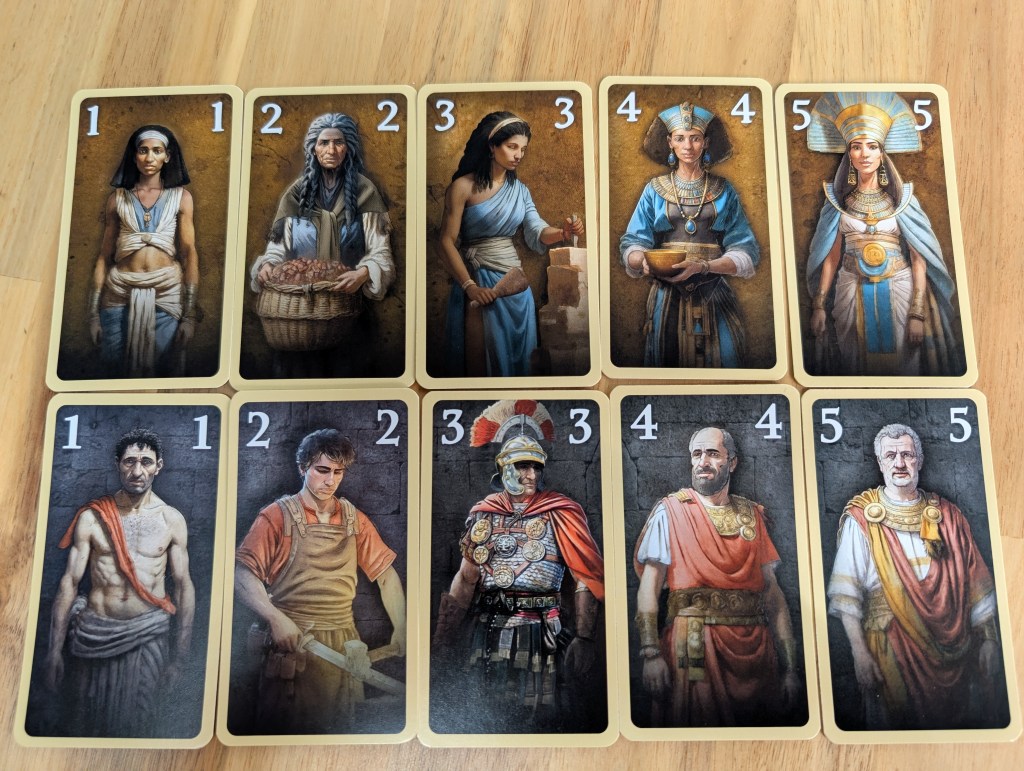
The instruction book is fairly short, and for me it falls squarely in that category of games that sound a little complicated in written words but end up being very simple to understand once you just get started and play the first turn. One player plays as Cleopatra and goes first, the other player plays as Caesar and goes second, but both sides play identically and have the exact same sets of actions and cards available to them. In the center of the table, 21 different “Patrician” cards are set out (face up) in 5 different columns organized by color, and winning these cards is the main objective of the game. Players win patrician cards by taking turns placing down “Influence” cards on their turn, which consist of cards numbered 1 thru 5, where higher numbers equate to more influence. At the end of the turn, what the game refers to as a “vote of confidence” takes place – a colored bust is randomly drawn out of a bag, and whichever color comes out relates to the color of patrician cards that are being voted on – the player with the highest amount of influence against that color wins one patrician card, and then cards are redrawn and play continues to the other player.
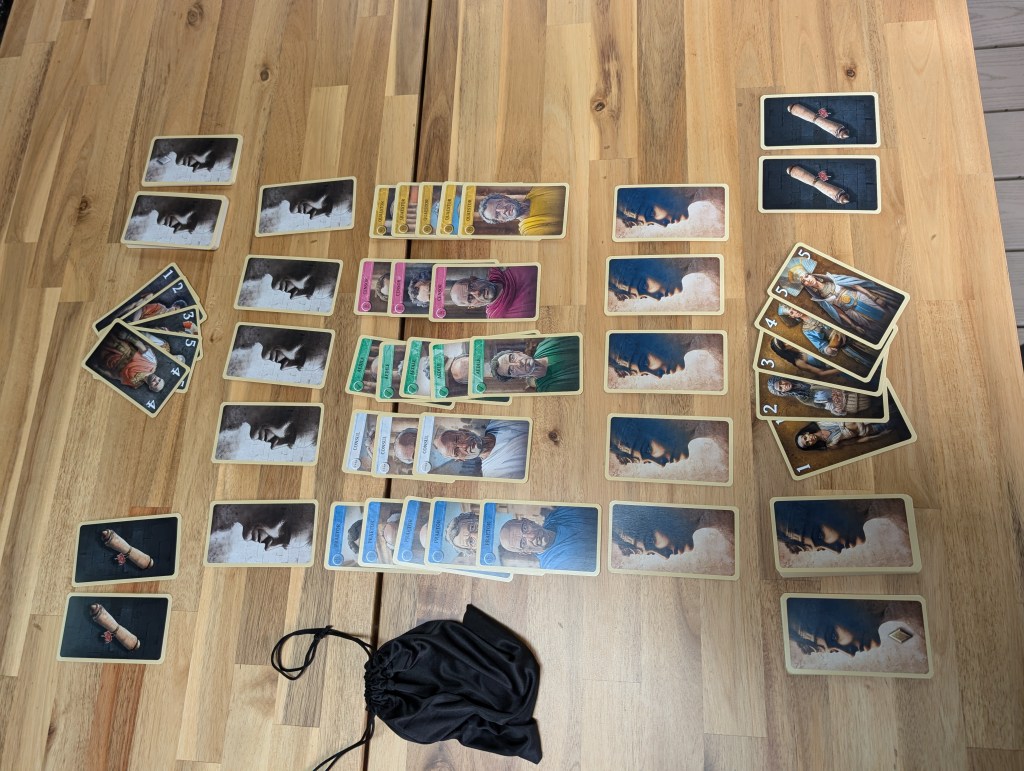
There are some twists to the mechanics that make this whole process incredibly strategic and interesting, though. Each player places two influence cards down per turn – but one of them has to be face up, and one of them gets to be face down, so for the most part players are never really sure how much influence the other player really has until a vote occurs. Furthermore, there are some special patrician cards known as “philosophers” that each player could randomly draw. If a philosopher is played (even face down) against a column of patricians, that actually converts the scoring from whoever has the most influence, over to whoever has the least influence, next time a vote of confidence occurs against that color. And after each vote of confidence, the player with the highest influence has to discard their one single highest influence card, and the player with the lowest discards their one lowest card; so this ends up becoming a very fluid process where the leader in each color is constantly changing.
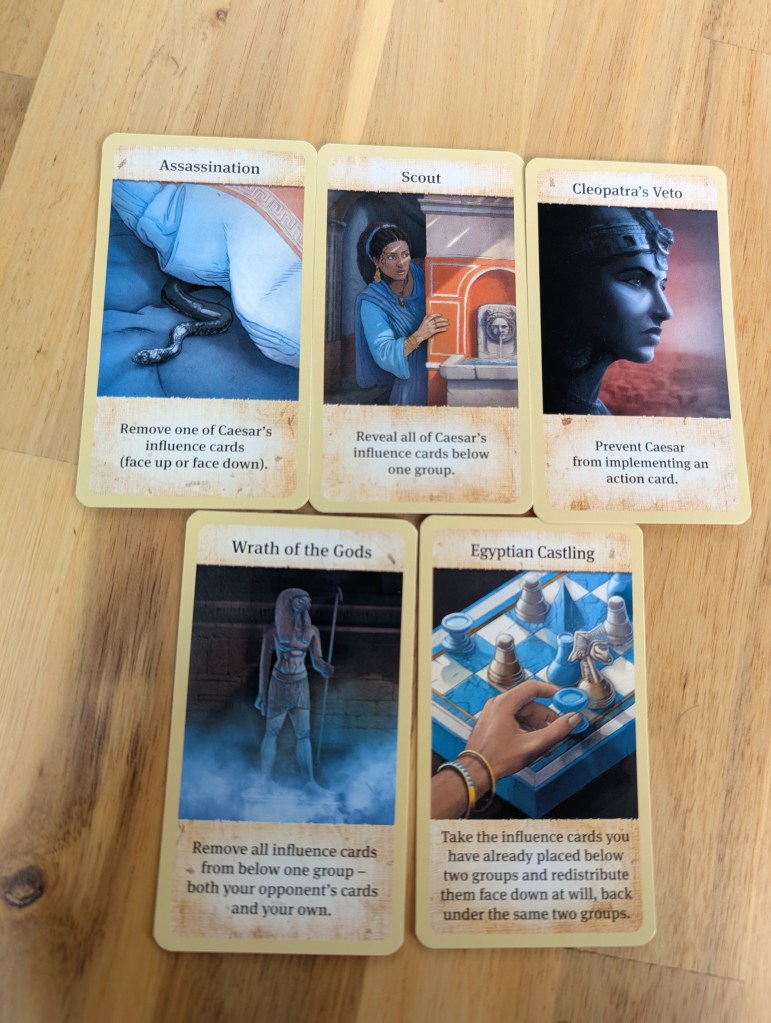
And lastly, there are also Action cards in the game, and each player is allowed to play up to a maximum of one action card per turn. The action cards can be anything from vetoes that allow a player to block the action card of their opponent, to cards that let players assassinate the influence cards of opponents and remove them from the game, to a few other actions that can really alter the outcome of the game.
Each player is also assigned two “mission” cards, in secret, before the game begins, and they eventually have to discard one and choose to attempt to complete the other. These missions are kept completely hidden from the opponent until the game ends. A mission might say something like, win the majority of a certain specific color of patrician cards, or win all of the patrician cards of any color of your choice, etc.
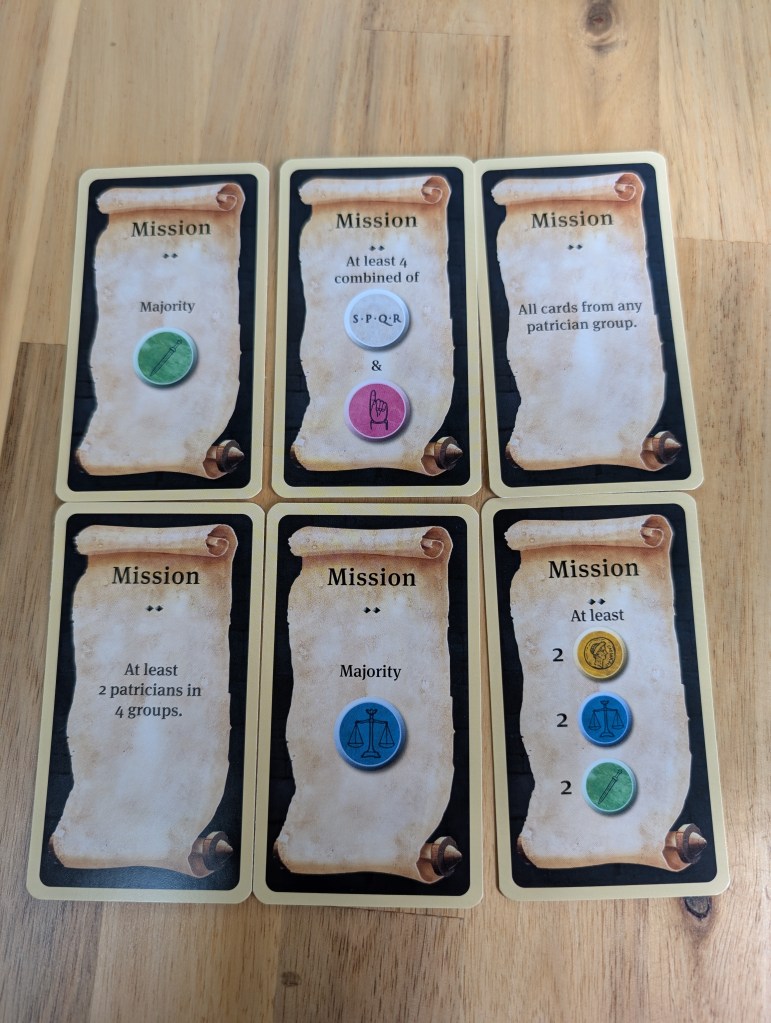
End game scoring is fairly straight forward. Each patrician card is worth 1 point, plus there is 1 bonus point awarded to the player who has the majority of each of the five colors (and another additional bonus point if a player manages a monopoly of the entirety of a certain color of patricians). A completed mission is worth two points if successful, although there is no penalty if it is unsuccessful. Sum all those points up, and the player with the highest total is the winner. That is Caesar & Cleopatra in a nutshell – again, it looks like a lot of text, but the game is very smooth and straight forward once you put it into practice.
My Thoughts
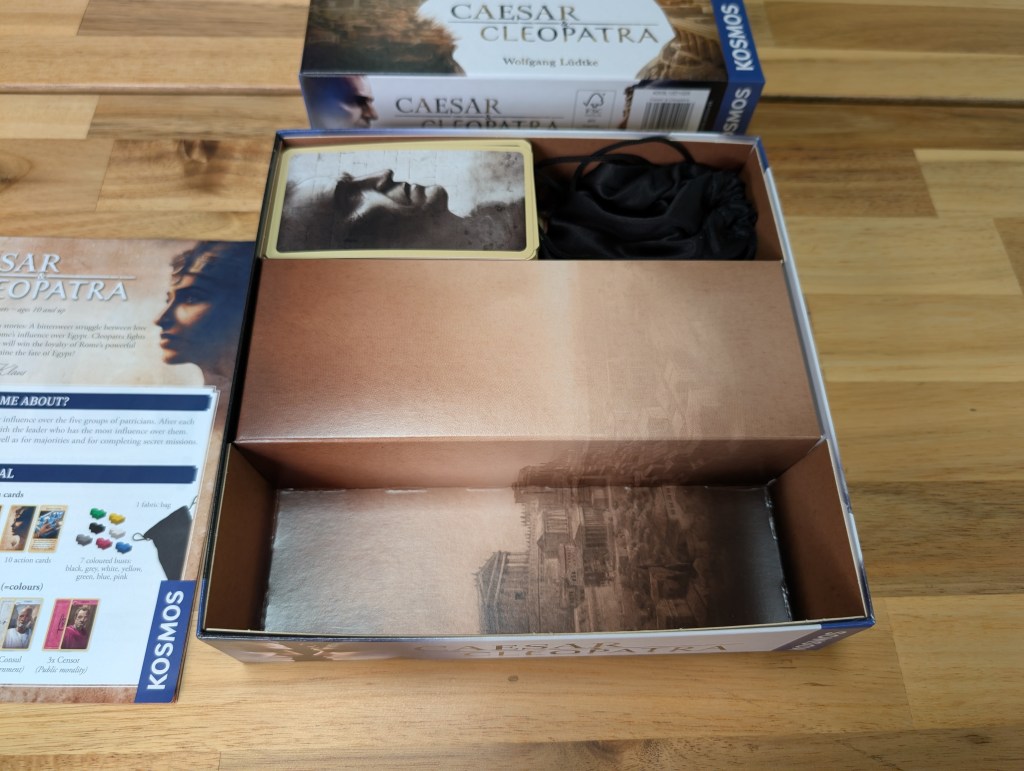
Every person hears the phrase “don’t judge a book by it’s cover” probably starting from kindergarten onwards, and those are certainly great words to live by when it comes to Caesar & Cleopatra. I received my copy of this game from KOSMOS to review, having never played the original printing, and I was not immediately impressed by the cover artwork – it’s a nearly grayscale looking silhouette of Caesar on one side and Cleopatra on the other, overlayed by some nearly grayscale artwork showing some ancient Roman and Egyptian architecture. Open up the box itself, and you will find lots of cards that thankfully are slightly more colorful than the box, but still lacking much ability to catch the eye. And while we’re on the topic of the box itself – the very first thing you’ll notice inside the box, is that over an entire third of it is just a walled-off cardboard divider that is completely unnecessary; this box could shrink by 50% in size and still contain the entirety of the game’s components, maybe even with room to spare. This may not matter much to people with endless amounts of shelf space, but I really wish packaging designers wouldn’t inflict this on gamers who are tighter on storage space (or, people like me who have so many games that their spouse audibly groans each time yet another one gets added to the massive collection – sorry honey, I swear, I just need this ONE last game and then it’ll be complete…).
But get the initial blah impressions on the box/art/theme out of the way, and what remains is just an absolutely wonderful, well-designed game that is really a blast to play. This game has the smoothness to the gameplay that reminds me of Reiner Knizia titles, so much so in fact that I had to keep double-checking to see if he was listed as a co-designer on this game somewhere (he is not, as far as I can tell). The designer here is Wolfgang Lüdtke, and he has truly nailed this one. It looked a little confusing on paper, but in practice it plays wonderfully – it feels light, and yet crunchy at the same time. Bluffing mechanics can be hit or miss, but the “play one up, then play one down” style for laying out influence cards adds so much into the game. You can’t even operate under a “worst-case scenario, the hidden card is a max of 5” concept, because there is always a chance it actually ends up being a philosopher card, and suddenly you’ve wasted all of your high cards to try and battle an opponent for a certain color of patrician card, when it was really just a cleverly designed trap. And on top of that, even if you think you plan well, you’re not always guaranteed to even get a vote on the color you were hoping for, since it comes down to a blind draw from a bag each turn. If the color you were hoping for doesn’t come out, you’ve maybe missed your window, and your opponent will have a chance to respond by placing more cards before the next vote.
I’ve found that most games of C&C end up being very competitive score-wise, so even those 2 additional points for each players’ hidden mission card adds up big time at the end of the game. It’s not easy to predict which mission your opponent has, but sometimes they tip their hand on a certain color of patrician being just a little too important, and you can plan out a strategy to block them out.
There is surely some luck involved in this game, but it’s the right balance – and the game design gives you ways to mitigate the risk of drawing a bunch of lower cards in a row by potentially allowing you to convert certain votes to be based on the lowest sum, rather than the highest. And there is a little luck when it comes to which action cards you end up drawing as well, but over the course of a full game that ends up balancing out. I personally love the assassin action cards, which can be used even to assassinate face down cards if you’d like. There is no feeling sweeter than using one on a face down card, and watching your opponent flip over the philosopher card that just got removed from the game, exposing their attempted trickery.
Verdict:
Don’t be fooled by the plain box artwork or ho-hum card design; Caesar & Cleopatra is an epic, wonderful two-player card game that shows a mastery of game design. The game plays so smoothly, and is such a blast – this would make a great addition to any collection and should continue to be played for years to come. Highly recommended.
Likes:
- Gameplay is extremely smooth, and all mechanics feel flawlessly designed
- LOVE the “one face up, one face down” aspect of placing cards each turn; the potential to bluff with face down cards adds a ton of tension to every vote
- Hidden mission assigned to each player adds yet another layer of depth
- Has a crunchy feel to the strategic decision making, but still presents itself as a lightweight game to setup and teach
Dislikes:
- Even with the updated design, the artwork and theme still feel a little dated
- Unnecessarily large box for the small number of components within





 Rolling In The Meep
Leave a comment