
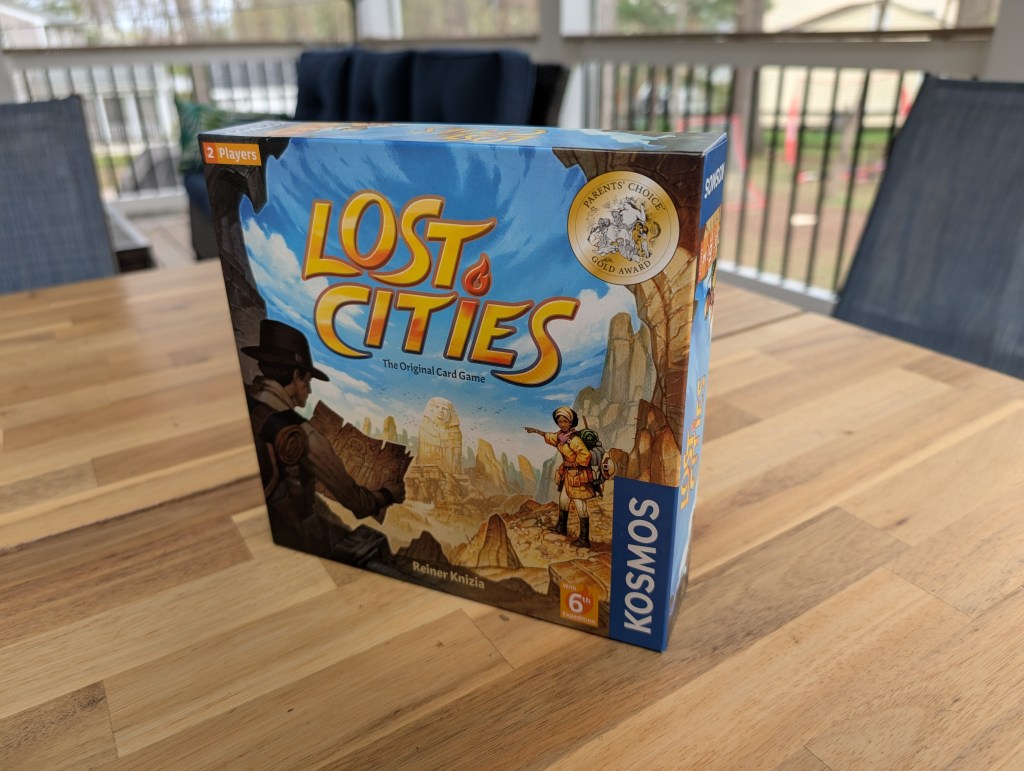
Grand adventures and amazing expeditions await. Take a journey to the Himalayan mountains, the rainforests of Central America, the deserts of Egypt, the bottom of the ocean, or even to a mysterious volcano. Will these travels be a success, or will they backfire? Let’s take a trip and find out!
Game Name: Lost Cities
Designer: Reiner Knizia
Artist: Vincent Dutrait
Publisher: KOSMOS
Player Count: 2 Players
Playing Time: 30 minutes
Upfront Disclaimer: I purchased my own retail copy of “Lost Cities”. No free copy was provided for review, and I’ve had no contact with the publisher regarding this game. All opinions contained within are my own unbiased thoughts.
Game Overview
While this Reiner Knizia card game is probably considered somewhat of a classic at this point (originally released in 1999, although my copy says it was reprinted in 2020), I somehow only played it for the first time about a year ago, and have logged about 25-30 plays on it since.
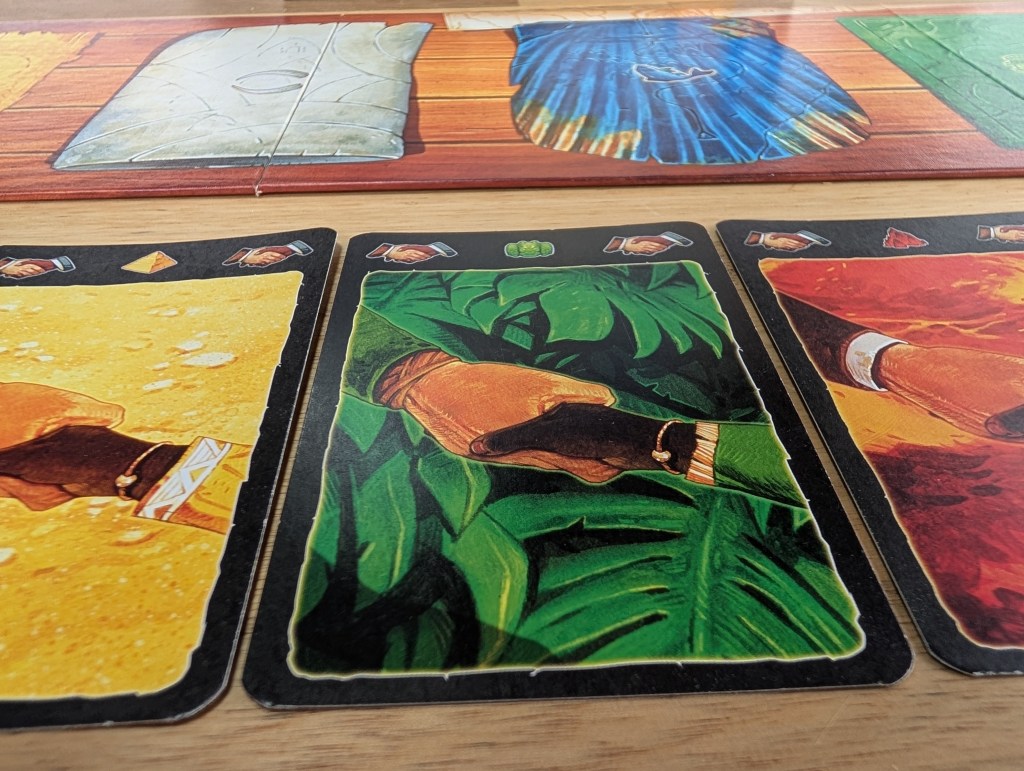
Lost Cities is a 2-player-only card game with very few components to it. Don’t be fooled by the roughly 8”x8” box it comes packed in – it takes up that amount of space solely because it fits a tri-folded game board that is meant to sit in the middle of the table to aid in showing players where to play each card type. Other than that, the only other contents are 72 slightly larger than average playing cards, and a very simplified 4-page rulebook. There are 54 “expedition” cards in the game, which consist of cards with values between 2 and 10 in 6 different colors, and then each of those 6 colors also has three “wager” cards, which feature a picture of a handshake on the front. In a standard game, only 5 of the 6 colors of cards are used – the 6th color is only added if you want to play a “long game” variant.
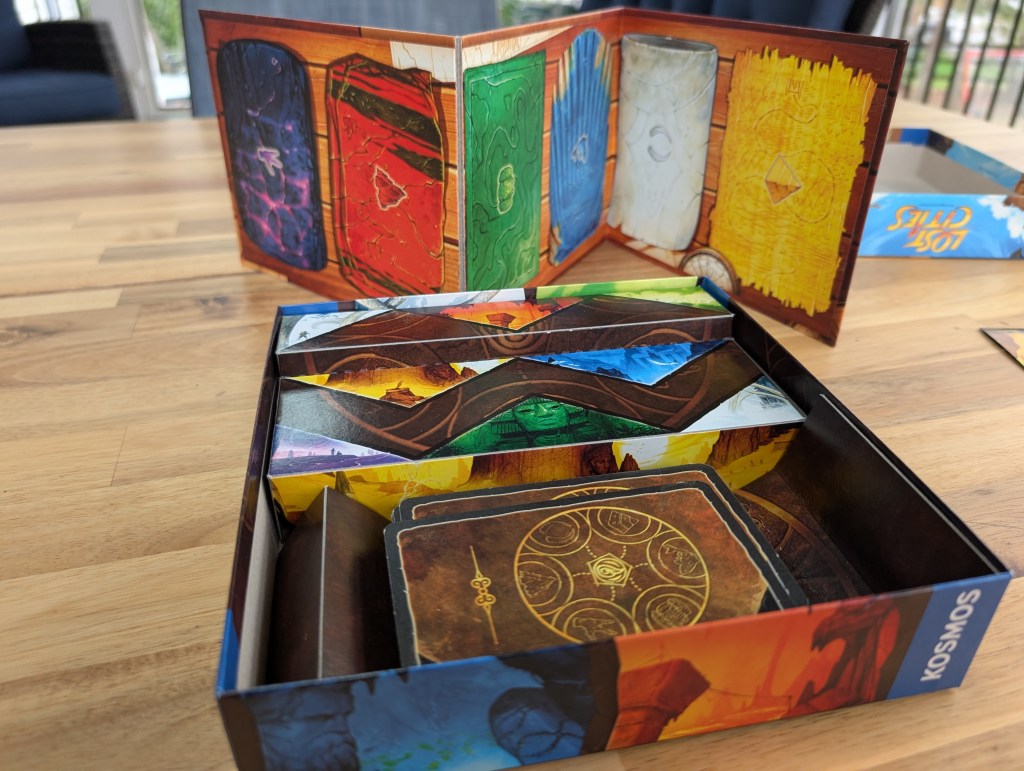
This game combines set collection with some good old fashioned “push your luck” mechanics. Mechanically, the game play is extremely simple:
- The game board is placed in the center of the table, which simply shows a picture of each of the five colors used in a base game (yellow, white, blue, green, and red).
- The 60 base cards are all shuffled together and placed next to the board. Each player is then dealt 8 cards from the shuffled pile to form their hand.
- Players then alternate turns. A turn consists of two actions: first, you must play a card by either playing it face up on your side of the game board in the appropriate column based on color, or else discarding it by placing it face up on top of the game board itself in the discard pile for the proper color. You can only play cards in each expedition column in ascending order; so for example, if you have already played a 4 in the green column, you can no longer play the green 2 or 3. And the wager cards (more on those later) can only be played BEFORE any numbered cards have been played at all within that column. Then, after playing (or discarding) your card, you must draw one single card, either from the facedown pile next to the game board, or else from the top of any one discard pile on top of the gameboard itself.
- This back-and-forth continues until the final card is drawn from the draw pile, at which point the game immediately ends and moves to scoring (each player will still have 8 unplaced cards in their hand at the end of the game). This constitutes a single round, and the game consists of three of this rounds (each ending with a scoring phase).
Any of the 5 expeditions (colors) you decide to play cards at during the game, is considered you choosing to undertake that expedition. You are scored within each one by summing up all of the cards you played against it – so for example, if in the green column you played a 2, 3, 5, 7, and 9, you would be scored 2+3+5+7+9=26 points in the green column. But there is a COST to each expedition of 20 points, which you subtract from your score for that column. This is where the push your luck aspect takes place – once you start playing in any given column, you need to reach a score of 20 or higher, or else you will end up with negative points when that column is scored. And remember those “Wager” cards from step 3 above, that must be placed before any numbered cards? Those multiply your score based on how many you put down. Putting one down multiplies your score for that column by 2x; putting down 2 of them would give you 3x, and if you played all three wager cards, you’d get 4x your score for that column. This cuts both ways though – if you end up with negative points in the column after subtracting the expedition cost, you’ll actually be multiplying the negative score for an even bigger loss of points. So you need to be very careful with which expeditions you decide to play, and which ones you decide to wager on to multiply even further.
My Thoughts
Going into playing the game the first time, the amount of excitement I had heard from others regarding this game made me feel like I was perhaps walking into a trap where the game wouldn’t really be able to live up to the hype. On paper, it doesn’t sound like there is much going on with the mechanics – you play a card either into one of five stacks based on color and ascending order, or you discard that card onto the gameboard in one of five discard piles…and then you draw a card either blindly or from a discard pile.
But boy – it only took me about 5 minutes into my very first play to realize…the strategy in this game is FAR deeper than it seemed on the surface. There is a lot going on here to consider. For starters – you can only ever have 8 cards in your hand at once, and unless you’re extraordinarily lucky and dealt a whole bunch of high cards all in the same color, you’re always going to be dealing with a ton of uncertainty. You can start playing towards a new expedition, but it’s super risky because once you play ANY card there, you’re basically committing yourself to score 20 or higher in that column, lest you end up losing points. But at the same time, you need to carefully watch what your opponent is doing. You may have a Blue 6 and Blue 8 card in your hand right at the start, but then suddenly your opponent starts playing towards the blue expedition themselves, making you wonder if maybe they already have the Blue 9 and Blue 10 hidden in their hand, making your chances of success REALLY low. Or maybe they’re acting on very little information? It’s a huge calculated risk to start playing in any column. Once players have a round or two under their belts and know what to expect, it gets even more interesting. The start of the game will see a lot of action on the discard piles, with players wanting to keep discarding things they don’t need (and hope that the other player doesn’t need), in favor of drawing better cards. But you even use this system to bluff a little bit – there is nothing saying you can’t discard a card, and then pick it up yourself a few turns down the road if you get your opponent to start discarding cards of the same color, thinking neither of you want them. And then all of this is amped up even further with the wager cards, where you have to place them before any numbered cards come out, meaning you’re really staking your future on getting a high score in those expeditions.
The end result of this creates games that are surprisingly more tense than you would expect from a simple card game. It’s kind of a slow burn at first, with neither player really wanting to tip their hand as to what expeditions they are intending to play against. Then you both start to see what each other is going for, and it becomes a combination of racing to build high scoring expeditions, while also playing some defense on not allowing your opponent to get what they need. And towards the end of the game, you have the tension of the draw pile dwindling down, and realizing you only have a finite number of turns left to play what you want, and not end up getting stuck with high value cards in your hand that you don’t have the chance to get out.
I really, really enjoy this game, and can say that it really lived up to the hype for me. I’ve even taught this game to my kids (ages 8 and 12 at the time of writing this), and they were both able to easily pick it up and enjoy it as well. It’s just a masterful use of game design to make something so simple become so interesting to play over and over again.
Verdict:
For people looking for a great 2-player-only game, I’d call this a “must own” with my highest recommendation. It’s a game that I often find myself thinking about after we’re done playing, thinking about how to refine my strategy for future games, and always looking forward to the next play.
Likes:
- Deceivingly deep game from such a simple sounding concept
- “Wager” system really amps up the risk/reward of pressing your luck
- Easily teachable
- More strategy-based than luck-based, but you still revel in the occasional perfect draw
- Sub-$20 price makes this one an easy add to any collection
Dislikes:
- Box is slightly larger than it needs to be, they could definitely condense this one
- Component quality (particularly the cards) is just so-so
- Very minimal theme




 Rolling In The Meep
Leave a comment