
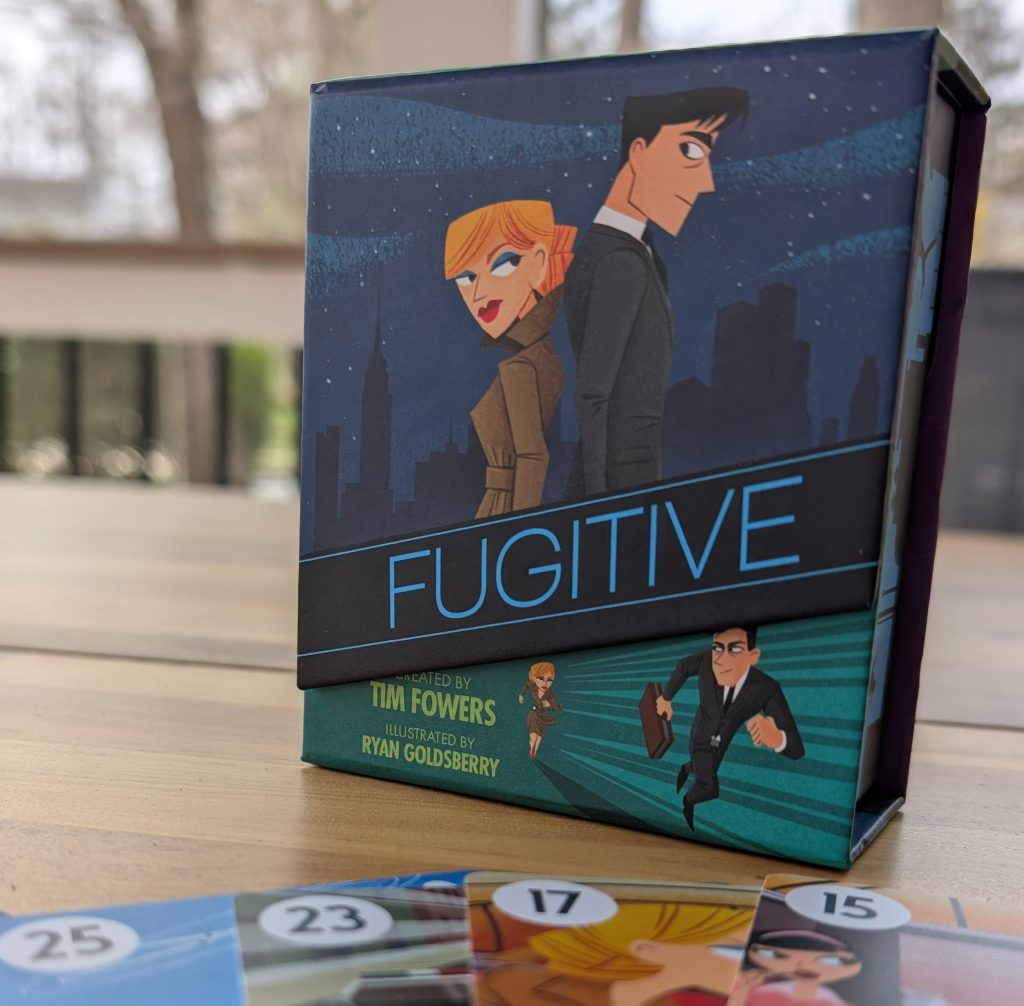
You can put on that Marshal’s badge and see if you can outsmart a criminal mastermind…or maybe you want to play the fugitive, and craftily sneak your way to a safe escape. Whichever one you choose, Tim Fowers’ “Fugitive” has something for you. Is the chase exciting enough to be worth it, or should we lock this one up and throw away the key?
Game Name: Fugitive (Second Edition)
Designer: Tim Fowers
Artist: Ryan Goldsberry
Publisher: Fowers Games
Player Count: 2 Players
Playing Time: 5 to 20 minutes
Upfront Disclaimer: I purchased my own retail copy of “Fugitive (Second Edition)”. No free copy was provided for review, and I’ve had no contact with the publisher regarding this game. All opinions contained within are my own unbiased thoughts.
Game Overview
I’ve been on a streak recently of really enjoying some two-player-only games (Lost Cities, anyone?) and was very excited when I read a preview about this game. Designed by Tim Fowers, Fugitive is now in it’s second edition, complete with some revisions to the rules, as well as additional content that really expands how much life you can get out of this game. I can’t say that I ever played the first edition of the game (and I don’t have a copy of it on hand to compare), but the majority of the rules remain intact, apart from a slight rebalancing to make things a little fairer for the fugitive.
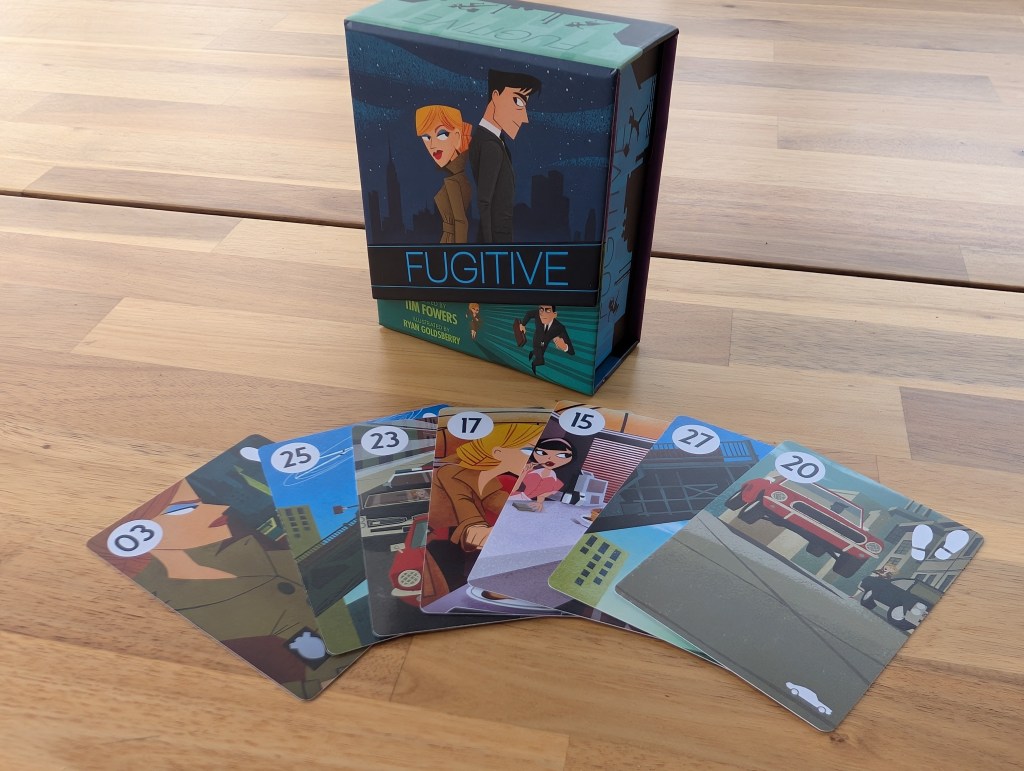
The theme of fugitive is simple: one player is a Marshal, the other a fugitive (for what crime, we’ll never know). The fugitive attempts to jump from one hideout to another, represented by a series of cards numbered 0 through 42. And the Marshal, using deduction and occasionally just some very lucky guessing, attempts to catch the fugitive before they make a full escape. There is no map to speak of – just a series of beautifully illustrated, colorful cards to represent each location in the chase.
I never want to rehash an entire rulebook, but the game play generally happens as follows:
- The card numbered 0, which is the starting point of each chase, is placed face up in the center of the table. Three more piles are formed face down in the center of the table – one pile contains cards 4-14, another with 15-28, and the last pile with 29-41, all randomly shuffled. The fugitive is given the cards numbered 1, 2, 3, and 42 into their starting hand, as well as 5 more randomly drawn cards from either the 4-14 or 15-28 piles.
- On each turn, the fugitive draws one new card, and then can place a new “hideout”, which is a facedown card that is anywhere from 1-3 numbers higher than their previous face down hideout (on the first turn of the game, the fugitive is allowed to place two hideouts at once instead of just one). So for example, if the last hideout played by the fugitive was the 7 card, the next one placed could be either number 8, 9, or 10 – never lower than the previously placed hideout, but never with too large of a jump either. HOWEVER, all numbered cards have either 1 or 2 “footprints” on them, which allow the fugitive to sprint a further distance by placing these cards face down underneath of a nearly placed hideout. The Marshal is allowed to know how many cards were placed down to sprint, but not how many footprints are on each card, so it’s possible for the fugitive to make very large jumps between hideouts (or BLUFF at doing so).
- Then the Marshal takes a turn, where the Marshal draws a card from any of the three decks (giving them knowledge of which hideouts are NOT available to the fugitive by way of deduction), and then gets the opportunity to guess one or more hideouts of the fugitive. If he’s correct (in ALL of his guesses if he chooses to do multiple), the fugitive reveals all of the guessed hideout cards.
This continues back and forth until either the fugitive reaches hideout #42 and escapes, or the Marshal has correctly guessed ALL hideouts of the fugitive at any point and no more cards remain face down. There is also a final resort chance for the Marshal to win once the fugitive plays the #42 card for the final hideout -there is a “Manhunt”, where the Marshal is given one opportunity to guess every single remaining hideout (one at a time), and if they get every single one correct, the Marshal comes back and still wins the game!
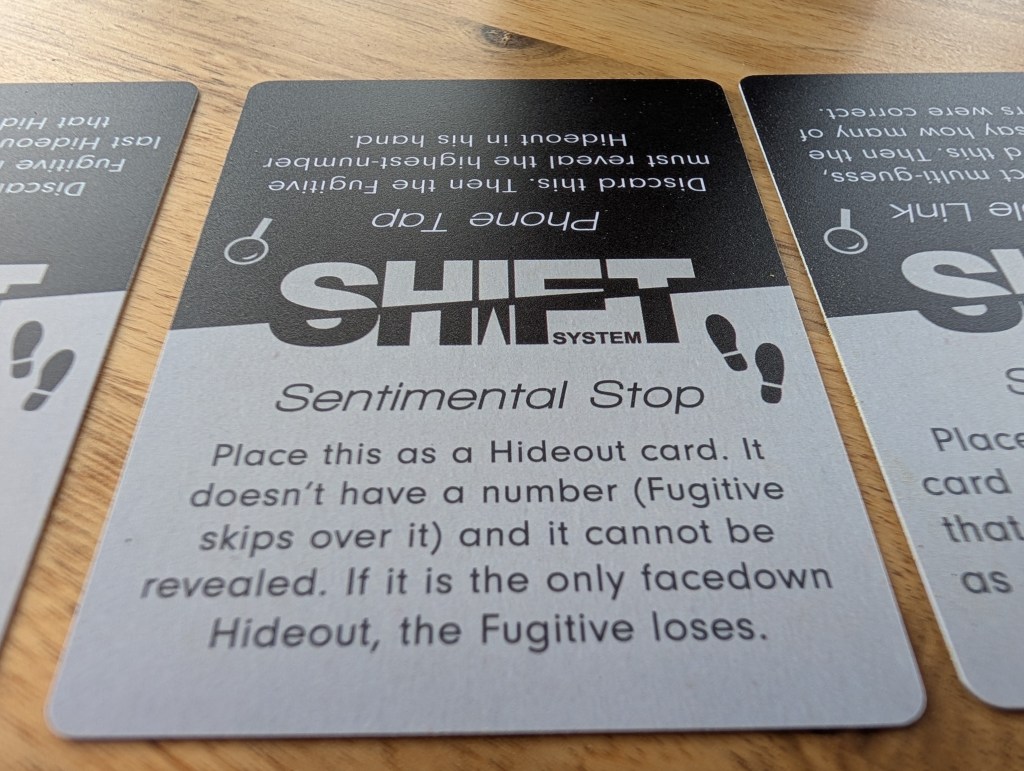
There is also (in the Second Edition version of the game) a “SHIFT” system, that allows the game to be played in a “best of five” game series, to keep a competitive balance going. These SHIFT cards are designed to give the player who lost the previous game a slight advantage in the next game to keep things close – think of them like special abilities that slightly modify the game in favor of the player using them. After each game ends, the loser draws two SHIFT cards, and decides which of the two they’d like to keep for the remainder of the best-of-five series.
My Thoughts
This is the first game I’ve tried by Tim Fowers, and hopefully it won’t be my last – I have really enjoyed this clever little game which offers more from the small packaging than I was expecting. Let’s start there – I was frankly a little surprised at the ~$25 price tag for a simple card game, but I was blown away by the quality here. The box itself is a super thick material and extremely rigid feeling – it seems like cardboard to me, but it’s so rigid and sturdy that I am honestly wondering if the inside is come kind of composite material. I won’t risk my copy by testing this out, but I almost feel like I could literally stand on this box and not crush it. It also has a magnetic latch to it when you close it, which just adds to the super premium feel. Inside the box is a very thick board for laying out the 3 decks and identifying which numbers are in each deck, and then a separate board for the Marshal to use (along with two included dry erase markers) to keep track of which numbers they have guessed/eliminated to help with each turn. But the real standout here are the hideout cards themselves – they are GORGEOUS, each with unique, brightly colored artwork that really pops. And not only that, the quality of the cards is outstanding – no cheap cardstock here, these cards are all thick PVC, which will absolutely last the life of this game and will avoid any damage from spills/etc that might otherwise allow someone to accidentally identify cards in future games based on any damage. I can see people being concerned about the $25 price tag, but they clearly went for quality over anything else with the components, which frankly I love (though I could see others wishing for maybe a cheaper less-deluxe version).
As for the gameplay itself, I was a fan, and this will make its way back onto my table many times over the coming years. It’s fairly quick to teach, and a quick play. At the core, it’s just a solid hidden movement mechanic, and I personally enjoy deduction AND bluffing mechanics, so it was right up my alley. Its also nice that you can play as the Marshal if you love deduction, and play as the fugitive if you love to bluff. In the rounds I played, we almost always found the fugitive throwing down lots of sprint cards to fake like they were making a big jump between hideout numbers. It’s usually pretty hilarious when the Marshal is guessing hideouts in the 20s and 30s. There is definitely a little luck involved in the game, though overall it’s a nice balance – I might feel that in a single game, at least from my experience, it’s maybe weighted a little bit towards the fugitive being easier to win with than the marshal.
Verdict: Overall, highly recommended as a simple-but-deep two player game that really shines from the GORGEOUS artwork that adds a touch of theme to what otherwise might just feel like a standard (but fun) card game.
Likes:
- Fun, fast gameplay pitting deduction against bluffing
- SHIFT system adds a great balance and a ton of replayability
- Absolutely GORGEOUS artwork
- Super high-quality box and components
Dislikes
- Fairly expensive for a card game (although the cost is evident in the component quality)
- Games occasionally get out of hand and are reduced to low-probability luck for the Marshal



 Rolling In The Meep
Leave a comment