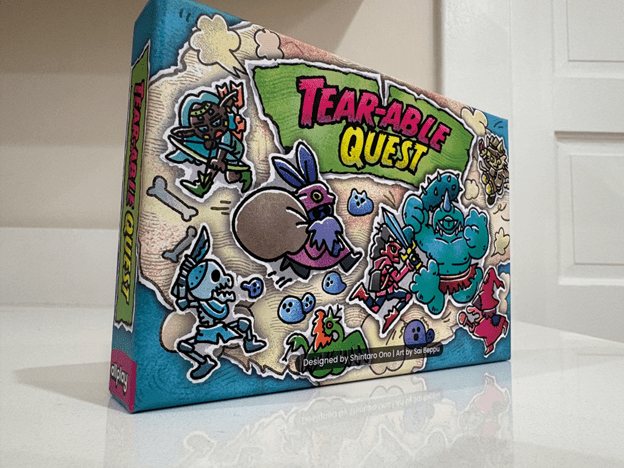
Fight skeletons and dragons with your bare hands–well, fingers, really–in “Tearable Quest”, a fast and simple game where you’re ripping paper into near-impossible shapes to complete quests and score points.
Game Name: Tearable Quest (2025)
Publisher: Allplay
Player Count: 1-50 Players
Playing Time: 10 minutes
Review Date: 3/12/2026
Reviewed By: Chuck
Upfront Disclaimer: Dan and Chuck were given a copy of “Tearable Quest” by Allplay as a review copy. All opinions contained within are my own unbiased thoughts.
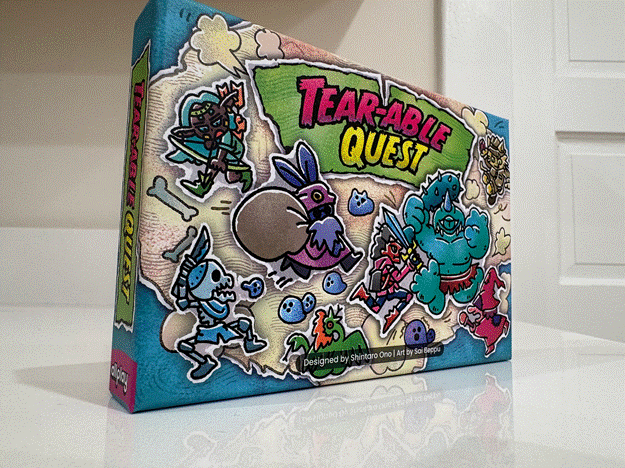
There’s a lot to like before you start playing “Tearable Quest”. For reasons that will be clear when we get into the rules, the art style needed to be distinctive and simplistic, with strong color choices and obvious silhouettes. It’s clear just looking at the box, your first glimpse at the delightful art by Sai Beppu, that the team’s scored a home run: the visual design is simultaneously compelling and practical, a philosophy that runs through all the game’s (relatively few) components as well as its rulebook.
It’ll take you barely a few minutes to get going with “Tearable Quest” – one of the few games billed as lasting 10 minutes that I can honestly say plays about that long even if no one at the table has seen it before. To play, each player needs their own play card, selecting from one of two “environments”. Everyone’s card is an identical hodgepodge of fantasy weapons (swords, axes, etc) and fantasy monsters (skeletons, slimes, etc). They’ll find combinations of those icons on the monster and boss card that confronts you each round, with higher scores given to more complex arrangements.
Across three timed two-minute rounds, players will attempt to create torn-up strips out of their cards that contain exactly the pieces they need to earn a score on one of the enemy cards. Two big swords and a giant will let you take a shot at the Cyclops boss, for example; you can shoot down one buzzard by combining a single bird and a bow, but the more birds you get the more points you can accumulate. The catch is that the paper has to be, again, exactly what you need: no stray slimes on your skeleton quest, not even part of one’s head.
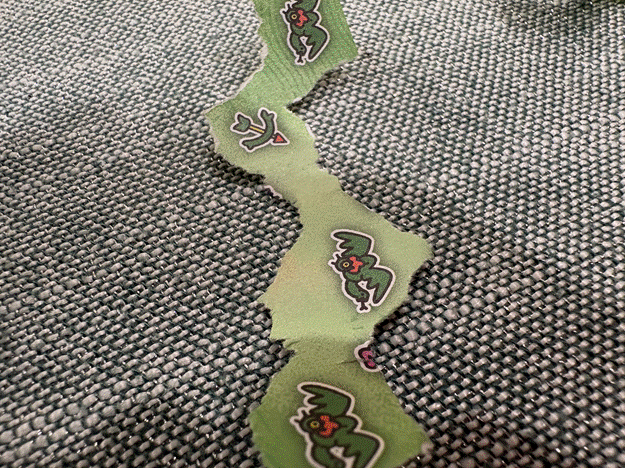
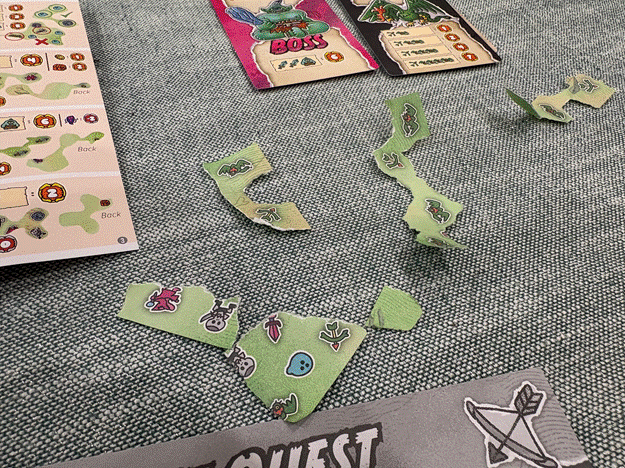
This requirement gives “Tearable Quest” a frantic, frustrating quality. This is not the most robust paper stock I’ve ever come across; I found it hard to transition from creasing or folding the paper to properly tearing, and sometimes an attempt at a clean line would take on a terrible life of its own. The arrangement of icons can make things even harder – sometimes removing all the irrelevant icons leaves you with hardly a centimeter’s worth of paper holding your precious score together.
In my play time, the main consequence of this was that many rounds, especially those where a player tried to get ambitious, ended up feeling like a waste of time: one hundred seconds of tearing, one microscopic mistake, and it’s all a pile of wasted paper. The rounds are fast enough to take some of the sting out of this, but it doesn’t stop it from making most of the runtime feel more mechanically frustrating than interestingly stressful.
There is some strategy here, to be sure. You only get the one, increasingly torn-smaller page to work with across all three rounds, but it’s impossible to score in round one without doing at least a little damage to weapons or enemies you’d ideally like to keep around for later. Though the monster card changes each round, the boss is consistent, so you can partially work on tearing those points out of the card and finish the job before the game’s over.
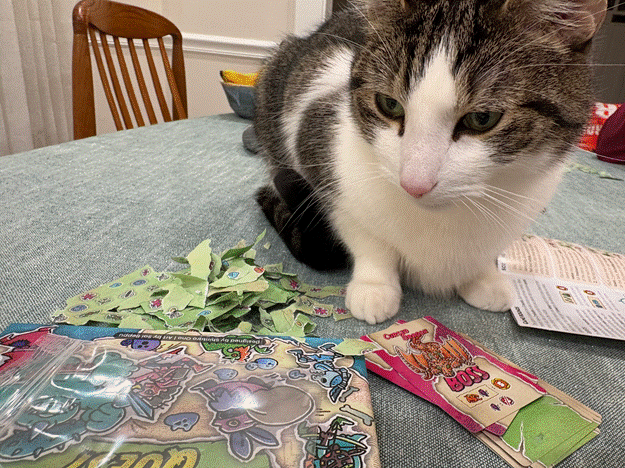
But a lot of this falls flatter than I would have hoped in actual play. To be honest, the main thing I kept thinking as I played was that “Tearable Quest” feels more like a proof-of-concept than a fully-baked game, even at the “tiny” scale Allplay prices and sells it for. The two environment types are 50-page stacks of identical pages, and the game features only four monsters (three of which appear in a given game) and a handful of bosses (only a few of which appear within a given environment). Combine that with the game’s pace and you could easily see everything it has to offer in less than 20 minutes.
On top of that there’s the obvious side effect of the gameplay, which is that you get a maximum of one hundred games of “Tearable Quest” (make that 50 if you’re playing with two, or 33 if you’re three, and so on) before you can’t play it anymore. It’s a quick consumable, and though the price justifies this to some extent, it’s worth remembering that you can buy at least a couple decks of playing cards for the price of a game like this, and when you score a Blackjack no one makes you tear the Ace in half.
The fundamental frustration, though, is that the central mechanic relies so heavily on your own manual dexterity and your patience for a high chance of wasted effort. In my playtime, we often gave players credit even if there were tiny bits of stray sword or buzzard on the scoring strip, because we felt so strongly that it was too unpleasant to try tearing millimeters of paper off of the end of something hanging together by threads. I am sure there is an audience for this game, but it seems like it’d be a surprisingly narrow one: not so old as to find the game too simplistic, not so young as to be simply incapable of tearing between the lines.
Verdict
At under ten dollars, it’s probably okay that “Tearable Quest” feels as disposable and simple as it does. It’s fun to look at and can give a table of players a couple rounds of yelling and laughing at each other’s failures to do a very silly bit of craft work. But if you’re looking for something more along the lines of an adventure, or have in mind other games with big swords and bigger dragons, this might not have quite enough going on to hold your attention for too long.
Likes
- Delightful but practical art design
- Easy to learn and fast to play
- A fun, unique concept
Dislikes
- Materials aren’t good enough to support the gameplay
- More frustrating than fun
- Too few variations
- Feels too disposable

 Rolling In The Meep
Leave a comment