
It’s a spy-meets-spy race to use your powers of deduction and crack your opponents’ code faster than they can crack yours. Will your faction reign supreme in the battle for power in a cyberpunk-themed future?
Game Name: Classified Information (Deluxe Box) (2025)
Designer: Justin Gunnell
Artist: Jerome Gunnell
Publisher: IncrediQuest Games
Player Count: 2 Players
Playing Time: 10-15 minutes
Review Date: 9/24/2025
Reviewed By: Dan
Upfront Disclaimer: IncrediQuest Games generously provided me with a copy of “Classified Information (Deluxe Box)” for purposes of testing it out and writing a review. No compensation was provided and I am free to write whatever I want about the game. All opinions contained within are my own unbiased thoughts.
Game Overview:
How deep of an iterative deduction two-player card game can you really create from a game deck of only 18 total cards at a time? It doesn’t sound like this would leave much room to work with, but as it turns out in the case of the recently released Classified Information…you can actually build a surprisingly intricate experience.
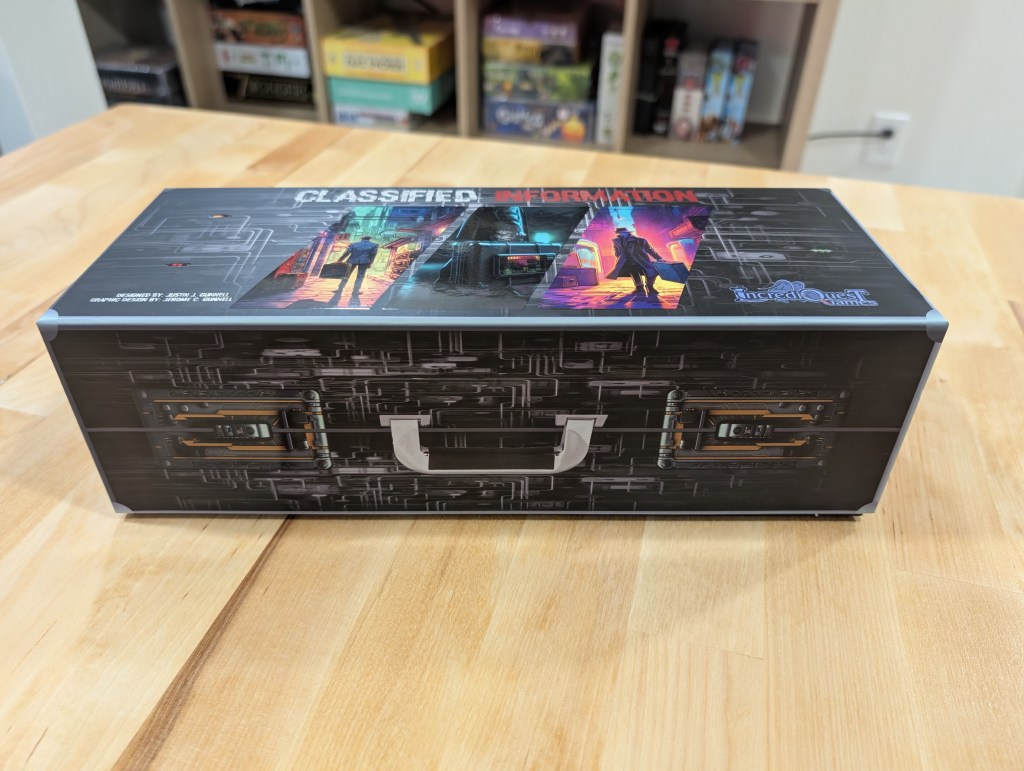
I really didn’t know what to expect going into this one, especially something coming from a first-time designer (Justin Gunnell). And yet right from the moment I pulled the game out of the shipping carton, he managed to grab my attention before I had even learned what the game was about. I should probably clarify upfront – the version I have to review is the “Deluxe Box”, which comes with 3 different mix-and-matchable game decks to use, as well as some really upgraded premium components like resin suitcase tokens, acrylic card stands, and a nice fabric pouch. But forget about all of that for now, because before I was even able to dig into that, it was the exterior box design that really caught my eye. It’s an unusual shape for a game box; it looks more like the shape of something you’d expect to see to hold a large collection of trading cards with a long-but-narrow design. But the real mood-setter here is the fact that it visually looks like it is a metal-edged briefcase with fake printed latches and a handle in which you could easily imagine a spy carrying classified information. I love this – it catches the eye on a board game shelf, and on the table when you take the game out to play a round.
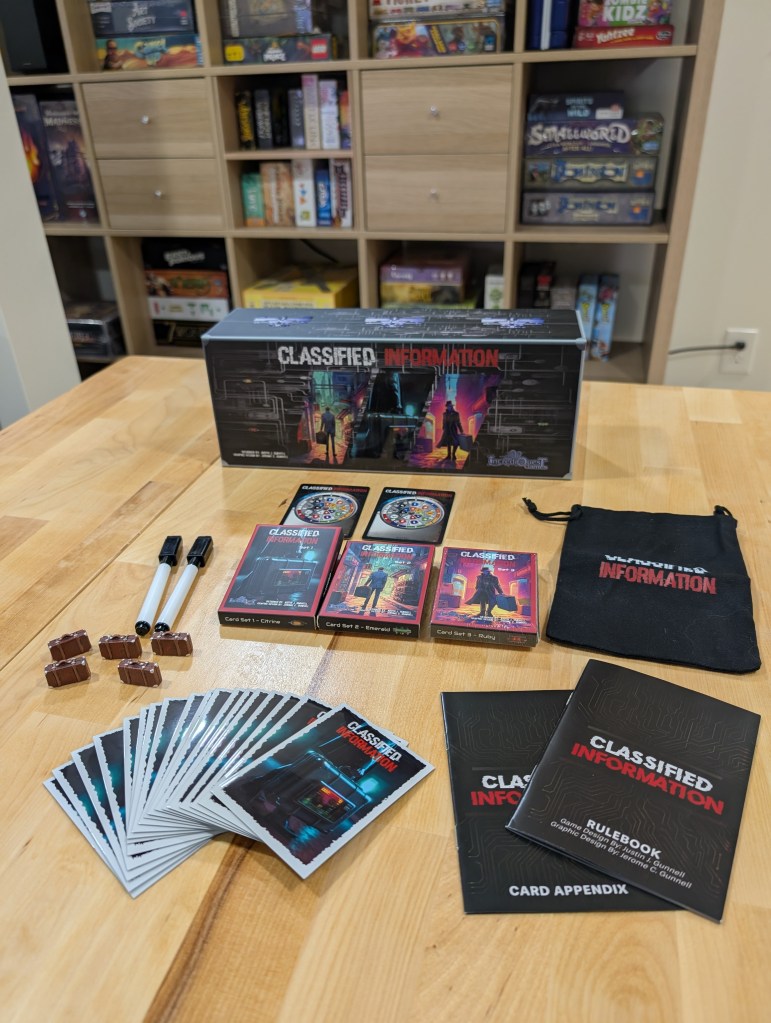
I wouldn’t necessarily expect a quick playing card game like this to even attempt to set much of a theme, but between the neat box itself, and the creative artwork on the cards, Classified Information really has managed to at least somewhat get me to buy in to this spying-meets-futuristic-cyberpunk code cracking world it intended to create. Without boring you with a full retelling of the rulebook, the gist of the game is that each player has one secret facedown card that the game refers to as their “Suitcase”, and the goal is to use your powers of deduction to guess what card number is on your opponents’ suitcase (within +/- one of the actual number). That may sound easy when you’re talking about a game that only has 18 total cards, which range from the number 1 through 9 with doubles of each card; but you don’t just need to know the number of their briefcase, you need to also finish the game with your own last remaining card being the number you want to guess.
And this is where the cleverness of Classified Information shines through, because while both players are busy playing offense deducing each other’s remaining cards, they also need to worry about playing defense. Players can choose to play cards face up to utilize the abilities listed on the card, or some cards known as Guards can be played face down in front of your suitcase to protect your hidden information. When the game ends, if a player has a guard blocking their suitcase, the number on that guard’s card is “protected” as a guess. So even if their opponent finishes the game with a card that would otherwise constitute a successful guess, it’s possible to still stop it from being a successful attempt.
When a player begins to build up guards (they can each have a max of 3), the other player can attempt to reveal and/or assassinate those guards through a variety of mechanics. Not only does assassinating a guard remove the card from the game, but it also potentially gives you an idea of what range of cards may be on your opponents’ suitcase…unless your sneaky opponent decides to put down an unrelated number as a guard just to throw you off!
There are a variety of card types and actions that you can utilize if you decide to play a card face up, rather than activate it as a guard or assassin. The number 8 card in the base deck, for example, is titled “Neutralize Target” and allows you a choice of actions such as flipping an opponents guard face up, rearranging the discard pile, and secretly looking at the bottom two cards of the draw deck. There is a lot of information to be gained by doing this, but at the same time, you’re exposing one of your cards and giving your opponent key information as well, allowing them to eliminate another potential card from being in your suitcase.
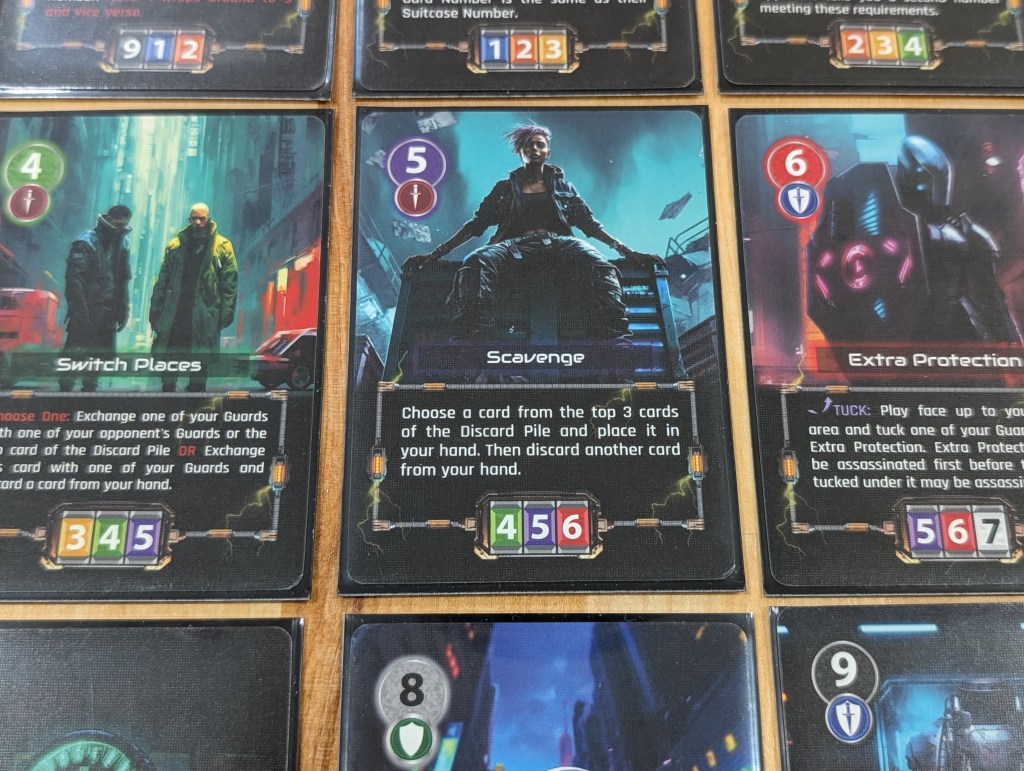
Everything I’ve written above is just scratching the surface of how a player can approach this game, and even when I read back what I’ve just written, this game may sound potentially very confusing. And it is, but only at first, and only because the rulebook itself is not really a prime example of great design. A friend and I read the rulebook cover to cover after unboxing it for the first time, got to the end of the last page, and both immediately realized we still had absolutely no idea how this game was played. Luckily it has a great section to explain the actual setup of a new round (which only takes about 30 seconds), and we just decided to wing it and see if it made more sense as we played a round. And somewhere near the middle to end of that first round, which fortunately is only about a 10-minute total experience, we both had that “OHHHHHHH” moment where finally everything clicked. It really is a well-designed game, and it plays very smoothly and quickly, and once you get that first round out of the way, you’ll probably want to immediately dive into a second round. I won’t try and paint myself as an expert at writing a rulebook, having never designed a game myself – but I know that the one for Classified Information could do with some improvements in clarity, because it seems to complicate an otherwise easy to understand set of game mechanics.
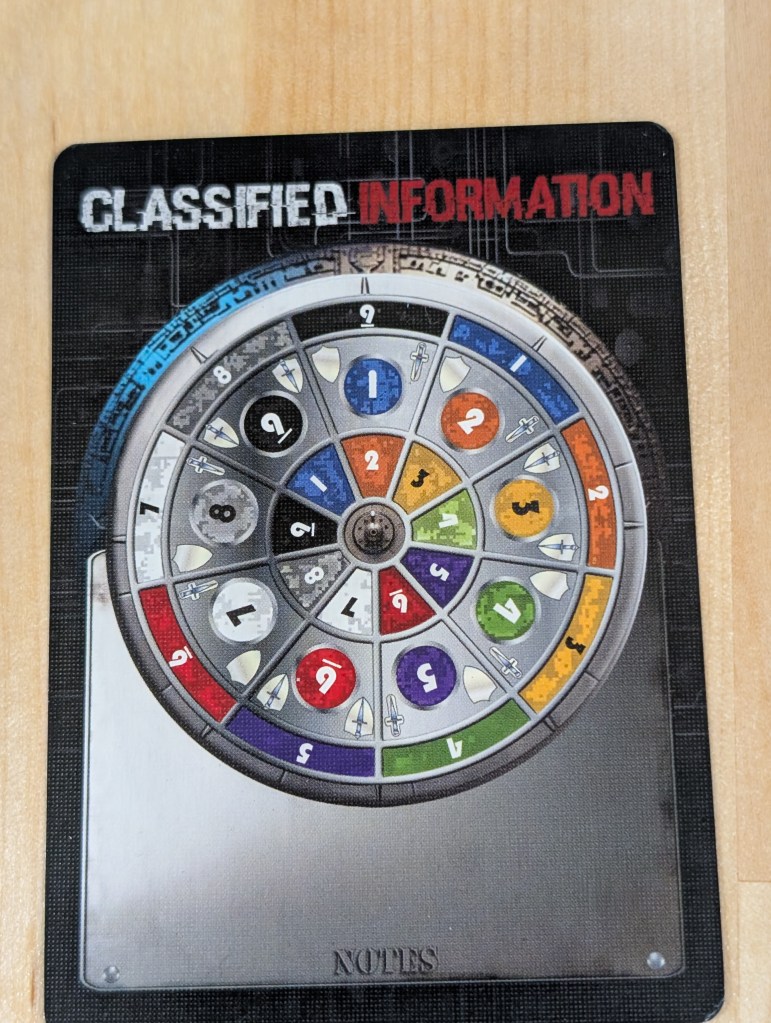
The game comes with two dry-erase markers and a card that the designers refer to as the “cypher wheel”, where players can secretly keep track of all information they are amassing to help aid in future strategy and deduction, and making that successful final guess. This cypher card also confused me quite a bit in the first round or two, where I managed to accidentally lose track of my own methodology for recording information and realized part of the way through that I wasn’t being consistent with my writing and lost all track of my progress. Much like the game itself, it’ll click after a round or two how to best use this card – but I feel like there is probably a better design that could have been used here, perhaps a more simplified layout for recoding guesses and info.
In the end though, once you get that rulebook frustration out of the way and clear those first-round jitters, Classified Information is a very solid game that I would recommend to any fan of the deduction genre. It lays out a pretty convincing theme, and the game flows smoothly. Once you learn it from actually playing it, it’s fairly easy to teach as well. And despite only a 10 to 15-minute play time, it’s actually a deeply satisfying experience that is packed full of strategic decision-making at every single turn.
Verdict:
Once you get through a potentially confusing first round, Classified Information is a great two-player deduction game that flows smoothly and hides some very clever mechanics inside. A great first offering from IncrediQuest games that I would highly recommend to any fan of the deduction gaming genre.
Likes:
- After you truly learn the game, it’s a lightning fast back and forth game that is super engaging
- Deluxe version has eye catching box design, clever artwork, and great component quality
- Includes multiple different decks with different powers that can be mixed and matched for excellent replay value
Dislikes:
- It’ll “click” and feel less complicated eventually, but I’d expect a thoroughly confusing first round for most people
- Anything other than “normal” difficulty is likely to end in a whole lot of stalemates or random guessing
- “Cypher Wheel” needs a less confusing design



 Rolling In The Meep
Leave a comment