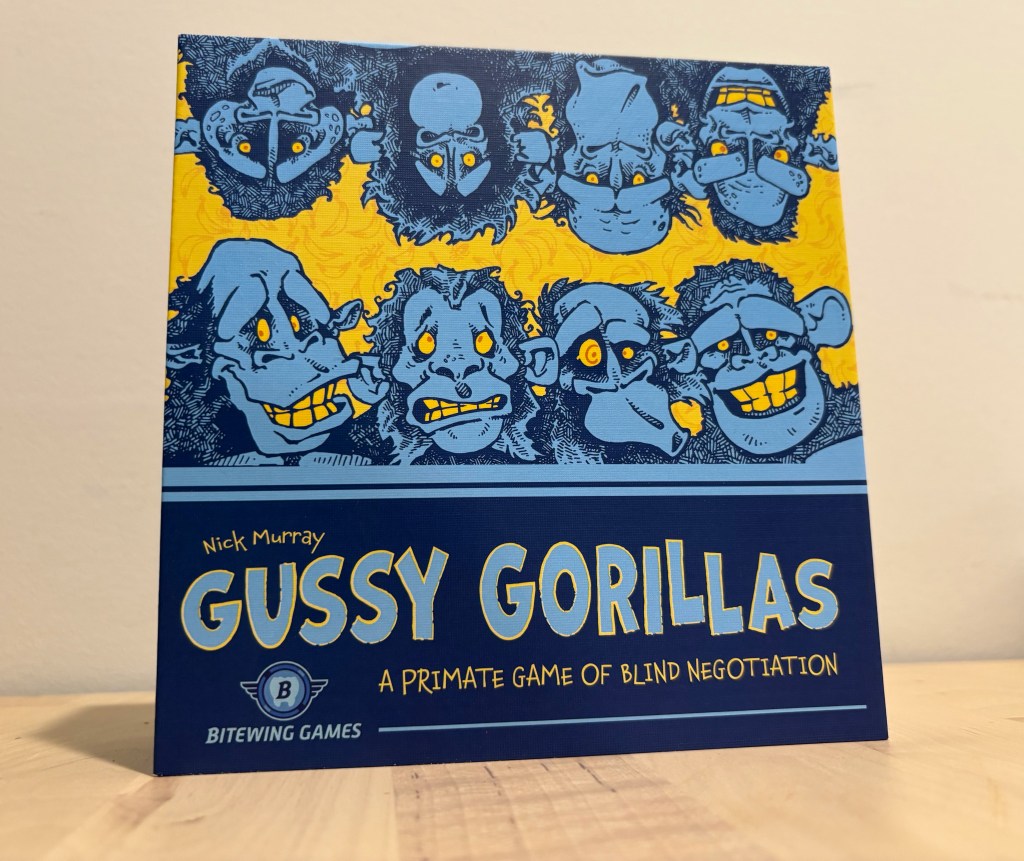
Can you out-bluff the table, or are you getting played? In “Gussy Gorillas,” other players can see the card you’re holding, but you can’t. Do you throw away the card on your forehead to get the sure thing another player’s holding up? Maybe you’re already holding the exact thing you need, or maybe it’ll ruin your day.
Game Name: Gussy Gorillas (2023)
Publisher: Bitewing Games
Player Count: 3-10 Players
Playing Time: 20 minutes
Review Date: 8/20/2025
Reviewed By: Chuck
Upfront Disclaimer: Bitewing Games generously provided us with a copy of “Gussy Gorillas” for purposes of testing it out and writing a review. No compensation was provided and we were free to write whatever we wanted about the game. All opinions contained within are my own unbiased thoughts.
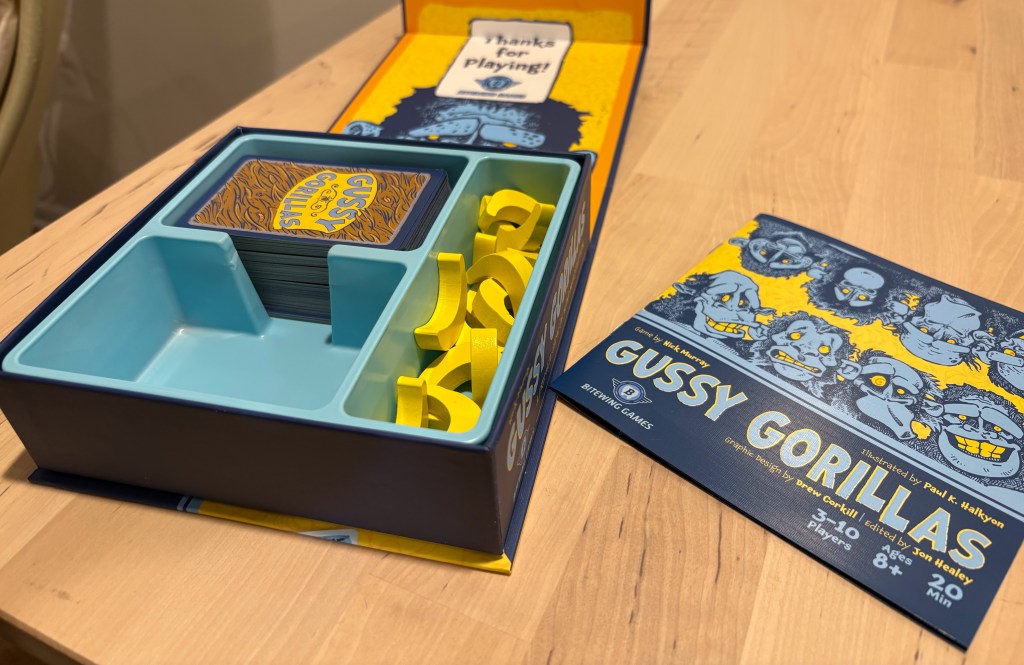
“Gussy Gorillas” arrives in a handsome magnetic-clasp box containing plenty of space for its components (surprisingly rare for this size of board game box!), which in this case comprise a single deck of cards, a handful of banana tokens, and a rulebook. The cards and box both have a nice, uniform aesthetic with a two-tone palette – blue monkeys and blue numbers, yellow eyes and backgrounds – that keeps things clean and readable for the sake of quick gameplay. I’m not in love with the art style, but it’s not too busy or distracting, either, and it has a certain impish charm that meshes well with the intended playstyle. Contained within a magnetic-clasp box is a set of _ cards and a rulebook; other than sorting out some of the cards meant only for higher play counts, the only setup required is to shuffle up and deal.
Refreshingly light on both components and rules, “Gussy Gorillas” still provides a frenetic pace of play and depth of strategy. I can give you about 90% of the rules in a couple of sentences: each player started with a set of cards dealt to them face-down, and one by one the players take those cards and place them on their forehead, so that everyone but them sees the value; play involves offering to trade your (unseen by you) card for another player’s (unseen by them) card. You can also add another (again, unseen by you) card to your forehead to sweeten the deal, or you can play your card right from your forehead to the table.
The inverse-bluffing mechanic is a ton of fun on its own, even before we add in how scoring works. There’s a sort of double-bluff potential where the entire table can pretend to be very interested (or disinterested) in someone’s card in order to throw off their perception of how valuable the card is; this sort of grouping-up happens dynamically, as players observe others’ behaviors and their accumulating score. It’s not exactly a game where you’re strategizing deeply about how to affect others as opposed to simply getting your best score in front of you, but there are constant small opportunities throughout to disrupt each other, which leads to constant interaction and fun dynamics across the table. Because everyone starts with the same amount of face-down cards and can see everyone else’s cards but their own, no one gets to sit back and quietly do their thing, and no one can really dominate the proceedings either.
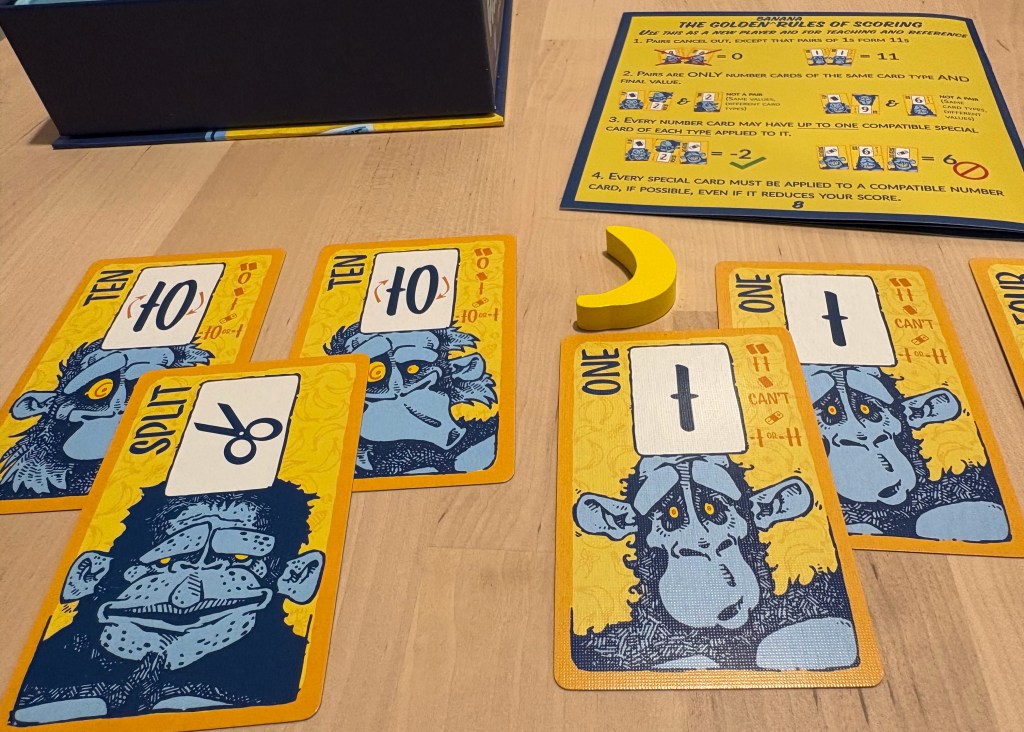
But the true complexity comes in the scoring system, and the way your scored cards interact with each other as they increase. Pairs of cards eliminate each other from scoring, unless they’re two ones, which instead combine to form an 11; some cards have negative values, while others form special actions that can split your pairs into two scoring cards or flip a negative value into a positive one (or, if you’re not careful, vice versa).
At first, you’re drawing essentially blind; any card could help or hurt. But as soon as you have one or two cards in front of you, a strategy forms in real time. Maybe you’ve grabbed the first 1 you saw, and now you’re on the hunt to get that 11; maybe you accidentally ended up with a -12 and are now hunting desperately for a reverse card to get back in the black. The special cards are especially spicy because, especially in a lower-player game, they’re not guaranteed to appear, so you may spend the whole game waiting for a trump card that never comes.
Combine this with the bluffing mechanics and you have a game of increasingly controlled chaos, frenetic shouting and card swapping dwindling as the game progresses into a higher-stakes game of more careful bidding and best-guessing. It’s still frantic, but as the available cards shrink, everyone has a sense of what they think their goals are, and makes more snap decisions about the value propositions available.
The game’s player count range – three to 10 – is a little odd, but makes sense. You could play a game like this one-on-one, but it’d be a very linear experience, and the lack of alternative options across the table would drastically reduce a player’s sense of agency. In general I’d say the more the merrier; this is a game that thrives on maximizing the volume of shouting and bidding and also creating the largest range of possible interactions. More than five or six players, though, might create too much chaos to be comprehensible, and also maybe lead to people too far across a table to clearly see each other’s cards.
Regardless of player count, I have mixed feelings about endgame. When all cards are played, everyone tallies up their score, and the highest score (or two highest, if you’re playing with the maximum of five players) gets a banana token. Then you play again; the first player with two bananas wins. This can feel a little underwhelming if, for example, you pull off a blow-out win in a given round, but the reduction of amassed points to a binary win-loss does allow for a variety of strategies to win out across rounds. The two-banana finish line can come abruptly, too. That’s probably for the best to keep games brisk, but it can leave some players with zero bananas and a lack of any sense of accomplishment when the game ends.
Verdict
Designing towards simple-and-frantic, though, is the game’s ultimate strength. Easy to teach and quick to play, “Gussy Gorillas” has the potential to take over a table of friends, especially if a few drinks are involved. It doesn’t have the lengthy power of larger-scale games, but that means it can be inviting even to friends who don’t usually enjoy board games–even if it doesn’t become their new favorite thing, it’ll be over before they know it. You always need a game or two like this in your collection, and “Gussy Gorillas” is a welcome new candidate for that position on my shelves.
Likes
- Simple rules and fast, intuitive play
- Lots of player interaction, “feel-bad” moments quickly erased by the next choice
- A small game that actually feels small (in a good way)
Dislikes
- Awkward player count requirement
- Endgame can feel abrupt and unsatisfying


 Rolling In The Meep
Leave a comment