In “Rummathon Royale,” rummy meets Uno as you race to play cards and undermine your opponents. Two to six players span twelve rounds of drawing, discarding, sabotaging and collecting to try to climb the points ladder faster than everyone else.
Game Name: Rummathon Royale (2025)
Publisher: Rummathon Royale LLC
Player Count: 2-6 Players
Playing Time: 60+ minutes
Review Date: 5/28/2025
Reviewed By: Chuck
Upfront Disclaimer: Rummathon Royale LLC generously provided us with a copy of “Rummathon Royale” for purposes of testing it out and writing a review. No compensation was provided and we were free to write whatever we wanted about the game. All opinions contained within are my own unbiased thoughts.
Rummy-style card games – where you collect groups of cards and try to run down your hand before anyone else – are a classic at the games table, for good reason. They’re a quick and easy way to play a game with friends, where all you need is a 52-card deck and a familiarity with the concept. The makers of “Rummathon Royale” are looking to capitalize on that fun and familiarity with a game that blends those classic rules with some extra opportunities for interaction and disruption.
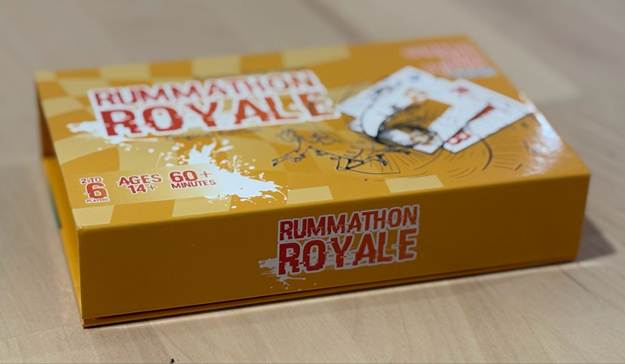
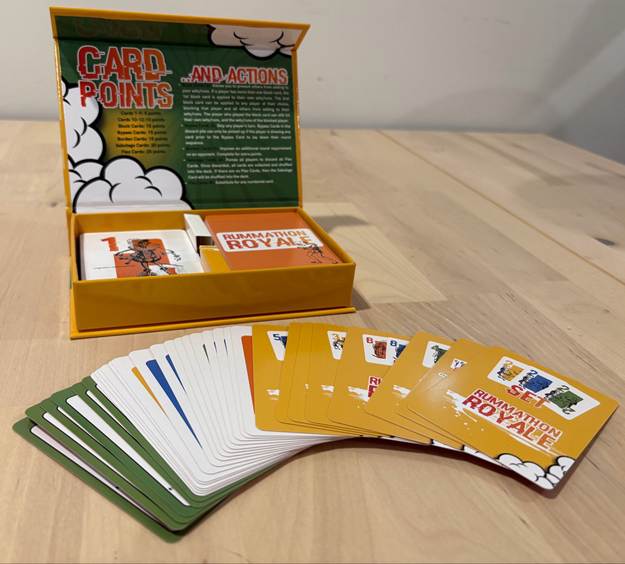
“Rummathon Royale” comes in a nicely made, magnetic-clasp box. The whole package is quite compact and tidy, with over 100 cards (mostly playing cards, plus a few rules-reference cards) tucked into two compartments beneath a multi-folded, single-page rule card. The impression is of a game that should be as quick and easy to set up as a kids’ game of Go Fish – though we’ll get to how that impression plays out shortly.
Art is solid, though it leans very heavily on public domain clip art sketches and combines that with some odd, glitched-text headings that don’t quite cohere into a clear aesthetic. Playing cards use large, readable text (not so much the rules cards; more on that in a bit) and generally simplify the numbers-and-suits structure of any deck of cards, ending up closer in style to an Uno deck especially once you include the action cards, which give players anything from wildcards to play in their sets to the ability to disrupt, skip, or burden other players in the middle of their rounds.
The simplest explanation of the rules I can give falls along those lines: this is a game of rummy, where you’re tasked with playing certain combinations of cards to satisfy the conditions of a given round, with Uno powers mixed in. There are also a healthy amount of complexities added in terms of scoring and turn sequence – you have to play all your requirements for a given round all at once, for example, instead of being able to lay it out piecemeal; a burden card may add another condition to your round, but you’ll get bonus points if you can overcome it. This all plays out over up to twelve rounds, only cut short if a player is able to satisfy two rounds in a row before anyone else.
As I mentioned, this box gives you the impression that the game inside will be quick and light, not too much different from grabbing a standard card deck – but impressions can be deceiving. If you’re looking to learn or teach this game, I would strongly recommend going with the provided QR code and video link rather than working through the provided rules sheet. The written rules are, to be honest, a bit of a mess – hard to follow, with large and unhelpful headings like “Not 2 Forget,” “Few More Rules,” or “Mishaps,” and unexpectedly convoluted explanations that caused me to lose confidence that I even knew what gin rummy was by the end. The YouTube explainer, by contrast, lays things out in a reasonably nice fashion across 15 minutes, though it’s a harder thing to reference for clarifications or details.
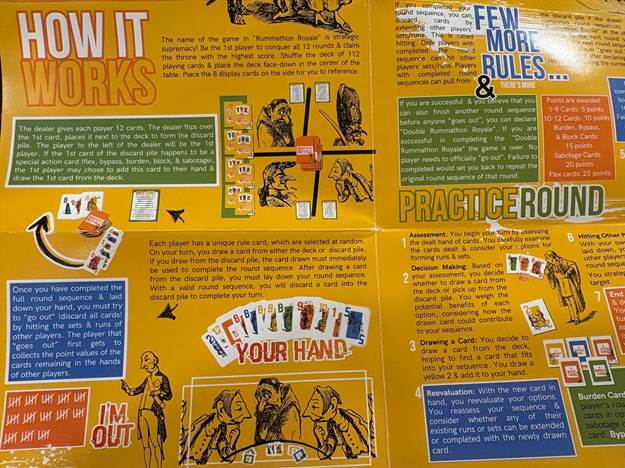
A 15 minute video might sound relatively short to you, but it still struck me as longer than I’d expect for a game of this design. In practice, no matter where we looked for them, our table of six players found the rules were frustratingly hard to grasp. For one thing, rules explanations aren’t super consistent between the rules cards and the video. A hugely important concept to the game is that a player can draw from anywhere within the visible discard pile, but must take all the cards above the one they desire if they dig into the stack. This is clear enough in the YouTube explainer but nowhere to be found in the rules card. Our table went back and forth about other basic rules – what happens at the end of a round, for example – without feeling like we were getting much clarity when checking the written explanations.
A bigger issue, even if the game had been quickly picked up by the table, is that many of the rules simply require more management than the game box suggests or allow for players to mistakenly (or intentionally) fail to follow them. One example of the latter is the Sabotage card, which forces all other players to discard wild cards in hand. How is the player playing the Sabotage to know for certain that players are doing this? Are other players meant to reveal their hands at the same time the card is played – and if so, isn’t this a much more massive advantage to the saboteur than the rules suggest?
Management-wise, expect to have not only a piece of paper for scoring at hand, but also some tokens or extra tools to keep track of player actions. Combine this with the fact that the individual player round cards – which detail what you’re trying to play each round – cram a lot of tiny text into a small space, and I wonder if this whole thing wouldn’t have been better served with a much larger, perhaps less tidy box, and a lot more structure around the on-the-table presentation.
Ultimately, what I think frustrated me the most was that for a game that’s being sold on adding extra interactivity and cunning into a classic model, everyone at my table spent a lot more time focused on their own problems rather than paying any attention to the overall game state. The rules even encourage this, at one point suggesting that players who are waiting to play should spend their time sorting their hand – fair enough, but when you combine it with everyone playing for their own hard-to-read line of text and with individual turns happening in bursts of either “I play this, this, and this, and my round’s over” or “I can’t do anything, I’ll draw a card” it all ends up feeling very listless when you’re not the one who’s playing. Really this is a problem that the game inherits from rummy itself, but it’s a problem nonetheless, exacerbated by the very attempts this game makes to add intra-player engagement.
Verdict
There’s a clever idea being explored with “Rummathon Royale”; at its best, this could be a game loved by tables of all ages, a bridge between those whose only gaming experience was playing Hearts at the high school cafeteria table and those seeking the cutting edge of complex, interactive board games. In practice, though, it’s much slower and more frustrating than it should be, leading to a game that mostly makes you want to play its inspirations instead.
Likes
- Nice, tidy box construction and presentation
- Clever concept that adds a lot of interesting wrinkles to the base “rummy-style” game
Dislikes
- Art is solid but uninspired, too obviously pulled from stock sources
- Rules are very confusingly written, too dense
- Box does not include or suggest many of the components needed to properly track play
- Hard to shake the feeling that you could play similar games that you already know instead


 Rolling In The Meep
Leave a comment