

You are a hero, trapped at the bottom of the mysterious and terrible Spire. The only way to escape is to climb, and to face danger with every step upwards. Handcraft a deck of powerful cards alongside your allies to fight strange and fearsome monsters, collect trinkets and artifacts to boost your skills, and work together to Slay the Spire!
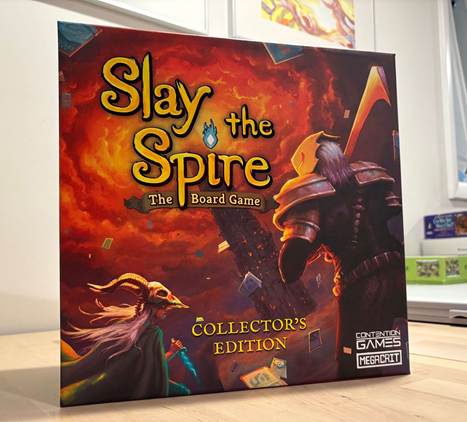
Game Name: Slay the Spire
Designers: Gary Dworetsky, Anthony Giovannetti, and Casey Yano
Publisher: Contention Games
Player Count: 1-4 Players
Playing Time: 60-90 minutes
Review Date: 5/22/2025
Reviewed By: Chuck
Upfront Disclaimer: Chuck purchased Slay the Spire with his own money. Contention Games and Mega Crit provided no free items or compensation. All opinions contained within are my own unbiased thoughts.
Game Overview
Full disclosure: I think “Slay the Spire,” Mega Crit’s 2019 roguelike deckbuilder, deserves a spot in the pantheon of greatest video games of all time. It blends a unique aesthetic identity with razor-sharp mechanics, a beautiful balance of intuitive play and tactical complexity, an ever-increasing depth of strategy across each run, and an individual run length that’s perfect for a “one more run” style. It’s a must-buy on your platform of choice – PC, Switch, mobile, whatever – and a permanent fixture in my personal gaming rotation.
You’d think that would prime me to love Contention Games’ board-game take on “Slay the Spire” before I even opened the box, but instead I felt a lot of hesitation. There already is a perfect version of this game; what value is this quite expensive, quite large version going to bring that isn’t already there in the often-discounted video game?
There are two big answers to that, but before I get into them, let’s talk about what this game is for those who might not be familiar with either incarnation. “Slay the Spire” the board game is a solo or cooperative deck-building game. You choose from one of four heroes, each with its own unique pool of cards and abilities to acquire or improve over the course of a session. As a group you ascend the titular Spire, a vertical branching map full of enemy encounters, treasures, and other mysterious events.
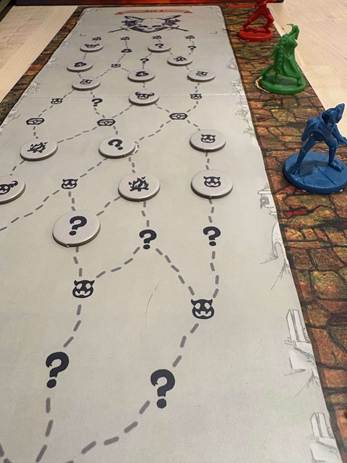
The spire map is appropriately long and intimidating.
Your progression and battle stats are all held on your player mat, which lets you track your acquired potions and relics (temporary or permanent buffs and alterations to your abilities) as well as your health, shields, and energy. Energy dictates how many cards you can play in a turn; the cards themselves make up the bulk of the tactical flavor of each round of “Slay the Spire,” and are an expression of your character’s mechanical strengths and weaknesses.
The cards are a great place to highlight how much care has been taken to replicate the video game’s aesthetics. I own the collector’s edition of this game, but even in the base-game materials you can see love and craft. Cards look like they were somehow pulled right from the video game while pulling off even cleaner streamlining of rules explanations; the map and other materials, too, replicate the game while serving as excellent physical tools. Even the collector edition’s bonus trinkets – hefty gold coins, well-sculpted miniatures for the hero characters – evoke the video game without feeling out of place on the board. Contention Games had a head start here with the existing game’s look and feel, but they’ve translated that into something that works as a board game with stellar results.
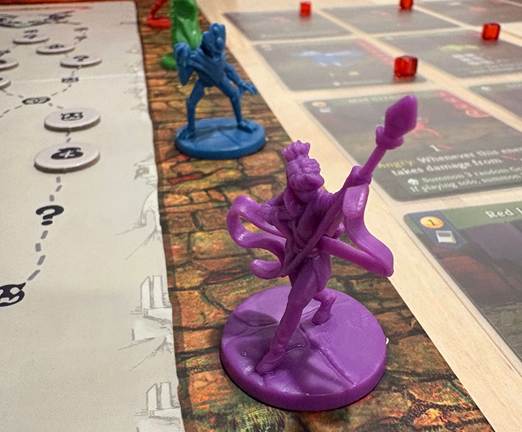
Lots of nice detail in each of the miniature sculpts.
The biggest change in translation that a video game veteran will notice is in the number counts. Take the Ironclad’s health pool as a clear example: in the video game, the character starts with 80 HP and the relic Burning Blood, which restores 6 HP at the end of each battle. In the board game, the Ironclad’s health pool is 10, and his Burning Blood relic restores a single point of health. This near order-of-magnitude reduction in stat counts applies to every number in the game, from enemy health to attack power to gold.
It’s a simple change that has wide ramifications for the effectiveness of certain strategies and your own sense of fragility and power as a run goes along. Prior knowledge of defensive strategies that work in the video game may work against you here, even if all the cards and components to make that strategy work are carried over mostly intact. The risk-reward prospect of each action in battle becomes more fraught, even as the flow of turns feels largely the same.
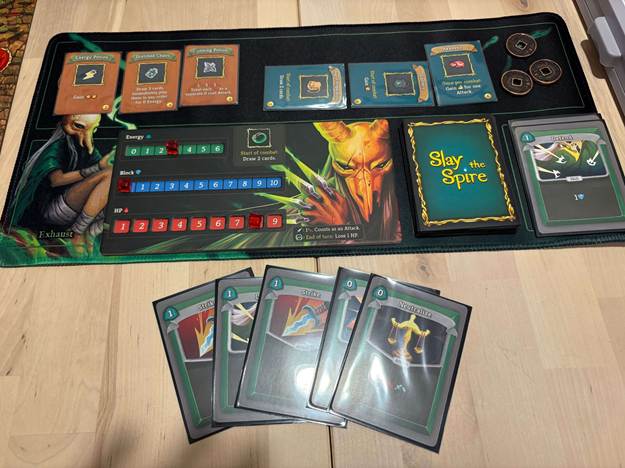
A single player’s game mat. Imagine four of these, plus the world map, plus enemy cards, plus reference materials…
One of the video game’s great innovations is that it allows you to see the intentions of your enemy before you take your actions, letting play and consequence feel earned and tactical rather than arbitrary. You know that one slime is attacking and the mugger is escaping with your money – do you take the hit and get your purse back, or do you conserve hit points and kill the slime before he gets his shot in? The board game replicates this with surprising elegance. Enemy actions are either conducted in a set pattern (an enemy might always attack, or it might alternate between attacking and building up shields) or dictated by a single die roll.
That single die roll affects every action on a given turn, which is a wonderful way to reduce additional cruft in a game already full of stats and tokens and mechanics. With four players at the table, there is a lot of maintenance and upkeep, but it all feels well balanced to keep battle and progression going as fast as possible, once everyone knows the rules. (Having at least a couple players at your table who have played the video game is a massive boost to rules explanations, by the way. If you don’t have that, expect the explanations to take a while.)
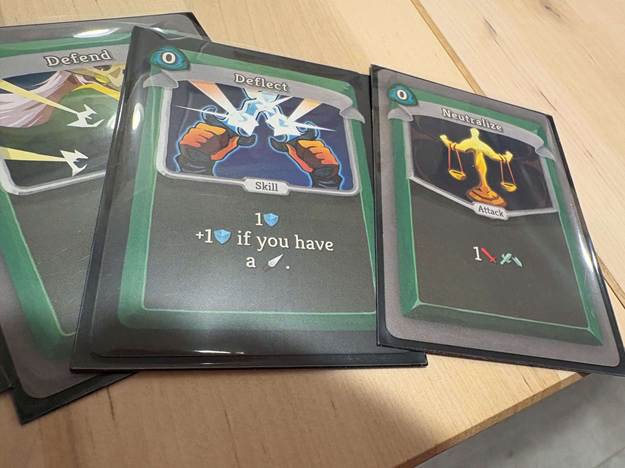
Lovely, striking card art pulled straight from the game.
Speaking of four players, that’s the board game’s other major change from the video game: it’s designed as a multiplayer cooperative experience, rather than a solo-only game. This works wonderfully in concert with the extra fragility I mentioned that comes from smaller health pools, and the game’s smart and elegant again about these more chaotic melees. Each player is assigned their own row of one or more enemies. These enemies typically attack only that player, but each player can attack enemies from any row they choose.
Oh, and one more thing: if any one player is killed, the entire table loses.
All this, plus a new array of cards and abilities that allow intra-player interaction, turns each round of battle into a conversation. It’s tremendously satisfying to work out as a team how you can prevent damage to your most at-risk teammate while also killing off as many threats as possible. Players will show off cards to each other, discuss the best way to pull off combos in sequence, and then execute in a flash of tossed cards and removed health cubes.
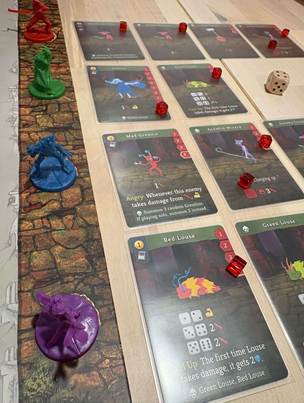
Four-player battles can look chaotic but have a great flow.
Between battles, players will draft new cards into their decks, and this too becomes a point of cooperative discussion. You may take a more defensive card than you’d planned because someone else at the table sees that choice and encourages it; you and a teammate may pick cards for their potential synergy. Cooperation feels incredible as a core, constant mechanic in this game that was first conceived as an individual experience.
Cooperation helps offset the game’s difficulty, too. At its base level, “Slay the Spire” is not too difficult with four players, though the difficulty curve has its spikes and peaks like the video game. There are also entire additional sets of cards and rules to implement a version of the video game’s ascension mechanic, in which a completion of a full three-act run triggers new restrictions and obstacles in future runs. This is a board game that knows it’s expensive, in other words, and has more than enough replayability mechanics to offer in exchange.
Solo play, on the other hand, is admirable but less successful, simply because it feels too much like the video game. I had fun running it solo but couldn’t escape the itch that my Steam Deck was sitting on a table across from me, and in seconds I could boot that up and play an even more streamlined and fast-paced version of the same game, with fewer fiddly cubes and no dice rolling or reshuffling at all.
My Thoughts
Price and value, then, are the sticking point for me when talking about this game. I bought the Collector’s Edition for $170; the base game runs $114 on Contention Games’ website. That is a lot to ask, especially in contrast to the video game, which can often be picked up on Steam on sale for between $5 and $20. The two big aces in this board game’s sleeves that I mentioned earlier are its cooperative-play mechanics, which don’t appear in the video game at all, and the sheer novelty and delight of owning this lovingly made recreation of such a fantastic game.
When I say “lovingly made,” I mean the materials and the play experience. I cannot say enough about how Contention Games have taken a video-game-specific experience and translated it into a beautiful, sparkling board-game flow. It feels like the same game and its own thing, a near-miraculous double victory.
Whether that’s worth it to you depends on your play group and your own appreciation for the craftsmanship of a good board game. If I’d only ever played this solo, I’d feel very skeptical about whether I had received my money’s worth. But right now, I’m delighted to have “Slay the Spire” in my collection. I love grabbing a handful of the merchant’s coins and feel their heft; one day I’m going to paint up the miniatures for some extra fun and value. And most importantly, I get a ton of joy out of the game itself – when I can get a few friends around the table.
Price aside, I’m glad “Slay the Spire” exists. Contention Games have proven that the trend of converting other IPs into the board game space can result in something spectacular while remaining devoted to that original vision.
Verdict
“Slay the Spire” is at once an incredible tribute to the masterpiece video game and a masterpiece in its own right, a distillation and recreation that also produces a thrilling experience thanks to the cooperative mechanics. It’s expensive and hefty, but if you have some willing friends and you’re OK with investing the time and money – and especially if you’re already a fan of Mega Crit’s indie sensation – there is an enormous amount to love and admire in this box.
Likes
- Beautiful art and design, pulled right from the video game but adapted perfectly to the new medium.
- Rules translated well from its namesake but trimmed and adapted to reduce the required math and keep things brisk and exciting.
- Cooperative play is a revelation and an absolute blast!
- Collector’s Edition materials feel well worth the extra money.
Dislikes
- Will take a long time to understand if you’ve never played the video game.
- Tracking mechanics, moving cubes, tallying up effects can all be very fiddly and complicated; I recommend splitting tasks across your table!
- Value proposition is tough, unless you consistently have a table of 2-3 other willing and excited players.
- A massive, heavy box requiring a lot of space to store and to splay out on the table.
- Solo play is repetitive and unsatisfying in comparison with cooperative play, makes you kind of want to play the video game instead.



 Rolling In The Meep
Leave a comment