
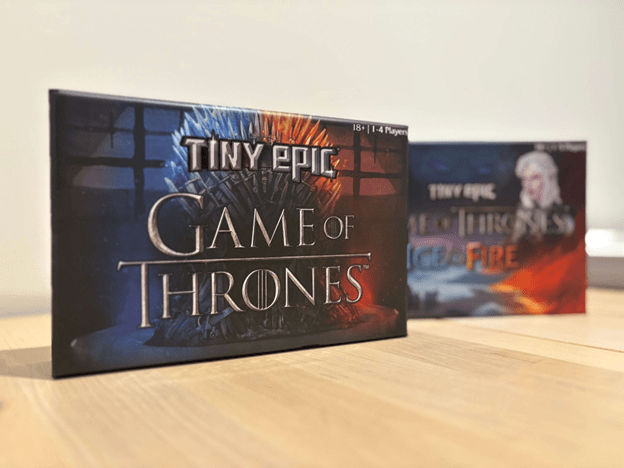
You are a leader of one of the great Houses of the world of Westeros, and you follow one rule: In the Game of Thrones, you win or you die. March on your enemies, cajole potential allies, and build your influence across the realm. Will you sit on the Iron Throne, or will you be crushed by the strength of your rivals?
Game Name: Tiny Epic Game of Thrones (2024)
Designer: Scott Almes
Publisher: Gamelyn Games
Player Count: 1-4 Players
Playing Time: 60+ minutes
Review Date: 5/21/2025
Reviewed By: Chuck
Upfront Disclaimer: Gamelyn Games generously provided us with a copy of “Tiny Epic Game of Thrones” for purposes of testing it out and writing a review. No compensation was provided and we were free to write whatever we wanted about the game. All opinions contained within are my own unbiased thoughts.
Game Overview
Just like Dan for his review of “Tiny Epic Cthulhu”, this is my first time playing one of Gamelyn’s “Tiny Epic” games. The proposition is intriguing: get the complexity and scope of a big-budget, big-box game in the volume of a few decks of cards. And, like “Cthulhu,” this game delivers up-front on that promise. Open the box to find a landslide of meeples, tokens, playmats, and rules sheets to rival your longest night of Gloomhaven or (more appropriately) Fantasy Flight Games’ much larger, much more intimidating Game of Thrones box.
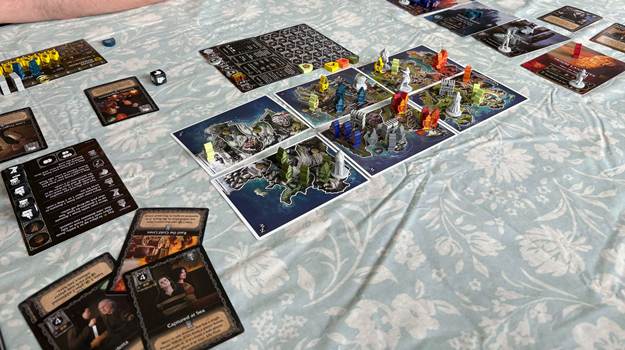
Initial set up and an initial perusal of the rules will put you in mind of the FFG game in more ways than one – a testament to how both that game and this one do a great job of compressing so much of the narrative flavor of George R.R. Martin’s world into their mechanics. Westeros is displayed on your table in the form of six jumbo-sized cards, which house a series of wooden castles and troops alongside some lovely plastic miniatures representing some of the series’ most famous and infamous characters.

Solo play set up.
Artwork and aesthetic are on point here, capturing much of the essence of both the television show and book series without being slavishly devoted to either. Tyrion Lannister may not look like a line-tracing of a Peter Dinklage photo, but his illustration and miniature both capture the character’s charm and essence. Card art is consistently solid, the map is detailed but not too busy to read, and the reference cards for scoring and dice-rolling admirably fit a lot of rules details into tiny spaces.
There’s a fine line between “tiny epic” and “cramped” that Gamelyn dances carefully here, and while they walk the line well for the most part, the world map itself is where things can get the most chaotic. The game features a total of over 100 tokens, and a shocking amount can sit together on the board in any given round. With up to six troop tokens per region, unoccupied castle tokens, and heroes dotting the landscape, it can be hard to parse who has influence where. Still, this cuts both ways: The map’s density makes the game feel alive and urgent at all times, with the potential for border skirmishes filling your vision.
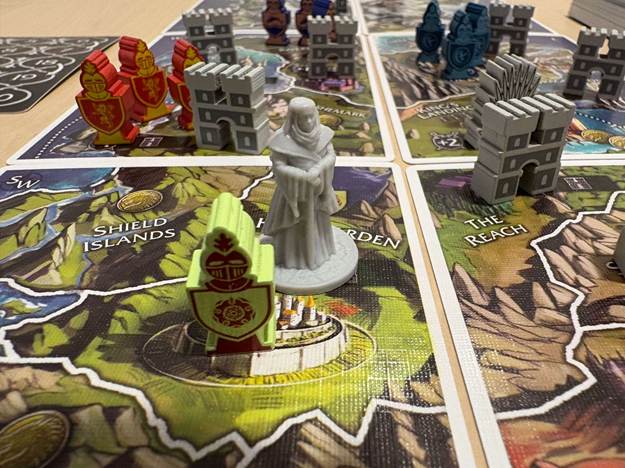
A close-up view of a game board, chaotic before play has even begun.
This visual splendor takes some time to come together and even more to play out across the game’s six rounds. My initial playthrough of this game took nearly 20 minutes for the initial set up, and initial rounds can be sluggish too as your players grapple with the game’s many rules and reference iconography. As with “Cthulhu”, this game features compatibility with the free “Dized” app for a more streamlined experience in both set up and play. It’s worth trying, though in my experience the 24-page rulebook does as well as it can to balance “put this there” directions with context and explanation, so that as you read and perform setup, you’re learning aspects of play that will be valuable as you transition to round one.
There are six rounds in a game of “Tiny Epic Game of Thrones“in either solo or group play, with scoring after three of those rounds to allow some build up of tension and strategy before the number-crunching begins. As a solo player, you simultaneously conduct your own strategy while pulling from a solo-play deck to dictate the actions of a rival. In a group, each round takes place over a series of both individual and collective turns, with rich decision-making and interactivity throughout.
Actions are controlled by the sides of the action dice. One player per round, designed as Hand of the King, will roll the (up to five, based on player count) action dice and choose one to keep, passing the remaining dice around the table to let each player select an action. One die will return to the Hand, who at this point will choose between their pre-selected die and the final extra to perform one action. After the player takes their action, everyone else at the table will have a chance to perform it as well – but the choosing player also gets a second action based on where they’ve set their die on the action mat (which contains the same set of icons as the dice), and they alone have the opportunity to perform the action on the mat.
This sequence can be hard to grasp initially, but becomes smooth and intuitive as the game goes along, and forms one of the game’s two main strategic pillars. Dice actions include land and sea movement, card play, card draw, and the recruitment of troops or allies – and that initial dice roll, locked in for the round, massively affects advantages and disadvantages to your choices within that round. The dice may have no movement actions at all – so, do you choose to force a March by placing your die on the corresponding action mat space, or do you double-down on strengthening your existing territory? You may not have a choice if you’re playing last in the round, and other players can wield that against you. Even without direct battles, the action dice pool creates interactivity and strife across the table.
The game’s other major strategic pillar comes in the form of the “ally pool.” Houses not chosen by players are instead set up as potential allies, with their troops tantalizingly already in place in their home region on the map. By gaining influence with these houses using the Plot action on the dice, you collect their troop tokens into your Ally Pool for an opportunity to form an alliance at the end of the round. Successfully ally with one of these houses, and you gain their on-board troops, their castle, and even the chance to spend gold to bring their house’s hero into the game for additional abilities and strategic opportunity.
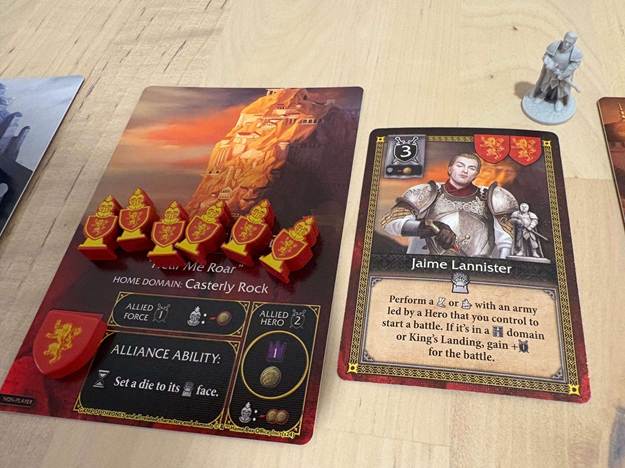
House Lannister, set up as a non-player ally
The Plot action utilizes the shield symbols on the cards, which perform triple-duty as chances for battle reinforcement, alliance recruitment, and the unique effects as written on the card. It’s a great way to mine as much complexity out of the game’s relatively small component set as possible, and it also makes every card you use a compromise. Do you play the card for its valuable shields, use its special ability, or save it as protection in a potential battle? Maybe no Event dice were rolled this turn – do you want to just use the card now for its shields, or hold on to it into next round, hoping you can pull off that powerful ability?
Speaking of battles: They’re a simple, Risk-style numbers game, counting troops and heroes as well as cards played by each player. The losing player retreats and loses a single troop; the winner instantly gains a victory point. A catch-up mechanic represented by “Valar Morghulis” tokens can be gained as the game goes along that gives a player who’s fallen behind extra victory points simply for starting battles – a great way to simultaneously prevent landslide victories and to encourage aggression across the table.
Other than in battles and from certain cards, victory points otherwise come in scoring rounds, based on your collection of castles, alliances, and special objectives for your House as listed on your playcard. After the sixth round and third scoring round, the victor is crowned!
There are other rules on top of these – gold collection and taxation, the influence of the Iron Throne itself, and the many wrinkles and unique effects of cards. These details flow naturally into the rest of the game’s rhythms, complicating every decision enough to generate excitement no matter the state of play. Even a player who feels lost or far behind early has a lot to chew on and ways to execute a satisfying turn; no one has to sit and whimper as the game flies away from them.
My Thoughts
It’s probably clear from how I’ve outlined the rules, but this game provides a shocking amount of thoughtful decision-making in a tiny package. The real triumph is how those choices are always simultaneously individual and collective. The world map is too small for players to simply turtle up in the distant North; even without flinging yourself into battles, you’re forced to compete for property and alliances and compromise on those battles with every choice. Others’ choices will always affect you somehow, causing you either to grimace or cackle, and you’ll always be eager to pay attention and to jump back in when the turn sequence comes your way once more.
It takes a good amount of time to get to that level of comfort and rhythm, though. The game’s smart use of many components for multiple purposes is tricky to learn and teach. I mentioned the cards already, but another example is the castle, which when on the board represents territory to be captured but once caught actually becomes a limitation on your maximum gold count. This is a clever, flavorful use of the token, but means that explaining the castle in full requires prior understanding of multiple mechanics, some of which won’t be relevant until quite a bit later in typical play. My recommendation, if your table has the patience, would be to start with a couple of open-hand practice rounds, letting rule explanations come up organically over the course of play, before doing a single scoring round and then restarting into a proper game.
That in mind, the game’s listed 60+ minutes honestly feels like a severe undercount of this game’s likely run time for most player groups. It’s more accurate for solo play, at least – but that mode has its own fiddly issues, mostly around the “rival” player, whose actions are dictated by its own deck of cards. In my experience, the rival’s actions and maneuvers felt more arbitrary than cunning, less like a rival House for the Throne and more like a random pirate or marauder, less interested in amassing their own influence or victory conditions than in being a pain in your butt as often as possible. It’s still fun, but it’s an expectation shift away from how the game feels with a group of like-minded players.
But players may feel an arbitrariness to their own actions at times, too, based on the available dice. The game can run into bottlenecking problems, such as a player who hasn’t happened upon a March or Sail action suddenly finding themselves unable to use any of their cards or actions because of a lack of territory (this happened to a player at my table). It’s not a dealbreaker, but it’s something to keep in mind and perhaps to warn your players about ahead of a session. Even if it triggers a big moment of frustration, it should be fleeting enough that they’ll find something to help them catch up and feel excited again on the next turn.
Verdict:
In spite of some complexity issues, “Tiny Epic Game of Thrones” pulls off a fast-paced and meaty representation of Westeros and its titular power struggles. It’s a lovely little box with a lot of well-made components, it looks great on the table, and if your group of players can get comfortable with the rules you’ll feel like lords and kings sending armies across the world, trying to give each other as hard a time as possible while jockeying to wear the crown and sit upon the Iron Throne.
Likes:
- The variety of materials feel great, from shiny coins and plastic miniatures to well-crafted wooden tokens.
- Card art is consistently solid and unique while evoking the series and books.
- Event cards and action dice feel flavorful and immersive.
- Solo play is thoughtfully crafted, with lots of extra mechanics and tweaks to balance it.
- Constant interactivity across turns – very little sitting and waiting for a player because you almost always have a chance to respond to or echo their actions.
- Genuinely feels like a miniaturized version of much more massive, expensive games!
Dislikes:
- Initial set up is very fiddly (first time I set up a solo game took 20+ minutes).
- The rulebook is a lot to take in; maybe some streamlining of visual representation of rules on the play mats would be helpful?
- Solo play can feel weird sometimes – the rival doesn’t really play like another player at all, more like a roving marauder, changing the game’s flavor (not necessarily a negative once you’re prepared for it)
- Player actions can feel too narrow in some situations, creating frustrating deadlocks



 Rolling In The Meep
Leave a comment