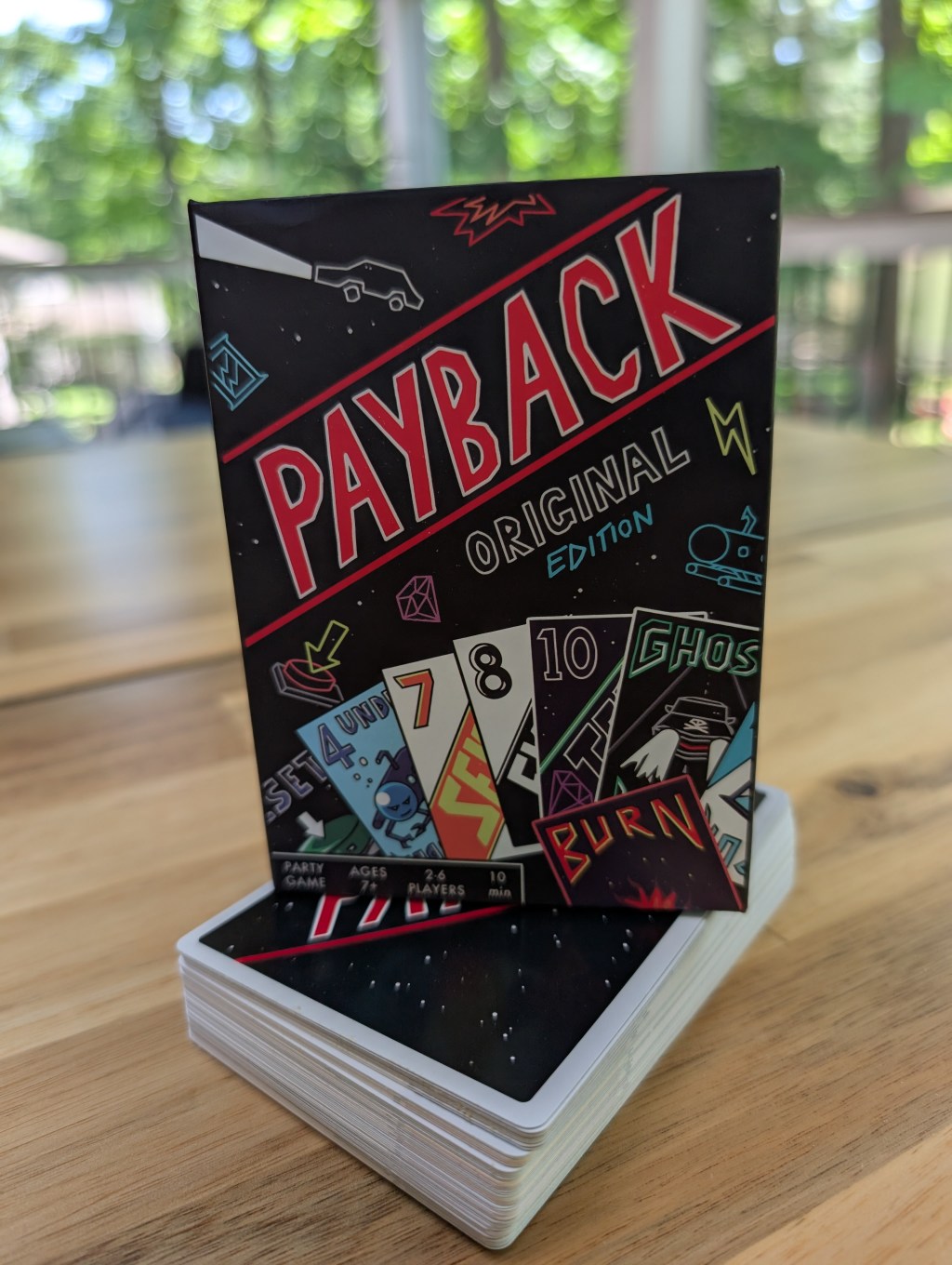
A modded version of the card game “Palace”, but with the carnage and chaos amplified to the extreme. Does Payback offer enough friendship-ending action to be worth the purchase? Let’s dive in!

Game Name: Payback (2025)
Designer: Karel Psota
Publisher: Self Published
Player Count: 2-6 Players
Playing Time: 10 minutes
Review Date: 5/18/2025
Reviewed By: Dan
Upfront Disclaimer: Designer Karel Psota generously provided me with an advance copy of “Payback” for purposes of testing it out and writing a review. No compensation was provided and I am free to write whatever I want about the game. All opinions contained within are my own unbiased thoughts.
Game Overview
Payback is the first game from designer Karel Psota, who I had the pleasure of exchanging multiple messages with about the game and the process. This game was created by a group of five friends, and as of the date of me writing this review, is less than a week away from launching their Kickstarter campaign. But this connection started out with me reaching out to Karel first – I saw some of the preview marketing for the game, and immediately fell in love with the promo video showing how the game artwork was designed in MS Paint. I can’t quite explain why, but learning that the art was made in Paint made me love the game so much more after spending years myself of messing around making silly drawings in Paint. On top of that, I’m a sucker for quick card games, and this one looked to be right up my alley.
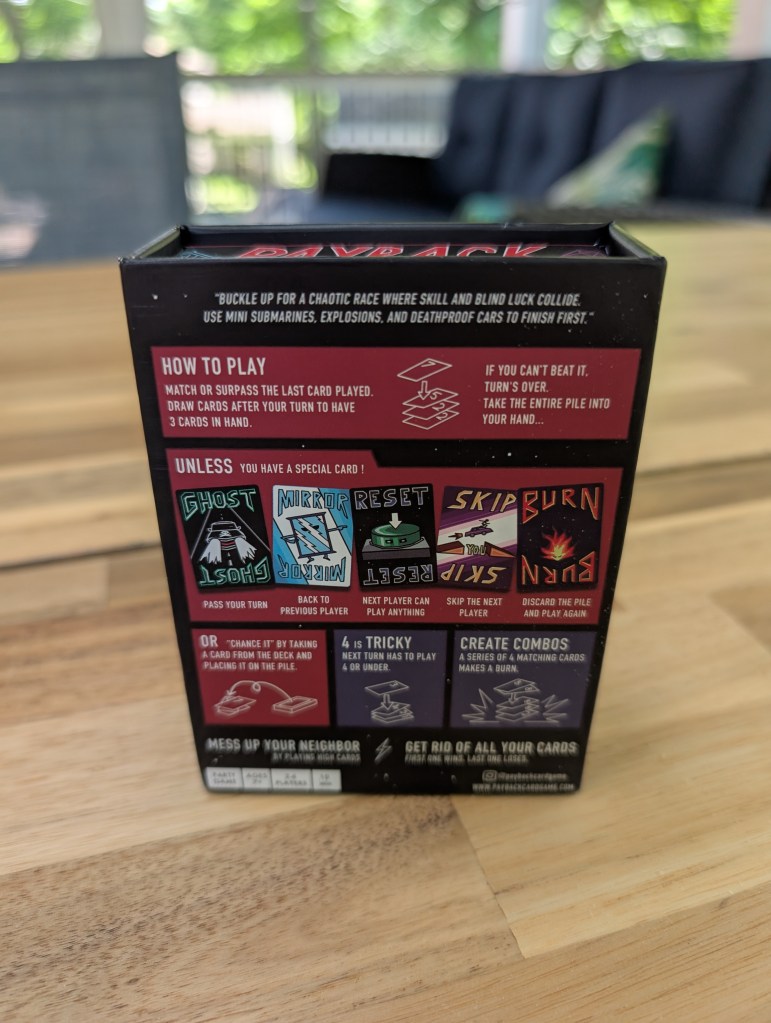
So, what is Payback? If you’re familiar with the card game “Palace”, it sets up and plays similarly to that, but brings in some Uno-like aspects as well. But more importantly – it’s designed from the ground up to function as a fast, quick party game for two to six players. The game comes in a very thick and sturdy cardboard case with a satisfyingly strong magnetic clasp; there is no way this case is opening up by accident, and the snapping sound each time it closes is very gratifying. Inside are 58 thick, quality feeling oversized cards, all of which are used in the game play. There is no included rulebook or unused cards; the rules are printed in various spots all over the box, and more importantly there is a QR code that leads you to a website with a cleverly made (and funny) “how to play” video as well as a more thorough set of online instructions. No doubt that Payback is a lightweight, quick to learn game, but for first timers I would definitely recommend using the QR code and watching the official sub-4-minute video on how to play – it’s all you’ll need. It’s very clear, it’s funny, and you’ll be ready to start playing or teach anyone else immediately.
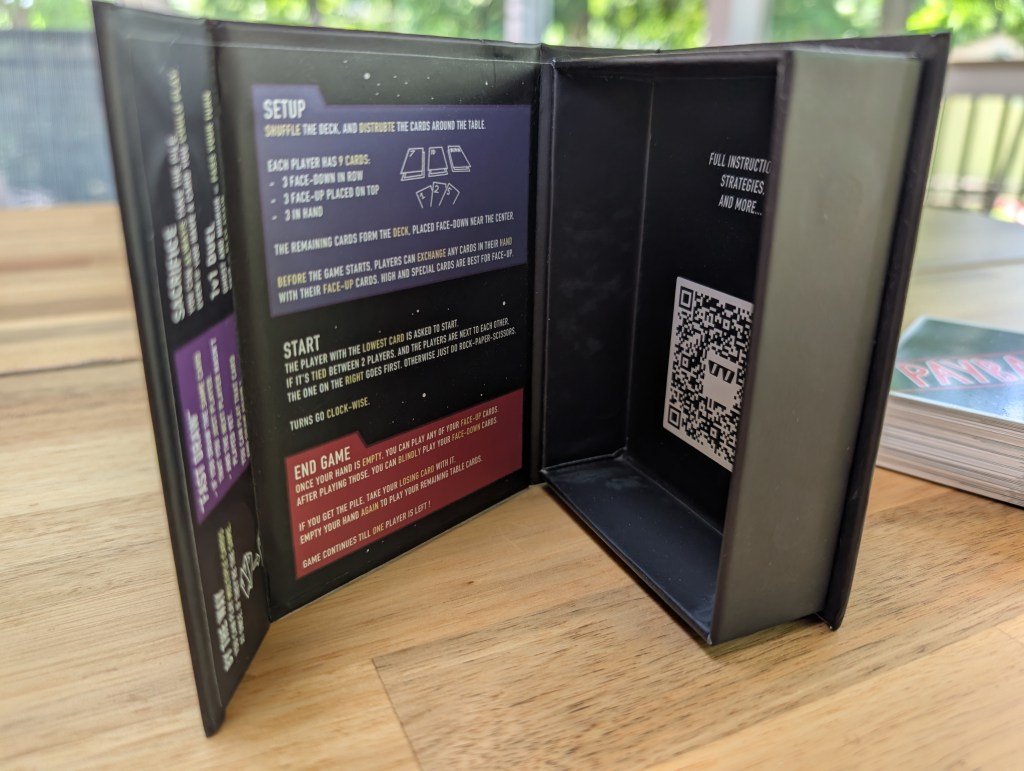
Here is how a game of Payback plays (not meant to be a full how to play, just a general overview):
- The full deck is shuffled, and each player is dealt 9 total cards. Three of them are face down separately into three different one-card piles, and the player is NEVER allowed to look at these cards until attempting to play them. Then, on top of those piles, one card is dealt face up on top of each for all at the table to see. The final 3 cards are dealt to the player to act as their hand, which they can look at, and keep hidden from other players.
- Just once before the game begins, each player has the opportunity to swap cards between their 3-card hand, and any of the three face-up cards in front of them. The general strategy here is that you want your best cards showing face up on the table in front of you; your best cards will either consist of any of the five types of special cards in the game, or else your absolute highest numbers.
- Play begins with the player who has the lowest number in their hand (settled with rock paper scissors if there is a tie). The active player has to play one card from their hand face up onto the pile at the center of the table; generally, the starting player each round will most likely want to get rid of the lowest numbered card in their hand. After playing a card, if the player has fewer than 3 cards remaining in their hand, they must draw an additional card from the draw pile to get back up to 3 cards.
- The next player goes, and they must play a card that is at least equal to or higher than the card on top of the stack. For example, if the top card is a 5, the next player can play a 5, any card higher than 5, or any of the 5 “special cards” in the game (more on those later). Players also have the option to play multiple identical cards at once; if they have 2-4 of the same cards in their hand, they are allowed to play all of them at once if they choose. One catch of this game – you are ONLY allowed to play cards out of your 3-card hand until your hand is gone and there are no more remaining cards in the draw pile. After your hand is emptied, you can then play from the 3 face up cards in front of you, and once those are gone, you then next try to play the three face down cards in front of you.
- A player who is unable to play a valid card is forced to pick up the entire stack of cards into their own hand and then start a new pile in the center of the table by playing a card of their choice.
The object of Payback is to be the first player to completely run out of cards – including the three face up and three face down cards on the table in front of yourself. Play keeps continuing after this point to determine who comes in second, third, etc. until only one player remains with cards, the overall loser (who undoubtedly is laughed at by all of their friends to rub the misfortune in further).
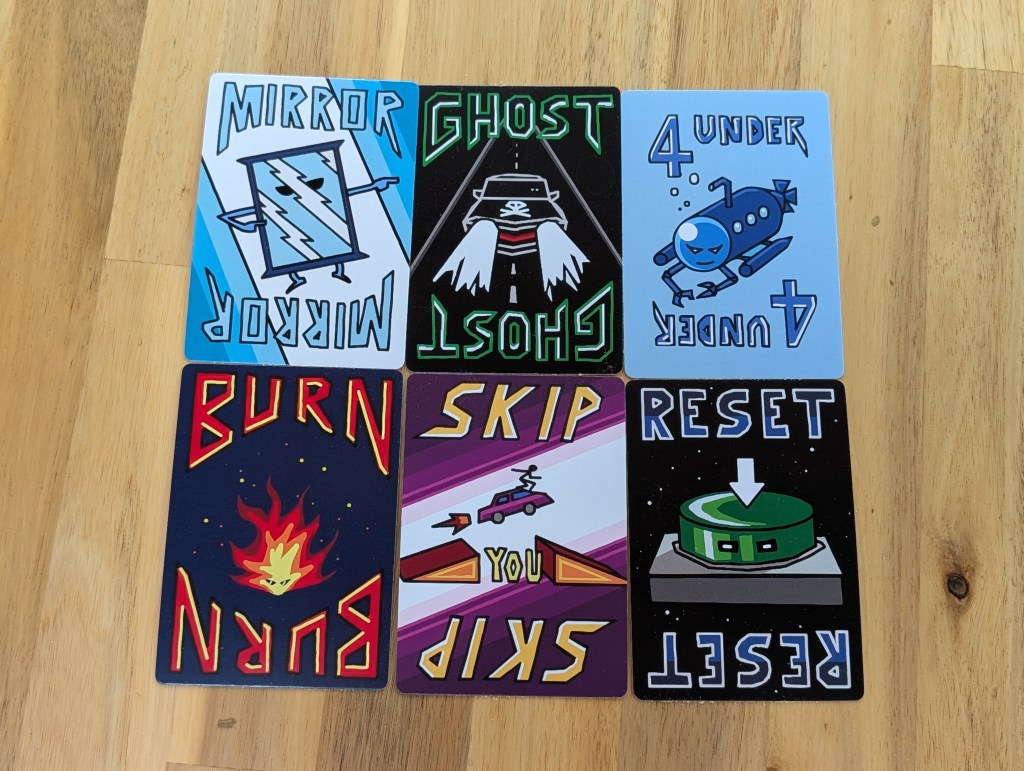
The deck consists of 58 cards, which include four each of the numbers 1 thru 10 (there are no suits or colors, they are all the same as one another), and then 18 different “special cards”. These Special Cards can be played at any time regardless of which number or other special card is on top of the pile. There are four each of Ghost, Burn, Reset, and Mirror special cards, and then two Skip cards; all of these are cleverly very straight forward to remember and are what make the game very interesting. “Ghost” cards essentially count as nothing – it satisfies you having taken a successful turn, but play just continues onwards to the next player who plays off of whatever card was underneath the Ghost. “Mirror” reverses the order of play and sends the game counterclockwise back to the player before you, but only for one turn; if they play successfully, order resumes being clockwise again. “Reset” is actually a nice gesture towards the player after you; it essentially overwrites everything underneath it and the next player to go can play anything they want on top of it. “Skip” skips over the turn of the next player. And lastly, “Burn”, which is probably the best card in the game, destroys the whole pile on the table. The entire pile is removed from play out of the game, and the player who played “Burn” gets to play another card and start a new pile.
My Thoughts
My very first time taking Payback to a table was with my wife and my two kids (12 and 9 years old, for reference). My wife isn’t really all that big into most games, and kids are a great litmus test at figuring out if a game is really easy to teach/understand. After a short 2-3 minutes of explanation, we were off and running on our first game, and never looked back. I found the game to be very simple to play, and the mechanics felt perfectly smoothed out and well-designed. If I had a video recording of the smile on my son’s face about halfway through the first round when he shouted “THIS IS A GREAT GAME!”, that would probably be all the review I needed here in terms of how it plays as a family game. We are pretty big on lightweight card games in our household, so that is fairly high praise from my kids. And, maybe this is weird, but ever since our kids were little, my wife started bringing simple card games along in her purse whenever we would go out to a restaurant or anywhere we had to wait. Sit down at table, and out comes a deck to play Crazy 8s, Uno, or any number of other simple card games. It was the perfect way to distract the kids when they were younger to avoid meltdowns while waiting for the food to come out; and we still to this day carry on doing this even as the kids get older because we all enjoy it. Payback probably in one single play, displaced all other family card games we have and will almost certainly be the go-to game of choice for the foreseeable future on every restaurant table we see.
But make no mistake – this is very much not just a “play with your kids” game; the impressive accomplishment here is that Karel Psota managed to make this a game that will be enjoyed by gaming groups of any age. I have played this with a group of 6 adults, and it resulted in a whole lot of shouting and laughter as we went around and around all vying to be the first (and definitely not the last) to rid ourselves of all our cards. With a group of friends, Payback sometimes changes from a game you want to win, to being a game that you REALLY don’t want to be dead last. We had one six-player game in particular, that came down to the final two people where the card showing was a 9, and on the very last possible turn, the final player miraculously produced a 10 as their last face down card, leading to some serious screams of joy among the eruption of laughter from all the other players.
Read through the full online rulebook, and it’s clear the designer knew that he would land a wide variety of gaming groups with Payback. I could completely see this game being used as a drinking card game; and unsurprisingly, scroll down in the rules and they have a recommended rule for drinking (take a shot any time someone has to pick up the pile). Similarly, there are recommended rulesets to modify this game to allow for gambling, 1v1 modes, 2v2 team play, and even a “devil mode” that revolves around a modification in the event that three 6’s are ever played in a row.

Be warned, on the sliding spectrum between luck and skill-based games, this one is definitely very heavily skewed towards luck. That’s not to say there isn’t any strategy involved at all; you can definitely increase your chances of winning a little bit through some clever play, but at the end of the day you’ll be far better off being lucky than skilled. There will certainly be a subset of players for whom this is automatically a huge turnoff, but at the same time this isn’t a game where I would expect or even have wanted it to involve too heavily around strategy. Payback is the type of game you throw down on the table when there is more of a focus on just having a fun time and evoking a lot of laughter, screaming, cursing, and other strong reactions.
The game plays with a player count of 2 thru 6 players. I think it plays well at all of those player counts, though one thing worth mentioning is that it can become quite a short game if you have the full 6 players. With each player dealt 9 total cards to start, there are only 4 cards remaining in the draw pile. So after the first four players make their first move, the draw pile will be permanently depleted, and players will start emptying their hands and moving on to their 6 table cards. That’s not necessarily a bad thing though, as this is really the phase of the game where Payback shines the most. The absolute joy of flipping out the PERFECT unknown face down card at just the right time, or the absolute hysterical laughter when a player is inches from winning the game and reveals a face down 1. And again, it’s nice to win, but it’s even nicer to not be the very last person to go out, so the game stays a blast to watch down to the final two players battling it out. Keeping all of this in mind, I’d stick to recommending “the more the merrier” when it comes to the player count. You could theoretically combine more than one deck of Payback together to incorporate 7-12 total players, but I haven’t had the chance to try this yet myself.
My only very, very minor gripe would be that the game doesn’t include a printed set of instructions…kinda. There are instructions for the game printed all over every flap of the box, and it’s enough to piece together to sort of understand the game, but I think I would have appreciated even a tiny rulebook included inside that really covered everything the online instructions show (including the additional recommended rule variants). Don’t get me wrong, if you use the QR code, you won’t have any trouble finding a really well-written tutorial online (with a great how-to-play video), but I think a printed version of the full rules would have been nice as well.
Verdict:
Payback strikes gold in a crowded genre where it’s normally very hard to stand out. A simple game with very enjoyable MS Paint artwork, well-designed mechanics, and a wide amount of appeal that will make it a hit with nearly all groups/ages. This sets a new standard for simple single-deck card games, and gets my absolute highest level of recommendation – a full 10/10.
Likes:
- An absolute blast to play at all player counts, leads to countless laugh-out-loud moments
- Wide appeal to everyone from younger kids, to drinking buddies, to more serious gamer groups
- High quality components; a great game box and a very nice feel to the oversized cards
- MS Paint artwork is an unexpected joy
Dislikes:
- Very heavily based on luck, might be a turnoff to some gamers
- Despite the great how-to-play video and easy rules, I would have appreciated a printed rule book


 Rolling In The Meep
Leave a comment