

On the island of New Arkhamoore in the 1920s, a madness begins spreading over the town, and a band of individuals come together to attempt to put a stop to it. Will they find a way to seal away the ancient evil before it is too late, or will the Harbinger of Chaos prevail?
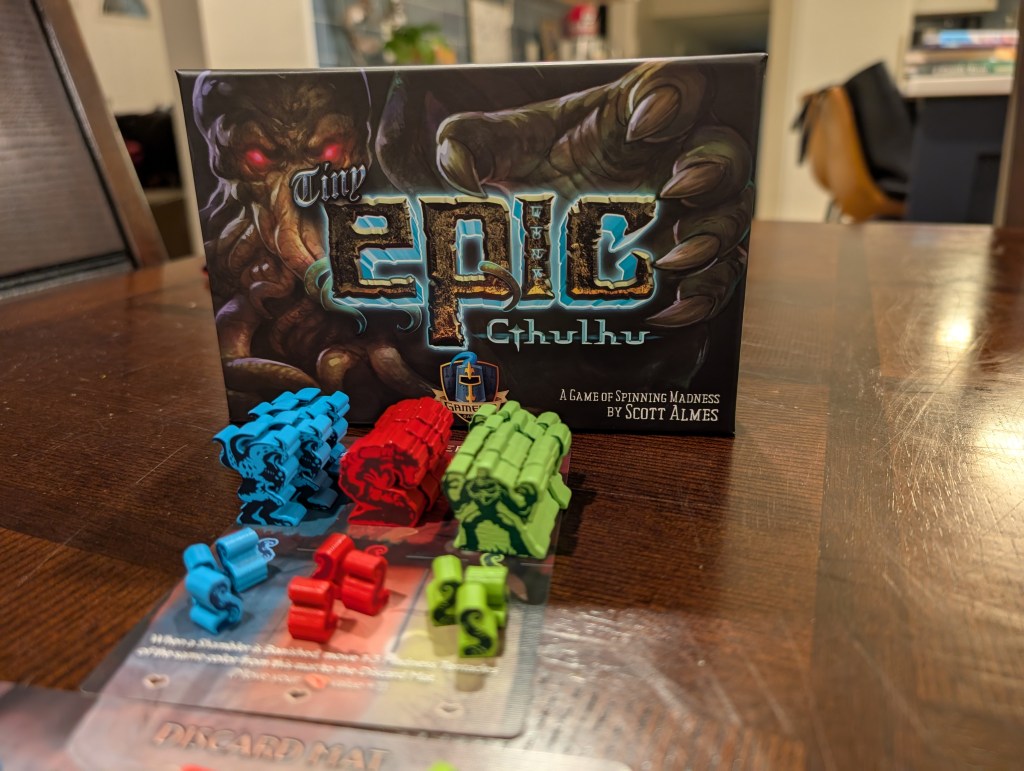
Game Name: Tiny Epic Cthulhu (2024)
Designer: Scott Almes
Publisher: Gamelyn Games
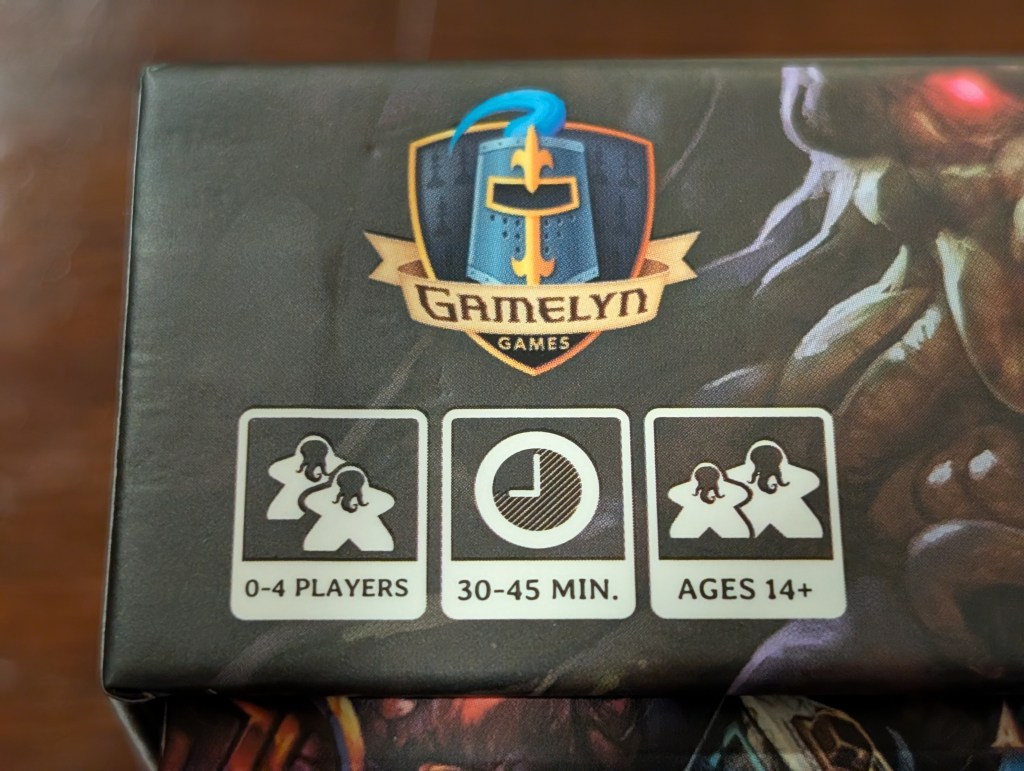
Player Count: 0-4 Players (yep, this isn’t a typo)
Playing Time: 30-45 minutes
Review Date: 5/16/2025
Reviewed By: Dan
Upfront Disclaimer: Gamelyn Games generously provided me with a copy of “Tiny Epic Cthulhu” for purposes of testing it out and writing a review. No compensation was provided and I am free to write whatever I want about the game. All opinions contained within are my own unbiased thoughts.
Game Overview
This is my first (and certainly not last) foray into the world of Tiny Epic games by Gamelyn, and I’ve always wanted to try their games out. So when they offered up the opportunity to test and review a few of their games, I jumped right on it. My first realization as I set this game up for my very first solo playthrough – they are NOT misleading anyone with the use of the words “Tiny” OR “Epic” in the name of this game. Even after multiple times of pulling this game out of the box and playing through it, I’m still a little amazed each time when I look at the entire thing set up in front of me, and then glance back at the tiny box it all came out of at the start. It almost seems like physics has been defied to fit all of this in a box that is roughly 7”x4.5”x1.5”. Tiny is a perfect adjective to describe the box size, and Epic is pretty spot on to describe the full setup and amount of game depth contained within. So far, we’re off to a good start here.
As you might expect from any game with “Cthulhu” in the title, this game oozes with horror, setting a mysterious dark theme that permeates through everything you can see and touch. The tone is set for a veritable Lovecraftian nightmare, and you can practically feel yourself wandering through the various buildings and locations on the dark and dread-filled fictional island of New Arkhamoore. Even the fairly lengthy 24-page rulebook is instead labelled as a “Pnakotic Manuscript”.
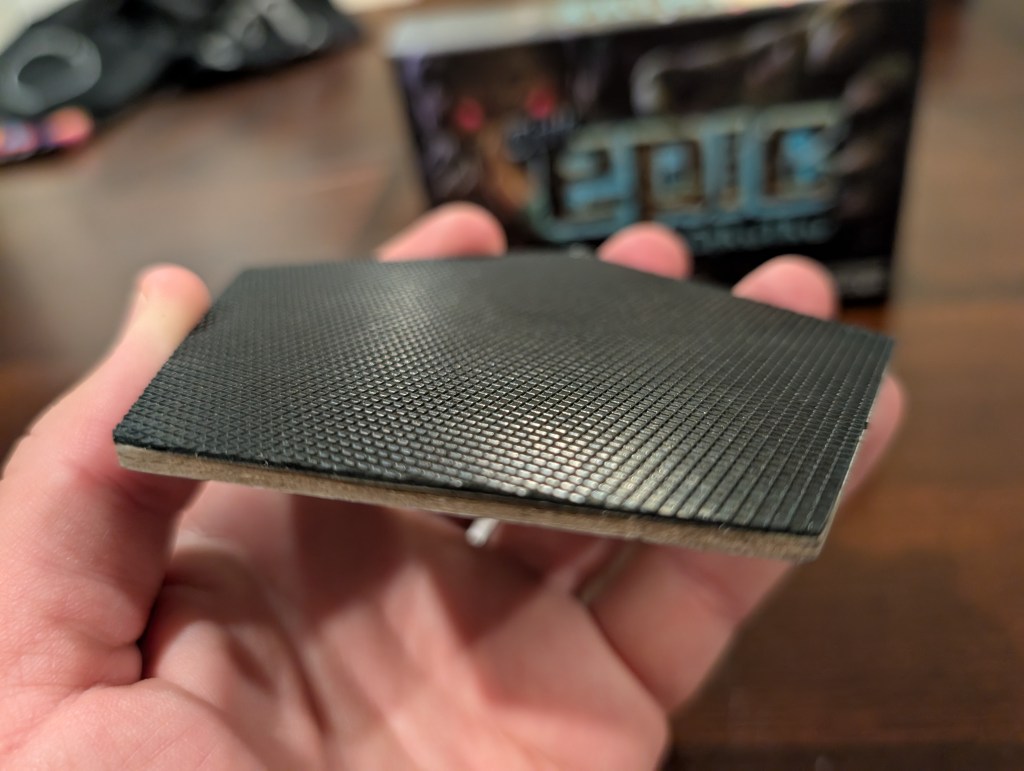
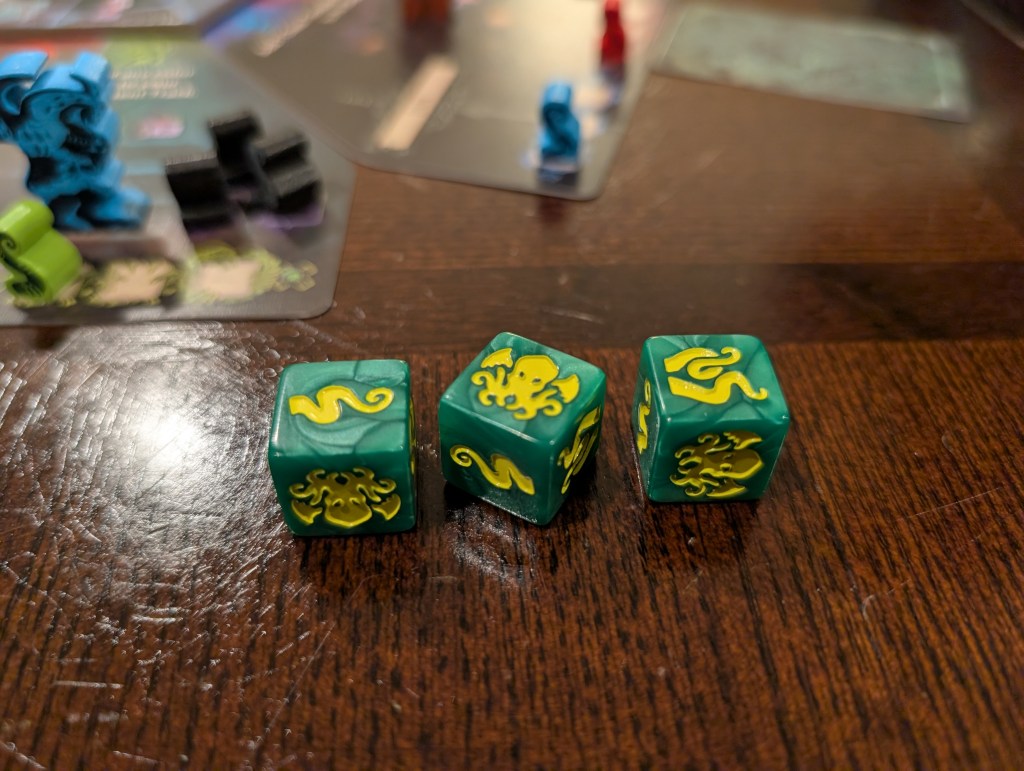
Many of the meeples and other components within may be on the smaller side, but none of them feel cheap or lacking of quality – color me very impressed. There are 140 – yes, you read that right – different painted wooden meeples/tokens inside the box, ranging from very miniscule tentacles, to decently large “Great Old One” monster meeples. All of the cards are nice quality cardstock, there is a nice fabric drawstring bag for use during the game, three small but well-designed plastic dice, etc. The piece that impressed me the most though, was the Wheel of Madness spinner that is set up in the middle of your play area during the game. It’s a very thick, durable feeling piece of cardboard that has a grippy and premium feeling section of non-stick rubber on the back (which it turns out, is very important) – and the plastic tentacle spinner that attaches to the front is very sturdy in design, with great clearance so it spins easily. I’ve played a ton of larger, much higher cost games that involve spinners, and they are rarely ever close to this nice in design. To Scott Almes, or whoever at Gamelyn was involved in the component design for this game – bravo to achieving this level of quality, at this size, at this price point.
Let’s again focus back on the word “Epic” in the title of this game series. One thing I think everyone should be aware of before purchasing this game is that you may be buying a small physical package, but you’re still buying a full-size adventure gaming experience. And more importantly – you’re buying into a medium weight game that is probably bordering on the medium-heavy side of the experience. Right up front, I’ll tell you, this is not a game you’re going to have out on the table in 60 seconds, and starting up your first game within 5 minutes after quickly explaining all of the rules. There are a lot of steps to the gameplay, many different symbols on the spinner or board or dice that will require a lot of reference back to the rulebook your first few times playing through. Thankfully, this game is compatible with the “Dized” app where it will walk you through how to play the game as you play your first (or second, third, fourth) round. More importantly, it will guide you through setting up the game for any number of players (aside from zero players, although, we’ll get to that odd topic later). I would HIGHLY recommend using the free Dized app for this game – even with the help of the app, it still takes me a solid 5 to 10 minutes to get this one out of the box and ready to go. The box says that this game should take 30-45 minutes, but if you include setup, I would expect your first few plays to easily top 1 hour.
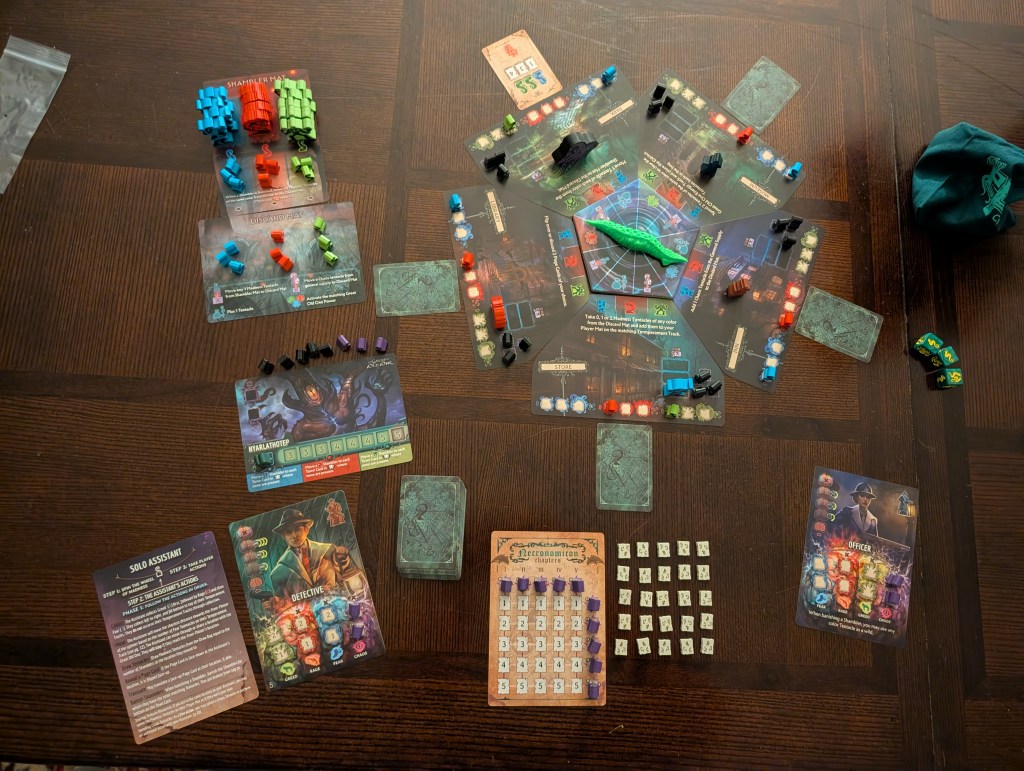
The main objective of TE Cthulhu is to work together with your assistant in a solo game, or other players in a 2+ player game, to defeat one of four different “Great Old One” monsters and lock them away before they become too powerful to contain. If I attempted to write out a fully detailed walkthrough of the rules of this game, my review would be about a dozen pages long; but a quick summary of how a game plays out would be:
- Set up the game with the wheel of madness spinner in the center of the play area, with five randomly draw town location cards spread out around it. Choose one of the four main bad guys to play against (they recommend Nyarlathotep as the easiest of the four, and not surprisingly Cthulhu as the most difficult). Each player chooses a character for themselves; the characters are all mostly similar, but each have one unique ability that can assist you during the game.
- Each players turn consists of a few different actions. They spin the wheel of madness, which can land on one of four different actions that range from moving tentacles around on the various gameboards, to activating certain powers of The Great Old One monster. Different tentacles can be drawn or moved around, additional enemies (called Shamblers) can be spawned, and then The Great Old one gets moved around the gameboard.
- Players then have the option to perform a limited set of actions. They can move around the gameboard, or collect tentacles from the gameboard to add to their player mats (which can increase the amount of damage, move distance, etc of each character in future actions). They can also banish Shamblers, or translate some of the 25 different pages of the “Necronomicon”, which is a required action to eventually move on to Phase 2 of the game to seal off the main baddie.
- Once all 25 pages are translated, Phase 2 begins where the players take turns moving around the game board to seal off all six portals and defeat the monster before it grows to be too strong.
The game is won by all players if all six portals are successfully sealed! However, there are numerous ways in which the players can take a defeat before this happens. If The Great Old One reaches the top of its strength track, or all Shamblers in the game are out in play at the same time with none remaining in the supply, or ANY one single player (including assistants) reach the top of their “Delirium” tracks and lose their minds, the players lose the game immediately.
The game has a solo mode, which works similar to a 2-player game, with the exception that the player is given an “assistant” that operates like a normal second player but without any unique ability. The player takes a turn for the assistant as normal, and the game provides guidelines for some of the decision making to keep a uniform set of outcomes each time a choice needs to be made on which tentacles to capture, etc.
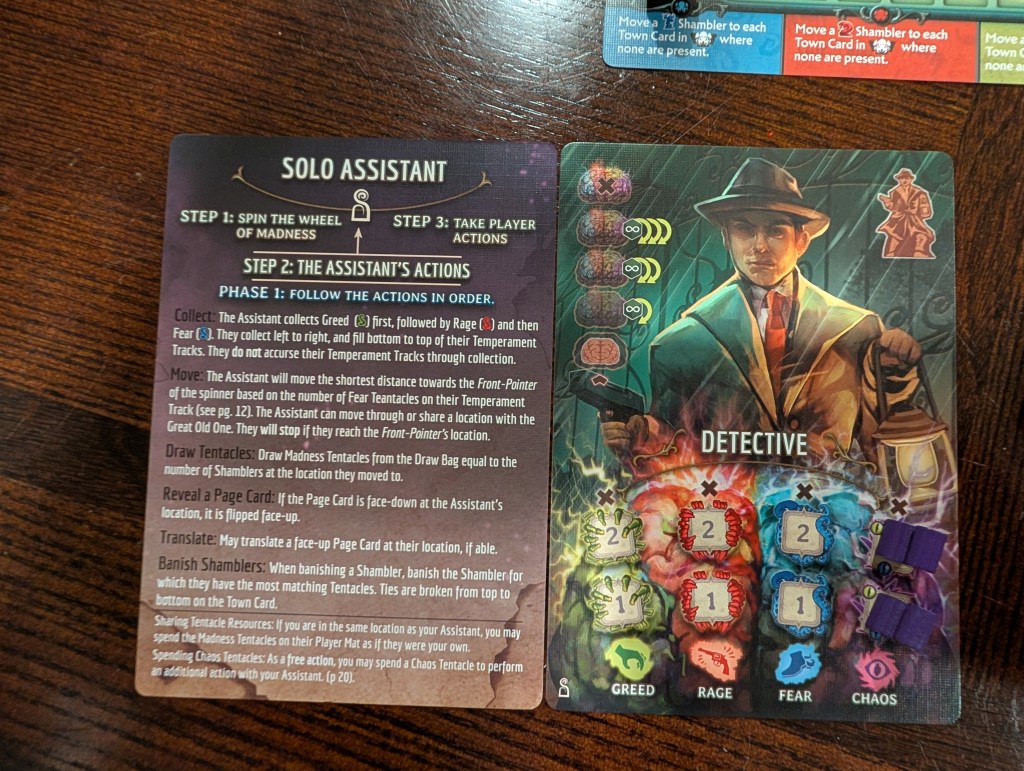
And now the part you’ve all been waiting for – an explanation for why I listed the player count as “0-4 players”. It turns out, rather than a typo by careless editing, this is indeed a thing that exists in this game…sort of. The rulebook explains this as playing with two assistants, but no actual player. But if you’re mentally picturing some magical robot arm that moves all of the pieces around by themselves as you shout with glee at the amazement in front of you – you may be a little disappointed. You still need to essentially take the turns of two assistant players at once by yourself, but it just removes all of the decision making from you throughout the game in terms of which actions each player takes. Neat gimmick, I like the creativity here, and it’s a great conversation starter to tell other gamers about the zero-player board game you have in your collection but in reality, I don’t see many people choosing this over a normal solo variant other than just once to try it out.
My Thoughts
Not to beat a dead horse, but even after writing all of the above and playing multiple times, I still just have to marvel over how a game so thematically deep and with such elaborate mechanics is pulled out of this tiny physical package. Combined with some seriously high-quality components, I find it hard to believe that anyone would be disappointed from this perspective.
I’ll admit that I’m less experienced in the Cthulhu/horror adventure genre than many of the folks probably reading this review, but as a normally light-medium weight gamer, Tiny Epic Cthulhu is probably pretty close to the top end of my “willingness to learn” range. After about the second full playthrough, it felt smooth to me, and I think from a gaming mechanics standpoint, the design is great. But I would definitely caution a hefty learning curve to anyone considering picking this game up. It’s not QUITE as complicated as the last small form factor adventure game I reviewed (Gloomhaven: Buttons and Bugs), but it’s definitely still up there, and probably something any purchaser should be aware of before buying. That all being said, the front cover of the game manual recommends downloading and using the free Dized app to skip the rulebook entirely, and this is about the best advice possible and I hope everyone who purchases the game gives it a shot. It’s worth it just for the easy, mindlessly smooth setup assistance alone.
One major thing I appreciated here is that this is a game where the solo mode played almost identically to the multiplayer mode, but more important, was every single bit as fun. This game should have a ton of appeal to a wide variety of gamers as a result – pretty much every player count (except for the gimmicky zero player mode) is a winner here.
My main gripe with the game is that I occasionally felt like I wished the game had a little bit more freedom in the design of the player actions available. I always felt immersed in the theme, but sometimes would just be hit with this feeling that my choices in the outcome were moving along a very narrow track. That is to say, I didn’t always feel like I had as much agency in how the game unfolds as I wanted, and sometimes almost felt like the choices made by a player were hardly different than those made by an “assistant” in the solo mode. You can alter the order in which you pull tentacles off of the board, and you can use your unique ability on occasion, but I often felt like there needed to be more choices available to me.
Verdict:
If you’re patient enough to deal with the high learning curve, and if you love adventure/horror games, you’ll almost certainly love Tiny Epic Cthulhu. It is an absolute wonder that this much theme and depth is packed into such a tiny box, and with incredibly high component quality to boot. Player choices can occasionally feel very narrow, but overall, it’s a wonderful entry in the genre.
Likes:
- A crazy amount of adventure gaming depth packed into a tiny box, that really lives up to the Tiny Epic name
- Everything about this game stays thematically deep and on-point, and will definitely please fans of the Lovecraft/Cthulhu genre
- I’m blown away by the quality of the whole thing; top notch components, and gobs of game design wizardry to make this all work together
- Plays just as well solo as it does with other players; clever design for the assistant
Dislikes:
- Despite the great Dized tutorial, this one still has a fairly high learning curve
- Takes up more table space than the box size might lead you to expect
- Limited player actions sometimes make this one feel like it runs on a narrow track
- Zero-player mode is a gimmick


 Rolling In The Meep
Leave a comment