

There’s no theme layered into this family game, but there are 52 marbles! Can a whole lot of marbles and a unique pattern-building mechanic make this a game worth playing? Let’s find out!
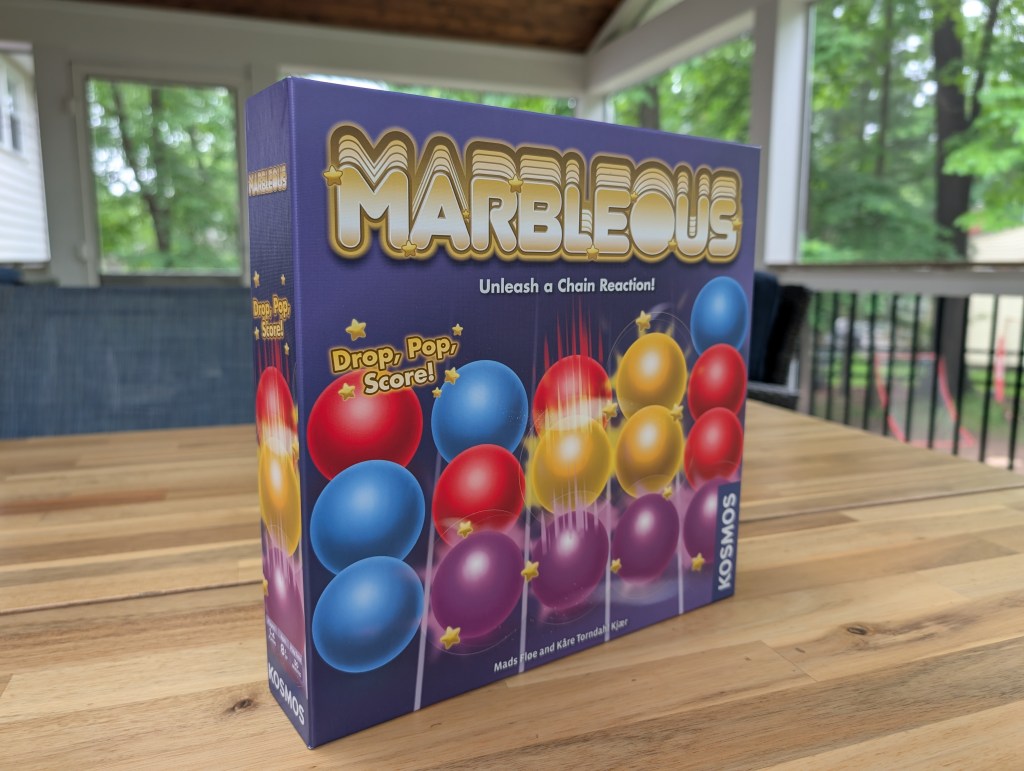
Game Name: Marbleous (2025)
Designer: Mads Fløe, Kåre Torndahl Kjær
Publisher: KOSMOS
Player Count: 1-4 Players
Playing Time: 30 minutes
Upfront Disclaimer: KOSMOS generously provided me with a copy of “Marbleous” for purposes of testing it out and writing a review. No compensation was provided and I am free to write whatever I want about the game. All opinions contained within are my own unbiased thoughts.
Game Overview
For some reason when I think of pattern-building games, my brain doesn’t start thinking about a list of board games, but rather a list of video games. Endless hours of Tetris, Dr. Mario, Super Puzzle Fighter 2 Turbo, and countless more were played for a considerable amount of time during my childhood, and still continue today. Sure, there are a plethora of great board games that use a pattern mechanic that I could list here: Sagrada, Azul, Cascadia, etc. But my mind always jumps to the video games first, and I can’t help it.
When the good folks at KOSMOS offered to send me over a copy of “Marbleous” to test out and review, their email about it was actually the first time I had ever heard of it – but it looked like it was perfectly in the style of games that I typically find myself wanting to review. I’ve got a good core group of adult friends that I like to game with, but as a household with two children (ages 12 and 9), I can never get enough of adding more family friendly games into our weekly mix.
Marbleous (a fun and creative name, that I manage to misspell every single time I type it until I go back and correct myself) is a new 2025 release from KOSMOS, who have a history of publishing some fairly great games over the years. The best way I can describe this game…it’s kind of like Connect 4 meets Tetris meets Snood, but with a more strategic scoring system added on top (be honest, how much did I date myself with the “Snood” reference?). And to my surprise, a solo mode added on top, which is not something I would have expected from this game.
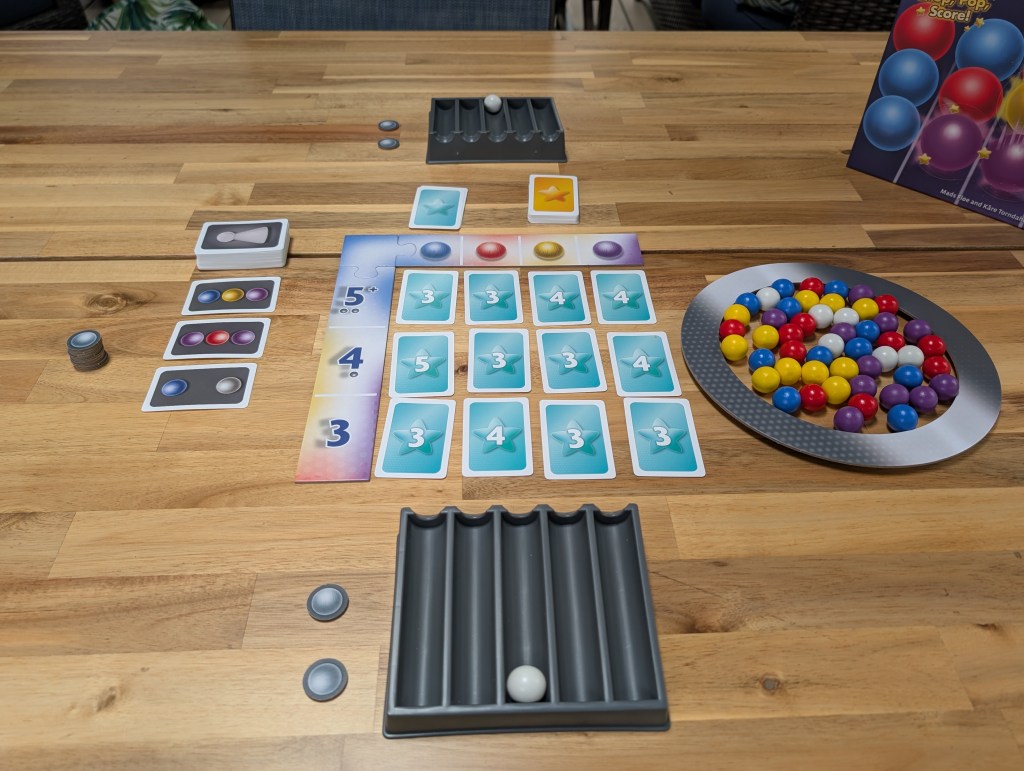
Without rehashing the entire rulebook, here is how a typical multi-player game of Marbleous works:
- The game is setup by laying out a 4×3 grid of cards on the table in the center, with the cards each showing a random number between 3 and 5, representing how many victory points each card is worth at the end of the game. The columns are each assigned to one particular color marble (blue, yellow, red, or purple), and the rows are labelled 3, 4, or 5. Each player is given a plastic tray that has 5 columns in which marbles can be stacked, with each column able to hold up to 5 marbles tall at any given time. They are also each given a special white colored marble, which acts as a wild marble that counts as any color. And lastly, each player is given two randomly chosen “bonus tokens”, which are small circular cardboard tokens that show one specific marble color on each.
- On each turn, players start by drawing one of 3 face-up marble cards, which show a picture of either 2 or 3 different marbles in order. For example, a card might show a yellow, red, and then blue marble in that order. Or it may show a white and yellow marble, with a blank space in the middle. The player who draws the card, then draws those colors from the pool of marbles on the table, and decides how they want to add them into their marble tray. They can be added vertically in either direction into one single column in the tray, or horizontally spread across any 3 different columns. The marbles must be kept in the same order as shown on the card, but the player can rotate it 180 degrees to choose which direction it faces, giving them a lot of control.
- After a player has added their marbles, they have the option to spend up to one “bonus token” per turn if they have any. Each bonus token shows a picture of one marble color; when they play that color, they can immediately grab one marble of that color from the supply and drop it in their rack into any column, provided there is still space (columns can be a max of 5 marbles tall each).
- Now, any completed sets of marbles are “popped” and scored. This happens by looking at the marble rack, and any completed set of 3 or more adjacent marbles is popped, in any order the player chooses if they have multiple sets to pop at once (but the popping is mandatory if they are touching, so they can’t be saved up for later). The marbles don’t necessarily need to be in a straight line, either – they can be “L” shaped or zig zag across columns, as long as they are touching directly to the side or above/below another marble of the same color in the chain (diagonals are not counted). So, let’s say for example a player has 4 connected purple marbles. They “pop” those 4 by removing them from their tray, and then they are allowed to take the point card on the board under the purple column that is in the “4” row. Removing these four purple marbles may allow other marbles in the rack to roll down and create new combos, which can be chained together to make huge scoring events!
The game ends once the marble cards run down and cannot be refreshed to show 3 cards at the end of a turn. Then played sum up the total of all points worth of marble cards they earned during the game, as well as how many remaining marbles/bonus tokens they have (and divide those by 3), and that makes up the total score for the game – highest score wins.
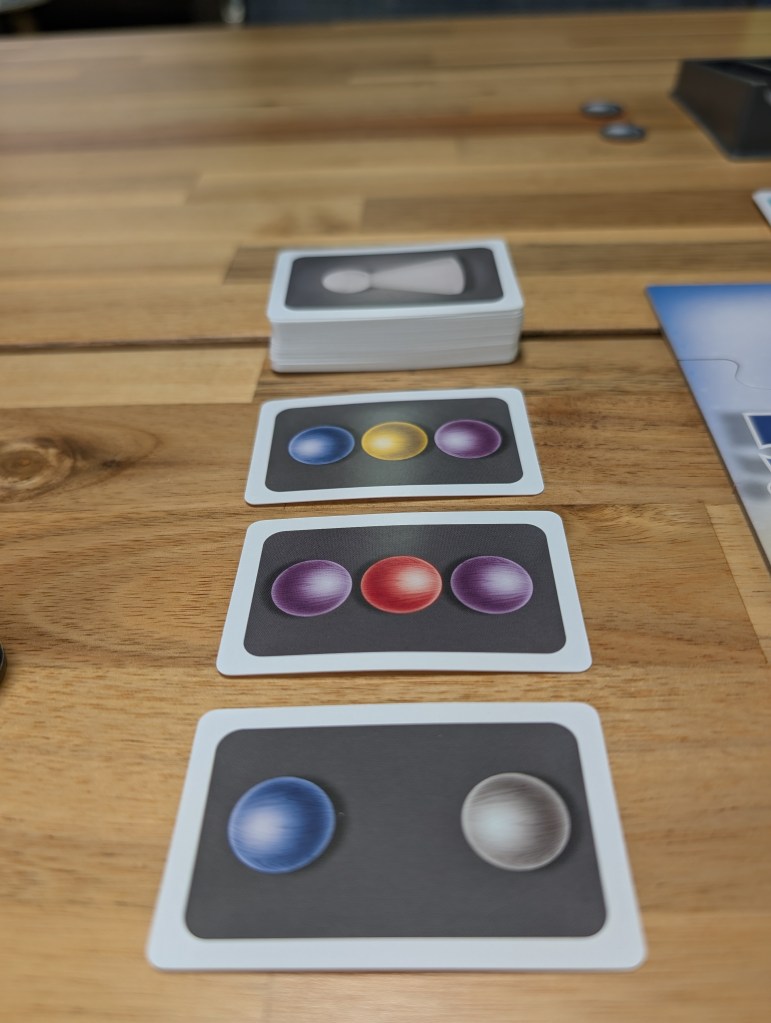
This game also includes, to my surprise, an unexpectedly great solo mode. The game is setup like a normal multi-player game, but adds on top a challenge whereby there are four special solo objective cards that are randomly ordered for each game, requiring the player to not only reach a certain number of points, but also to pop a chain of 4 or more marbles of each color in a specific order throughout the game to win. If the game is finished without completing these solo objectives, it is scored as a loss. Assuming these objectives are completed, the player must score either 60, 65, or 70 points throughout the game, depending on if they are choosing to play easy, medium, or hard difficulty before the game begins.
My Thoughts
With my kids in the house, I end up playing and reviewing a lot of family games like this. It’s not uncommon to play one, and only a few minutes in be hit with the thought of “I can see why younger kids might enjoy this one, but this is brutal to play as an adult”. How many times as an adult have you found yourself sitting through endless games of Candy Land, Sorry, or other family games where you have zero engagement as a player and find yourself wondering, “why does it seem so hard to make a game that is actually enjoyable for kids AND adults?”. But then occasionally, you finally come across a solid one that is actually fun for EVERYONE playing it, and it just feels like a revelation. I’m very happy to say that Marbleous falls very solidly in the “fun for everyone” category. In fact, I would easily recommend this one to a group of adults to play as a light game to open a gaming night or just for casual fun.
This is a game where you can take it easy, build up stacks of marbles, and just have fun being surprised what pops. But it’s also a game where you can inject a surprising amount of strategy into your decision making, which I greatly appreciated. Sure, you’re subjected to the luck of the draw with which three marble cards you are able to choose from when it’s your turn – but you can really put together some impressive combos of popping marbles if you carefully plan out how different stacks will fall as you pop them in specific orders.
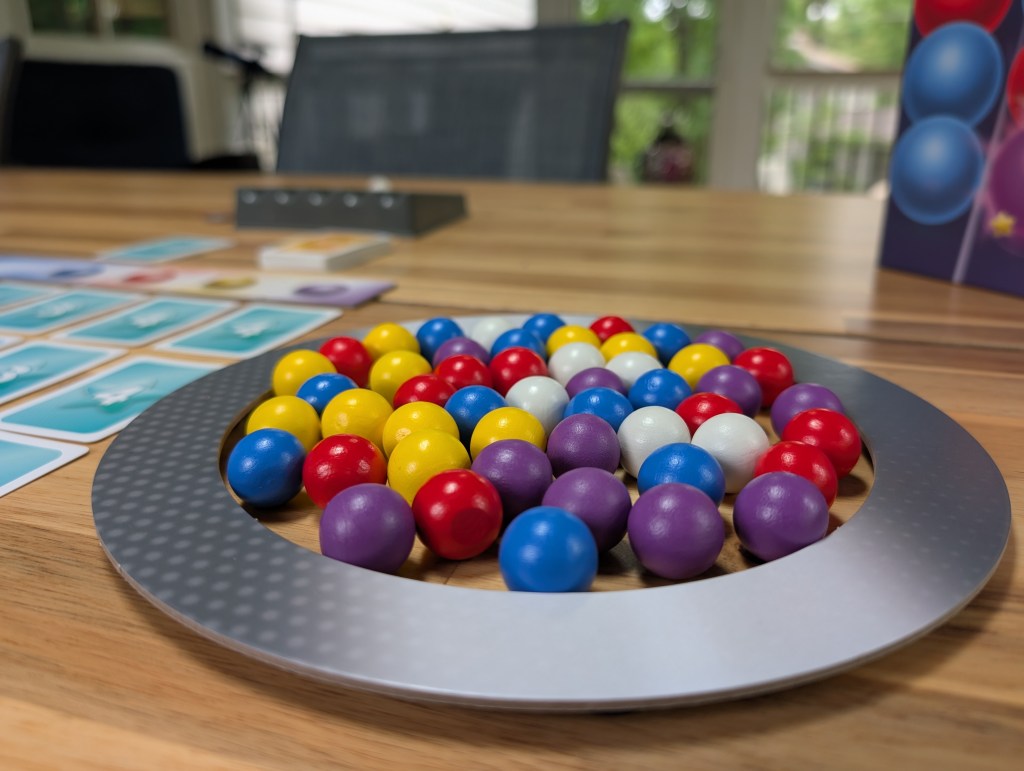
Also…the solo mode, which almost zero games in this genre have at all, is REALLY well done. This was hands down the biggest surprise for me with Marbleous. I try to test games out at all player counts before writing a review, and that’s probably the only reason I even bothered trying it out in this game. I sat down to play one round to test it…two hours later, I was still sitting there reloading a new game as soon as I finished another one and playing it over and over. It would have just been a ho-hum “play the game, measure your score against some rubric to see if you did great or poorly” solo game, except the concept of having to pop certain 4x chains of marbles in certain colors in order as you play really adds another layer to the game. It goes from a mindless point salad to what feels like a clever brain-teasing puzzle. I need to carefully build chains of marbles to pop…while also being cautious of how many turns I have remaining to ensure I can complete all four objectives in time.
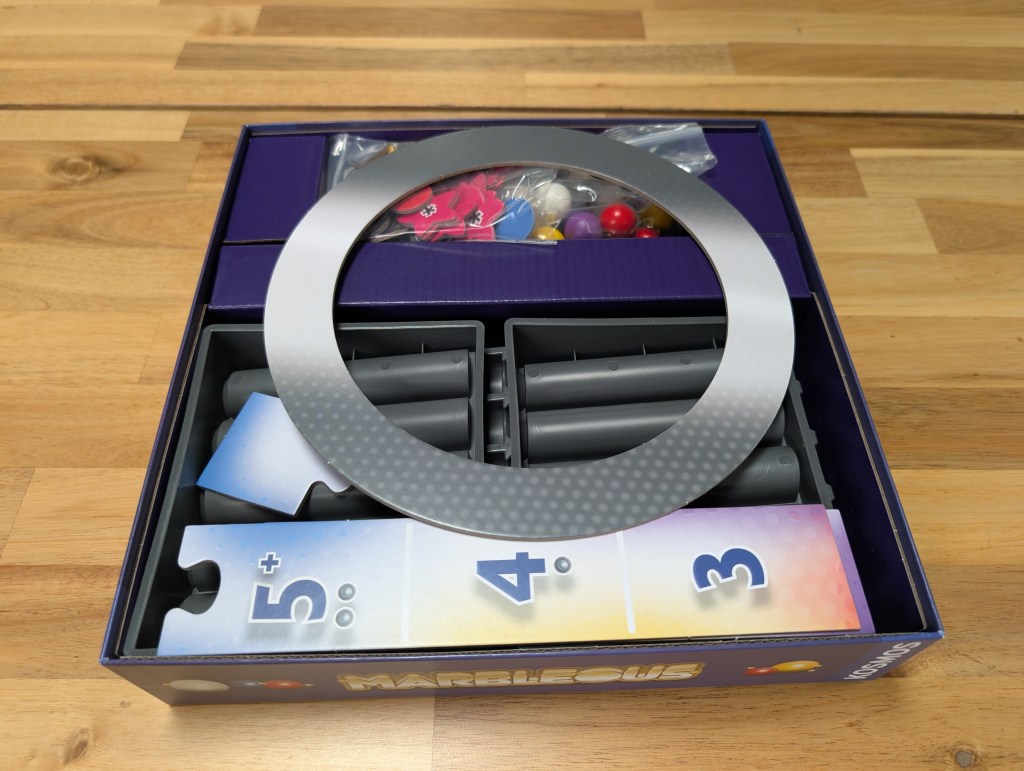
The dislikes are few and far between. If I have to get nitpicky, one thing that I didn’t love is the box itself. I was going to complain about the box art on the front of the box being a little too plain, but it actually grew on me after staring at it for a while – it’s colorful and has kind of a retro feel to the fonts used. But I did find that the built-in box organizer wasn’t very efficiently designed to hold the game pieces, and even though the box itself is way more than big enough to hold everything, it’s actually quite annoying to properly fit everything back in to get the lid to close all the way. I’m no packaging engineer, but there is clearly a way KOSMOS could have made the box smaller and STILL found a way to fit everything inside better than it does right now. My only other suggested change, would be to make the marble trays a tiny bit taller so you could fit 6 marbles tall into each column, and maybe offer this as a rule variant to make the game a little more open to building up massive, game breaking combos. I found that 5 columns wide were sufficient, but had plenty of opportunities where allowing me to go a little taller would have let me really come up with some huge moves in the game.
Verdict:
A fun, engaging family game that is extremely enjoyable even for adults, a very rare thing! With a wonderful solo mode as well to really boost the value of the game. KOSMOS has a winner on their hands!
Likes:
- Fun, colorful, easy to teach family game that offers a surprising amount of replay value and remains fun even for adults
- Chaining together multiple sets of combos in the same turn is a GREAT feeling that will keep players coming back
- Solo mode is quite fun, and feels like a great strategic brain teaser
Dislikes:
- Box design actually makes it a little tough to get this game completely back in the box after playing
- I kinda wish marble tray columns were one marble taller; it would allow for more opportunities to create huge combos





 Rolling In The Meep
Leave a comment