
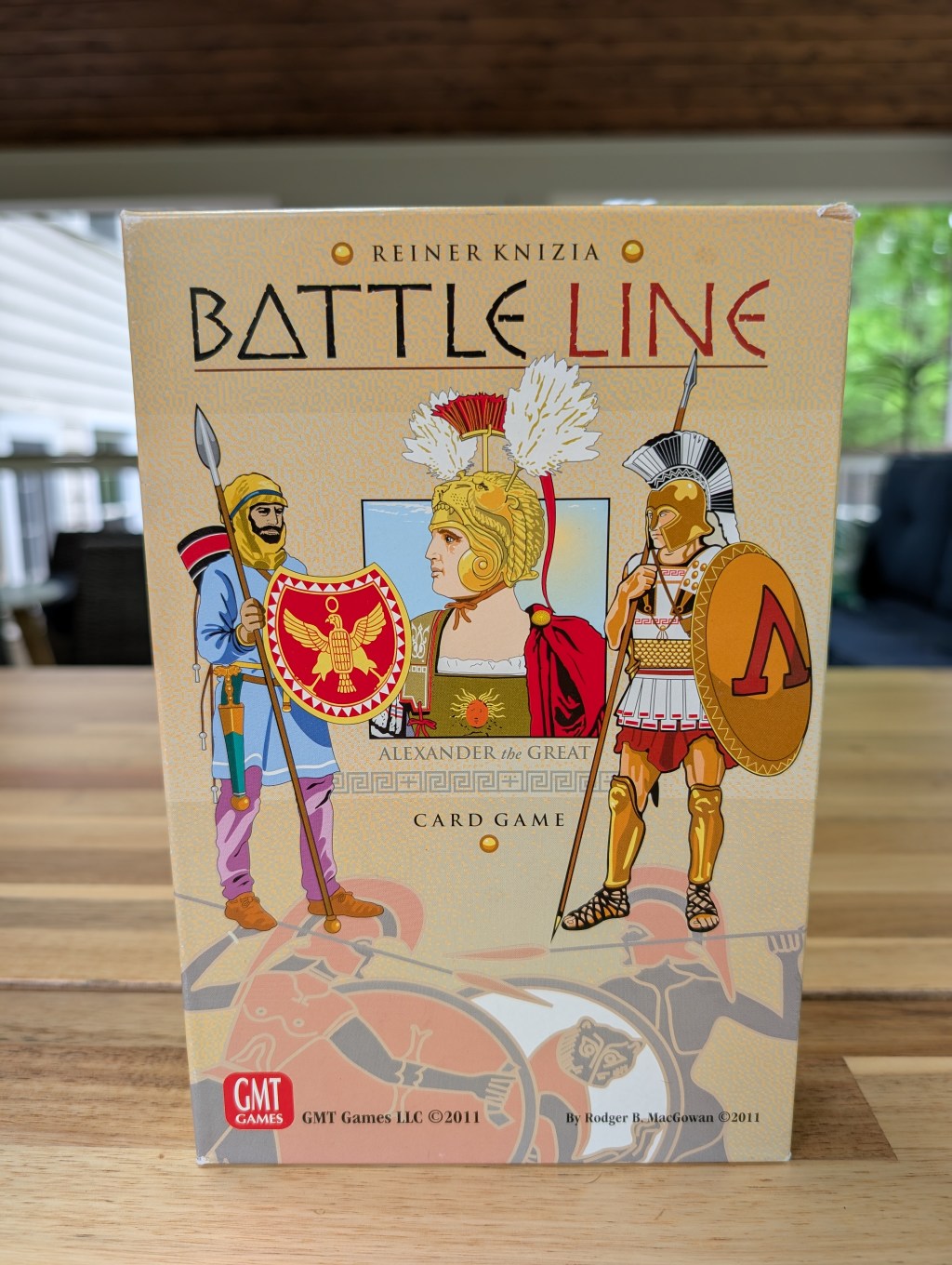
Game Name: Battle Line (2000)
Designer: Reiner Knizia
Artist: Roland MacDonald, Rodger MacGowan, Mark Simonitch
Publisher: GMT Games
Player Count: 2 Players
Playing Time: 30 minutes
Upfront Disclaimer: I purchased my own retail copy of “Battle Line”. No free copy was provided for review, and I’ve had no contact with the publisher regarding this game. All opinions contained within are my own unbiased thoughts.
Game Overview
I’m a sucker for a good two-player-only game; for whatever reason, it seems to a format that has just worked well for me over time, countless “duel” games that I’ve enjoyed over time make up such a large part of my board game collection. I honestly don’t even remember how I originally heard of Battle Line, but it has been on my shelf for close to 15 years now and has made countless dozens of trips to the table to be played.
Recently, over the course of doing research for another game I was reviewing, I ended up on the Board Game Geek page for Battle Line, and was surprised to find how many opinions of this game seem to hit the extremes of either singing its praises or absolutely hating it. It’s a game that I’ve spent a considerable amount of time playing, so despite it being a quarter of a century old at this point, I thought I’d add another review onto the pile.
So, what is Battle Line? It’s a two-player card game from Reiner Knizia, with a light (nearly non-existent) Ancient Greek theme to it. The best super short way to sum it up to someone in one sentence: it’s basically playing a one-on-one poker game, where each player is playing 9 different hands against each other at the same time. You are battling your opponent to see who can control each of 9 different “flags”, which are controlled by playing a better poker hand behind them than your opponent can muster. And you have two ways to win this extended game of poker: you can either be the first to win 5 of the 9 flags and win by majority, or you can try and strategically win any 3 adjacent flags and win by what the game calls “breakthrough”.
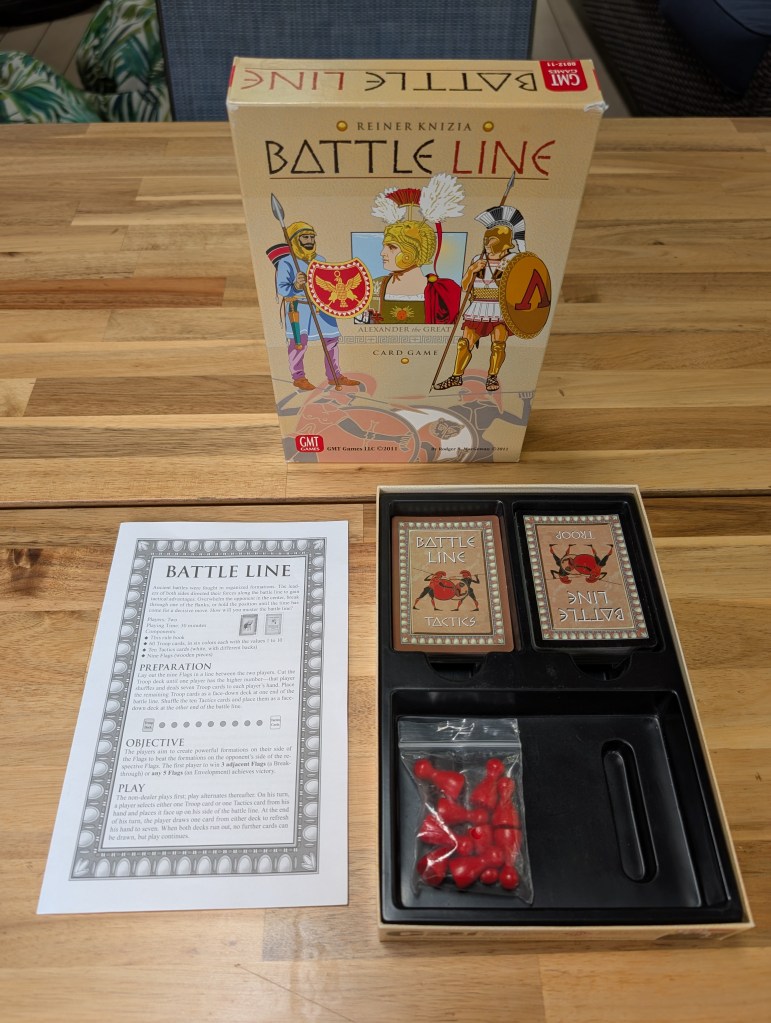
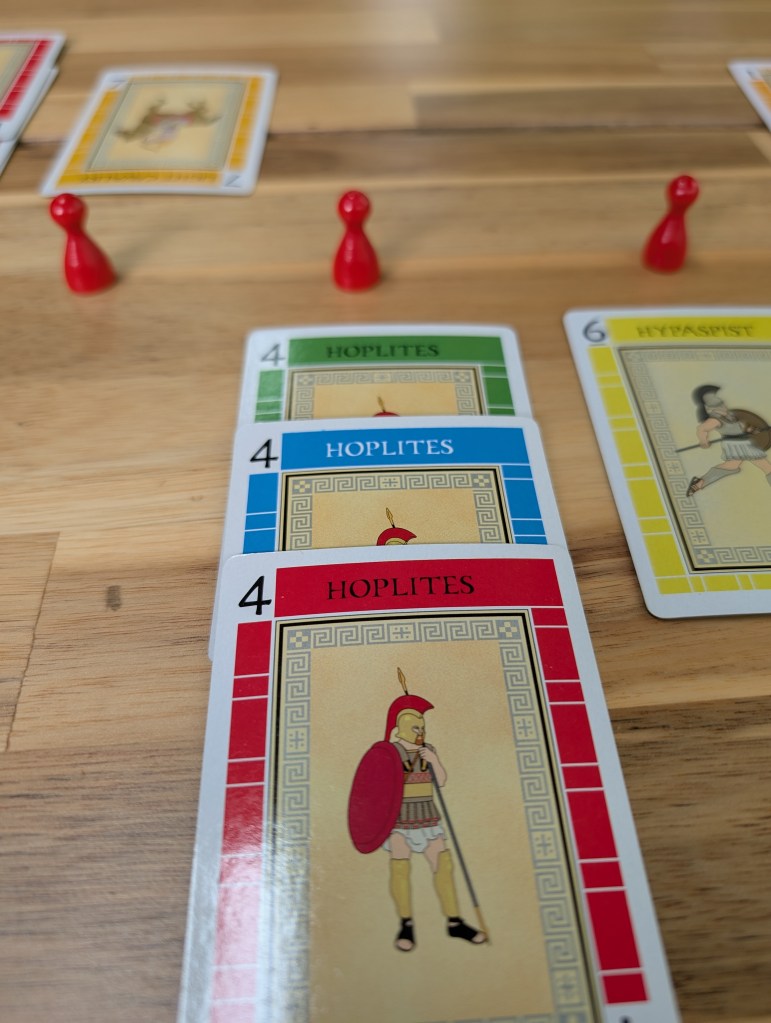
Crack the lid of the box open, and there isn’t much to it – the box contains 70 standard sized playing cards, 9 little red wooden “flags” that kinda look like miniature chess pawns, and a set of instructions that is essentially just one folded in half standard sized sheet of paper that looks like it was just fired out of a standard laser printed and thrown into the box. The cards are very basic – they have a very glossy feel and appearance, and just feel…average. If you’ve ever bought a standard deck of Bicycle-brand playing cards at a convenience store, that’s about what you’re getting here. The nicest component here are the little flags – they are at least made out of wood, painted in a nice appealing color of red, and have held up admirably over the decade and a half I’ve owned the game. But, to sum this all up – you’re probably not buying this game to show off the beautiful components inside the box. They’re fine, they’re functional, they get the job done, but there is nothing remotely premium here.
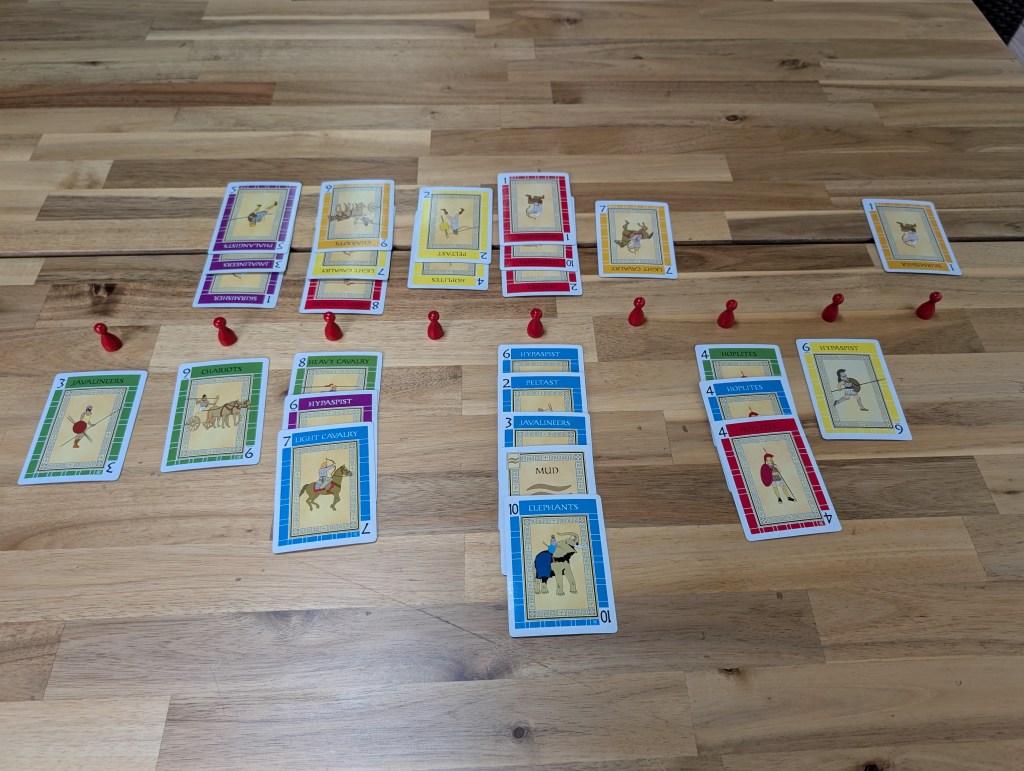
So, without a full reciting of the rulebook, here is how a game of Battle Line is played:
- Nine wooden “flags” are lined up between the two players, and each player is dealt 7 “troop” cards. The deck contains 60 troop cards, which are comprised of six different colors of cards, with each color containing the numbers 1 through 10. The remaining 10 cards in box are called “tactics” cards, and these are shuffled and placed face down at the other end of the troop line.
- Play is very simple – on each turn, a player selects one troop or tactics card from their own hand of 7, plays it face up on their side behind any of the 9 flags in the battle line, and then ends their turn by drawing a card to get their hand back up to 7, from their choice of either the troop or tactics deck.
- Each of the flags is resolved by essentially playing a 3-card poker hand against it, and the strength of each hand is nearly identical to how normal poker hands work other than factoring in that only 3 cards get played (a flush beats a straight, a three of a kind beats a flush, but a straight flush beats a three of a kind). You don’t necessarily need to wait until both players have played all three cards against each flag – you can actually claim a flag if you’ve played your three cards against it and can prove based on all cards showing that your opponent couldn’t possibly beat you (or at best, could tie you).
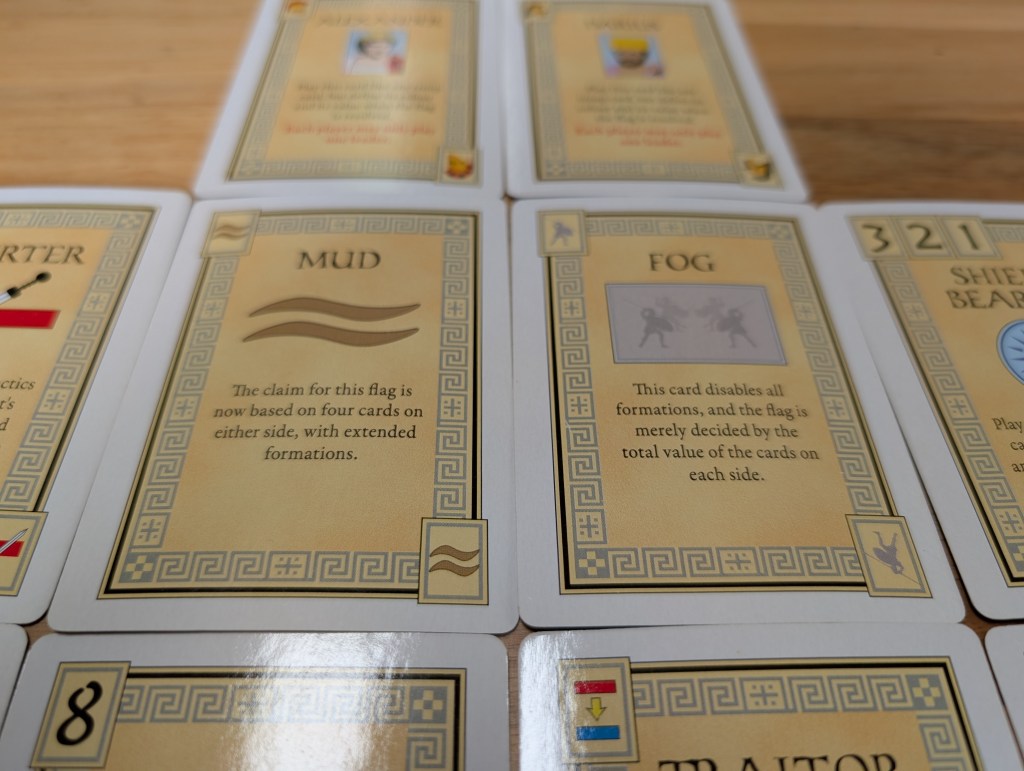
- Both players are allowed to play “tactics” cards, some of which act as wild cards, others let you change how a flag is scored (4 cards instead of 3, highest total wins, etc), let you move cards from one flag to another, etc. The catch with tactics cards though, is that you can never play more than one more tactics card than their opponent. So if you’re the first to play one, you can’t play anymore until your opponent has decided to play at least one.
- The game ends once one player has either captured 3 adjacent flags, or any 5 flags in total.
So that’s essentially the game – you’re taking turns playing 9 poker hands at once, being strategic about which flags to play towards, and what kind of hand strength you want to put on display for your opponent. One important mention – the tactics cards are super powerful, but you’re limited to only being able to play them if your opponent is also doing the same. And more importantly, unplayed tactics cards are not considered when proving that your opponent cannot beat you on a certain flag, allowing you to claim it for yourself. Your opponent may have that “Alexander” or “Darius” wild tactics card in their hand, but until it’s actually played, you can rush to finish your hand at a certain flag and claim it if you can prove from the other cards showing that they couldn’t beat you otherwise. The rules include an “Advanced” modifier you can play with, which says that flags can only be claimed at the beginning of your turn, rather than as soon as you can prove you can claim the flag – but I actually find this removes some of the strategy from the game and introduces a little extra luck – I wouldn’t recommend playing with this, because it actually negates some amazing strategic plays throughout the course of the game.
My Thoughts
Where do I weigh in on this one? Well…I love it. I still remember finishing my first round of this game years ago and remarking with my opponent how fun of an idea it is. This game is meant to be a no-frills, basic, get it on the table and start playing within 30 seconds type of game. Most people know how poker works, and have a general idea of the strength of poker hands – and that’s pretty much all you need to know to get cranking here. One of the things I love most is how this game plays out with a slow burn – you can only ever have a max of 7 cards in your hand at one time, and each turn you MUST play a card out face up – so what typically ends up happening at the beginning of games is that both players are spreading their cards out all over the place rather than playing multiple cards against the same flag. And unless you luck right in to being dealt all three cards of a fairly high straight flush, you’re going to have to take your chances on flags without having the final card to complete a nice 3-card hand.
The concept in the rules of being able to claim a flag once you’re able to prove that your opponent can’t beat you (tie at best) is what really makes this game shine tactically. It’s a key element that dictates exactly when you might decide to play your third and final card at a certain flag – and often times, it comes by your opponent playing a card at a flag that they didn’t even realize would allow you to prove your victory at a totally different one. Games can take as little as 10 minutes, or as much as 30 if people really put a ton of thought into every single move.
The tactics cards also really are a wonderful bit of game design. You have a hand size permanently limited at 7 cards, so the act of deciding to draw a tactics card means that you will have one fewer normal troop card saved in your hand at any one time. You may get a great tactics card that you want to immediately play, but you may also draw one that doesn’t provide you any immediate help. And playing it just to get it out of your hand is risky, because that might open you up to a situation where your opponent knows you can’t play any more of them because you’ve played one more than they have. But sometimes, that feeling of playing just the right tactics card, at just the right time, gives the sweetest sense of victory. You can sense your opponent is about to play a really nice straight flush with a couple of lower cards, and suddenly you bust out the “Fog” card on that flag before they complete it, which changes the rules of that flag to just be determined by the total value of the cards on each side, putting them at a severe disadvantage.
And not just that, but also, the rules for victory add another level of depth to the game that sound simple on paper, but really change your thought process as you play. It’s possible for you to win more flags than your opponent, and still manage to lose the game, if you’re not careful to protect from allowing them to win 3 adjacent hands. Even when things don’t seem to be going your way at first, you always have that last hope of just focusing on the right segment of the battle line, and trying to catch your opponent off-guard to grab 3 in a row before they can win their fifth flag.
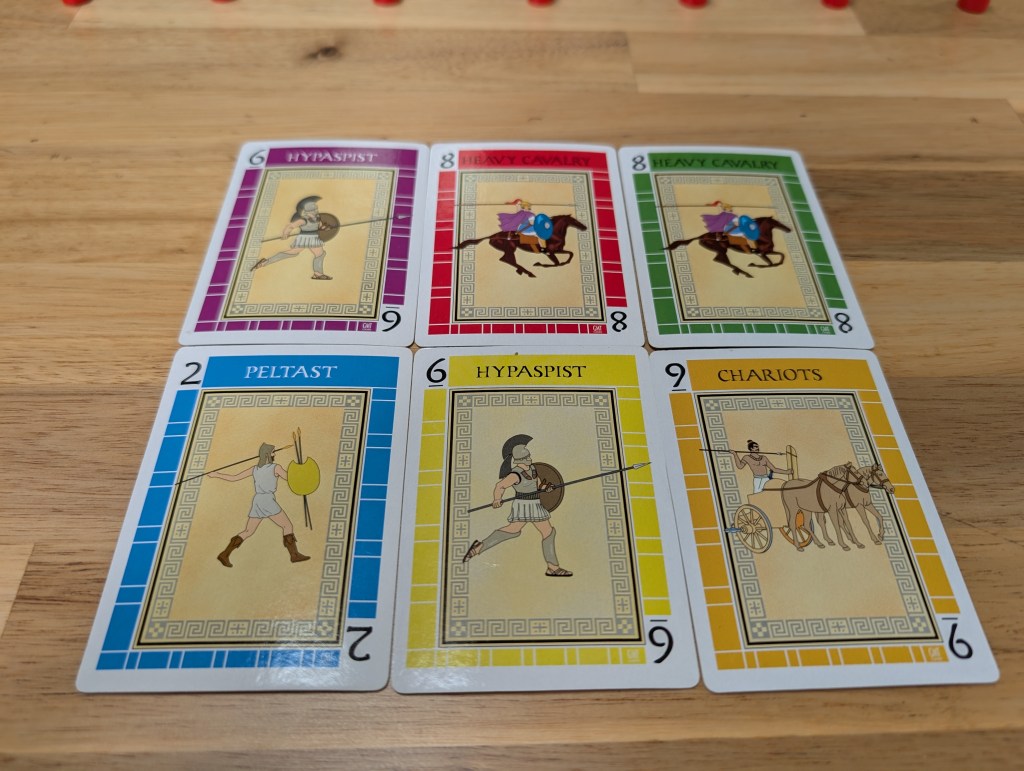
But of course, there are some flaws to the game that are worth mentioning, no matter how much I enjoy the actual gameplay. Let’s start with the physical; as I mentioned earlier in this write-up, the components are very cheap. It’s just a deck of 70 cards, with fairly dull artwork that doesn’t even seem like a wholehearted attempt to count as a theme. There are six colors to the cards, and because of the dull printing, it’s often times very hard to tell the orange and yellow colors apart, even with 20/20 eyesight I still manage to get them confused sometimes when playing without the best lighting. They bothered to give each of the different numbers a position title – for example 1 is a “skirmisher”, while the number 4 cards are “Hoplites”. They even gave ancient tactical formation names to the different hand strengths; a straight is actually called a “skirmish line”, and a three of a kind is a “phalanx”. You won’t remember any of this as you play, or really end up paying much attention to the dull art. It’s a half-hearted attempt to dress up a genius bit of game design with the minimal amount of theme to get it to market. But the main physical problem worth mentioning isn’t the components in the box…it’s the actual box itself. It’s unnecessarily huge for what it contains, and I really hate it when games do this. You could legitimately fit two of this game, maybe even closer to three, inside this same box size. Why do companies do this?! I assume it’s to gain a little bit of extra appeal when sitting on a shelf for sale, but it really sucks when you bring it home and have to store it somewhere.
As for non-physical flaws; the bickering I have been reading in other reviews about this game bring up a somewhat valid point: this is a rare game where having to be the first player to act is actually somewhat of a disadvantage, at least in the earlier part of the game. I can see that potentially being frustrating to some players – a lot of the games I’ve played, the first player plays at a flag, and then the second player just immediately plays a slightly higher card at that same flag. In all honesty, once both players have a ton of rounds under their belts, I do think that this disadvantage tends to go away as people get more creative with their strategy. But it’s certainly a real concern that most beginners will face for the first few rounds, and I can see how it feels like a turnoff.
Verdict:
It’s not without its physical flaws (get rid of the overly gigantic box), but at the end of the day, I still find Battle Line to be a stroke of genius in the realm of lightweight game design. Reiner Knizia knows what he is doing it seems, and this is a 2-player game that I’d recommend almost anyone to add to their collection, flaws and all.
Likes:
- Genius “slow burn” to how the game play unfolds as each new card is played
- The rules are so simple, and yet bury within them the most perfectly designed mechanics
- Tactics card system allows for some wild mid-game swings
Dislikes:
- Unnecessarily large box is just a shelf-space waster
- For beginners, going first acts as a bit of a disadvantage (negated once players are more familiar with the game)
- While they’re sufficient, I do wish the quality of the cards themselves were a bit higher, and that the orange/yellow colored cards weren’t so hard to distinguish



 Rolling In The Meep
Leave a comment