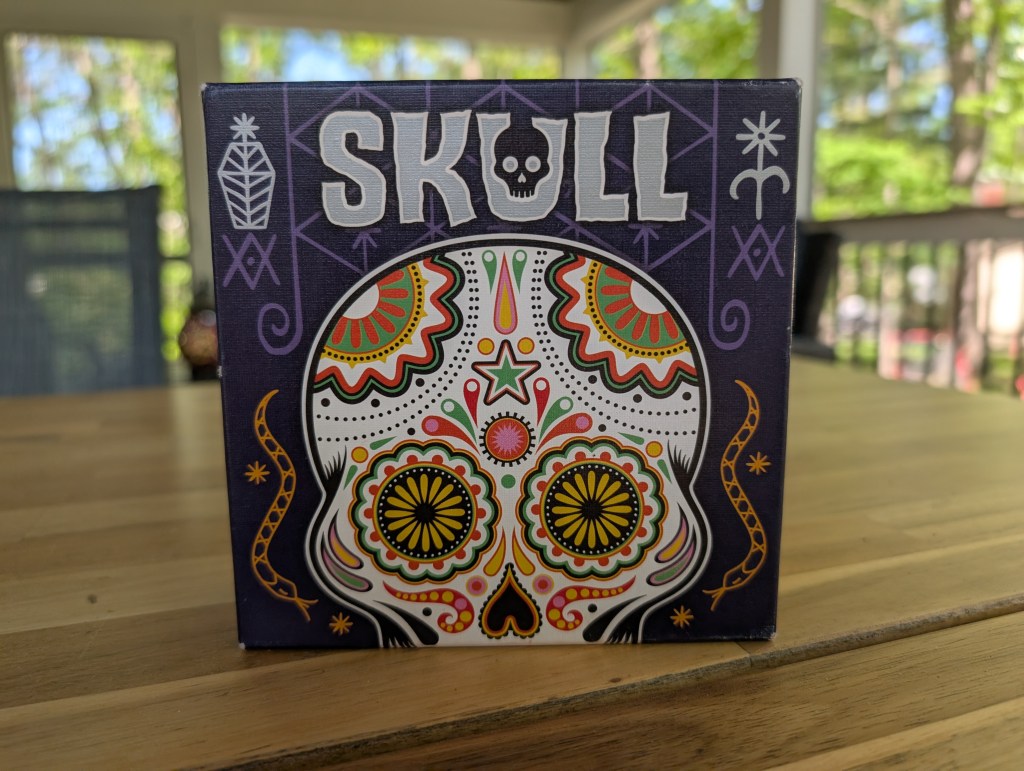
Game Name: Skull (2011)
Designer: Hervé Marly
Artist: Rose Kipik, Thomas Vuarchex
Publisher: Lui-même
Player Count: 3-6 Players
Playing Time: 15-45 minutes
Upfront Disclaimer: I purchased my own retail copy of “Skull”. No free copy was provided for review, and I’ve had no contact with the publisher regarding this game. All opinions contained within are my own unbiased thoughts.
Game Overview
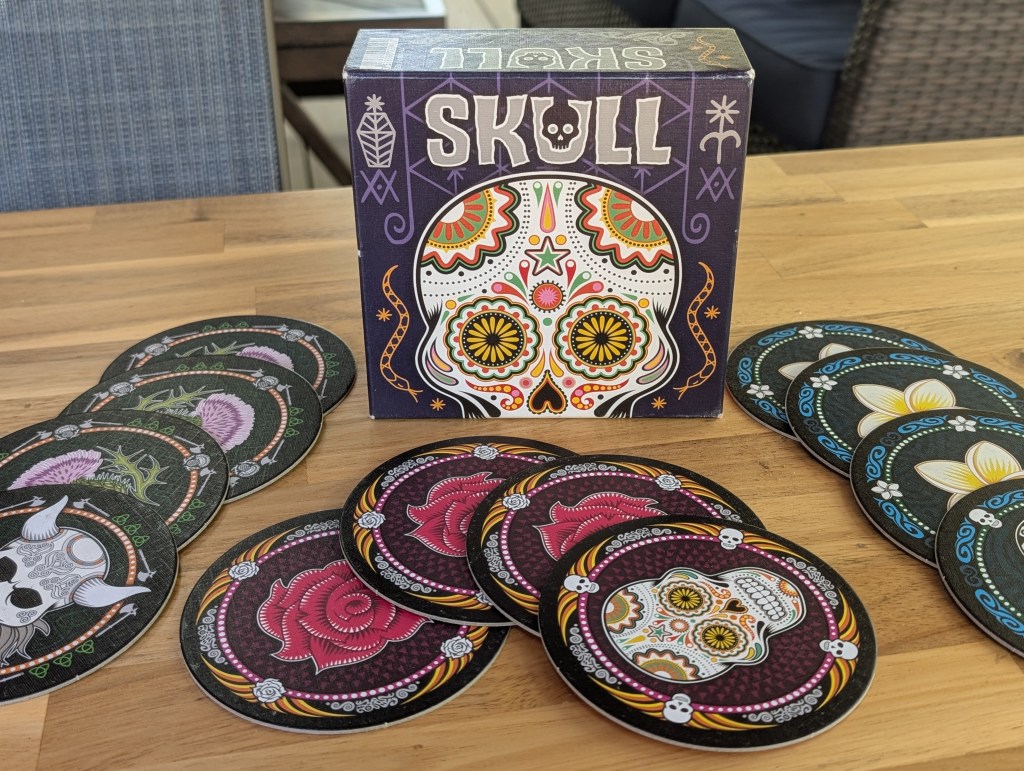
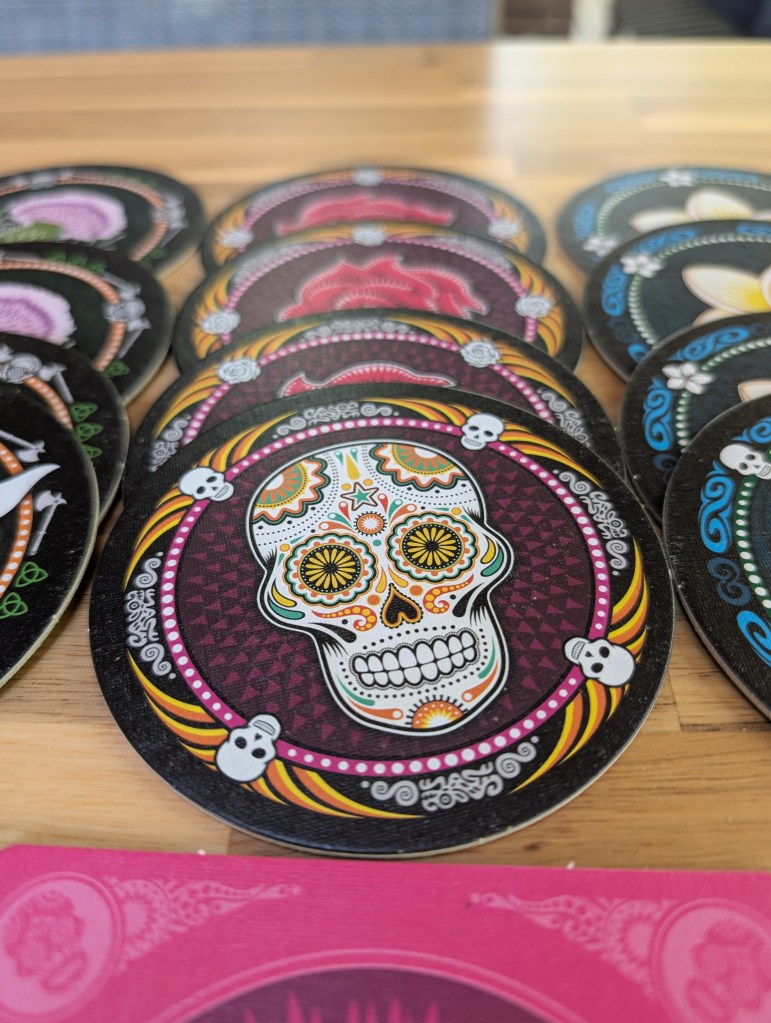
I first heard about Skull while on a trip to a cabin with a group of friends; someone brought the game along and advertised it to us as a quick-to-teach, quick-to-play party game that was great for a group. Out to the table comes a fairly small box, roughly 5”x5”x2” in size, adorned with some very colorful “Day of the Dead” style artwork. Open the lid, and there is surprisingly little to the game: 24 different thick cardboard circular discs, six slightly larger square cardboard playmats, and a tiny rulebook that looks like it would take 30 seconds to read cover-to-cover.
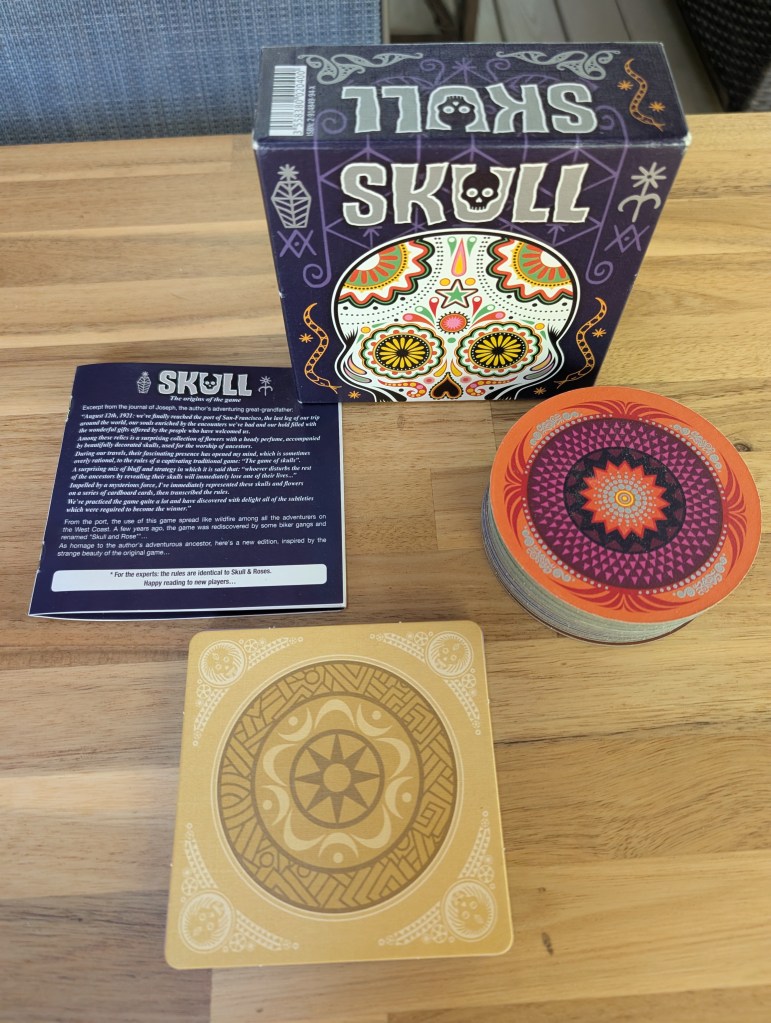
The rulebook starts off with some backgrounds about the origins of the game – it apparently originated from an idea someone had while on a sailing trip around the world back in 1921. Players who have the misfortune of revealing a Skull will “disturb the rest of the ancestors”, immediately resulting in losing one of their lives in the game. You’re probably not picking this one up for theme – I’ve been playing this game every now and then over the past decade, and the first time I heard any of this was when I decided to go through the rulebook with a fine-tooth comb before diving in to write this review. But don’t let the lack of theme dissuade you; what Skull lacks in theme, it more than makes up for with the gorgeous artwork. Enough so that no matter how many times I’ve seen the game in front of me, I still find myself almost mesmerized by the different designs on each players’ components.
If you don’t enjoy bluffing – and I mean REALLY love to bluff people – I’ll save you the time, you can stop reading the rest of this review, Skull just isn’t for you. This simple game is a minefield of mind games that you need to be willing to engage in with everyone else at the table. There is a ton of luck involved too; but at the end of the day, it almost feels similar to playing a game of poker. You need to be creative; you need to convince others that you are playing in ways that you really aren’t, and you need to be able to read other players and try and figure out who is lying and who is really going for it.
Here is a brief overview of how the game works, although it is so simple in procedure that you could basically play the whole thing just from these bullet points:
- Each player is given a dual-sided playing board (which also doubles as a win-tracker), and four circular cardboard discs. Three of these discs have a colorful drawing of a flower on one side, and the fourth disc has an image of a skull (the back side of all four discs have bright designs in the players’ color and all look identical until flipped over).
- Play starts with one randomly chosen player, and that player picks one of their four discs (either a skull or one of the flowers), and places it face down on their player board. All other players, moving clockwise, do the same and place one disc of their choice face down in front of them.
- After everyone has placed a disc and play returns back to the starting player, that player can either play an additional disc face down on top of their first disc, or they can issue a “challenge”. If they decide to play a disc, play keeps continuing clockwise until a player either cannot or does not want to play a disc and decides to issue a challenge. A challenge would be, for example, “I can flip over two discs”. Once a player has issued a challenge, the next player clockwise has two choices: they can either “pass” and decide to sit out, or they can issue a higher challenge (for example, “I can flip over THREE discs”). The challenge must be one disc higher than the previous challenge (but you can raise it even further if you want). This process continues until all players have passed except for the highest challenger.
- So once a challenge has been decided on (for example, “I can flip FOUR discs”), the player who issued the challenge must begin by flipping over all of their own discs one-by-one starting with the top disc and working their way down. Then they can choose discs placed by anyone else, starting with the top, and flip those as well, from any player they like. If the challenge flips over all flower discs, they win the challenge, But if they flip over ANY skull disc (their own or any other players), they immediately lose the challenge and stop flipping.
- If the challenger loses the challenge, they lose one of their own four discs at random for the rest of the game (the disc is removed at random, but none of the other players know whether a flower or a skull was lost). If the challenger WINS, they flip their play board over to show that they won a round and a second round is played.
- Any player who loses all four of their own discs is immediately out of the game. The game ends once a player has won two rounds.
Despite the very basic mechanics of playing, the strategy here is very deep, and ultimately ends in tons of laughs and surprise at the table. The fact that you need to flip over all of your own wagered discs (in order) first, means that you can get hit with a huge penalty if you try to goad someone else into bidding too high, but end up with the highest bid, knowing you’ve already guaranteed a failed challenge for yourself. And then the fact that each failed challenge means you’ve lost a disc at random for the rest of the game – other players won’t know which one you’ve lost, but it’s pretty brutal when you lose your skull early and can no longer trick anyone else into losing.
My Thoughts
This is one of those games where I think it shines the most when it’s played with the right group, at the right time. It’s simple enough that you could get any group of people, even with younger children, up to speed on how to play it in about 90 seconds or less. But it just doesn’t feel right as a family game with kids, much in the same way that playing poker with younger kids for fake chips doesn’t really hold attention for very long. On the other hand, break out Skull at a game night with friends, or as a really light game at a party, and it is perfectly up to the task.
One of the most fun things Skull has to offer comes in the form of just an incredibly enjoyable bluffing mechanic. Sure, you can play it very cautiously, lay your own skull out there early and just go into the challenge bidding process knowing you’re going to pass immediately and hope someone else flips your skull and loses – but in practice, you probably won’t want to do that. Peak enjoyment for me comes in really making a show of wanting to be the highest bidder in the challenge, then acting begrudged when I finally have to pass, only to have an opponent flip my very top disc and find themselves with an unexpected skull to ruin their day.
Sometimes later in the game, after multiple players have lost a disc or two each, it’s also worth taking huge risks on flipping just to figure out if your opponents have lost their skull and only have flowers remaining. If you have an opponent with only two discs left, and they’ve placed them both face down, you can find a way to challenge and flip both of them over. If they’re both flowers, you know you can always flip their discs as part of any challenge and never run into a problem.
I don’t think I’ve had a single situation where this game has hit the table with friends, where a good time wasn’t had by all who play. It can be played with as few as 6 people, but the more players who join, the better the game. The physical game box is very small, and it doesn’t take up a lot of table space either, so you can bring Skull almost anywhere. Throw it in a suitcase, carry it with you to play while waiting at a restaurant, play it in a hotel lobby, set it up on a picnic table at a barbeque, etc. It’s almost a guarantee that if you have the right group to play it with, that it’ll end with laughter and good times by all at the table. It seems so simple to just win two quick rounds of this game, and yet, it’s so incredibly difficult (but satisfying) to pull out a victory once players begin permanently losing discs.
Verdict:
Skull gets a very high recommendation from me for being played with just the right group of friends – it’s simple but fulfilling. The components shine with excellent colorful artwork, and it’s a game that I always enjoy teaching to new players. The larger the group, the better!
Likes:
- Bright, colorful artwork really shines
- One of the simplest, yet most fulfilling bluffing mechanics in any party game
- Comes in a very tiny box, and takes up very minimal table space to play, so it works almost anywhere
- One of those games where you’ll never need to read the rulebook twice because it’s just so straightforward to teach and play
Dislikes:
- Really needs 4+ players to shine (it’s not as interesting with only 3 players)
- Not very engaging as a family game with younger kids, works much better as a party game


 Rolling In The Meep
Leave a comment