
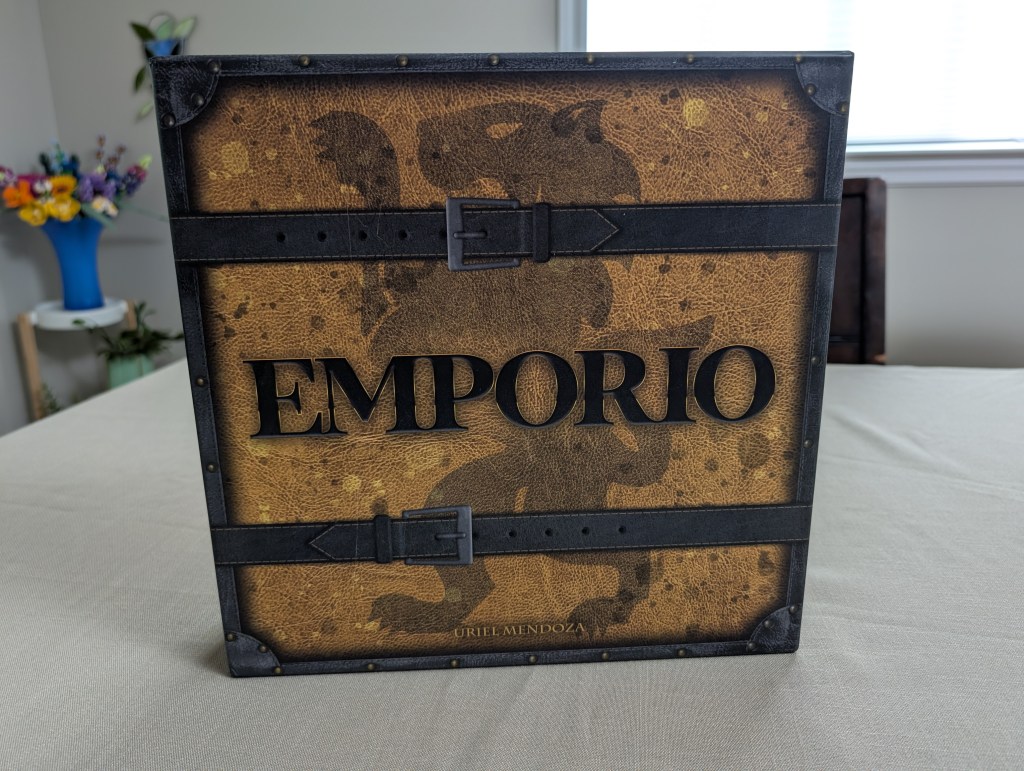
It’s the Medieval ages, and legend has it that the person who beholds 12 precious diamonds will have the power to forge the Emporio Crown. You need to carefully outwit, outfight, and outmanage your rivals to gather the diamonds as quickly as possible and secure your legacy. Welcome to Emporio!
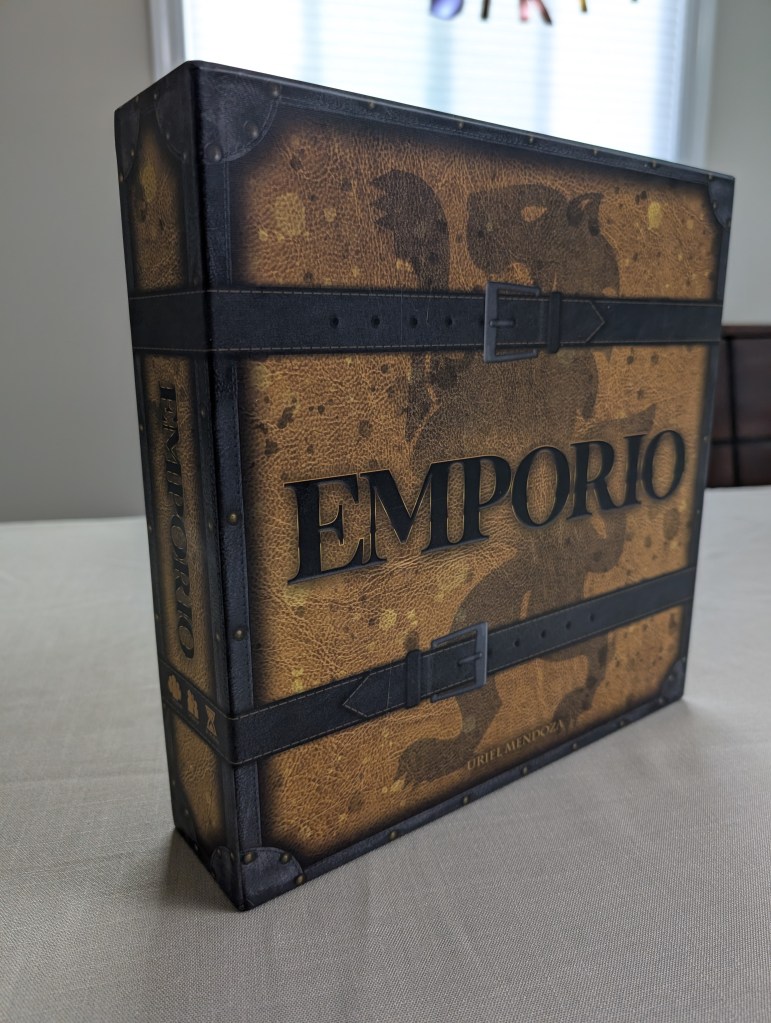
Game Name: Emporio (2025)
Designer: Uriel Mendoza
Artist: Jorge Inzunza
Publisher: M2A Games
Player Count: 2-4 Players
Playing Time: 60-120 minutes
Upfront Disclaimer: I was provided an advanced prototype copy of “Emporio” for purposes of testing it and writing a review. Aside from the pleasure of having the early opportunity to try out a yet-to-be-released game, no compensation was provided to me, and no restrictions were put in place about what I decide to write. All opinions contained within are my own unbiased thoughts.
Game Overview
Emporio is a coming-soon-to-Kickstarter game from Uriel Mendoza at M2A games, and I had the privilege to spend a few weeks playing an early copy of the game. Just to avoid the need to caveat this for the rest of the review – although it certainly looks and feels like a finished product to me right now, this is a prototype copy of the game, so the components/design/rules are still potentially subject to change.
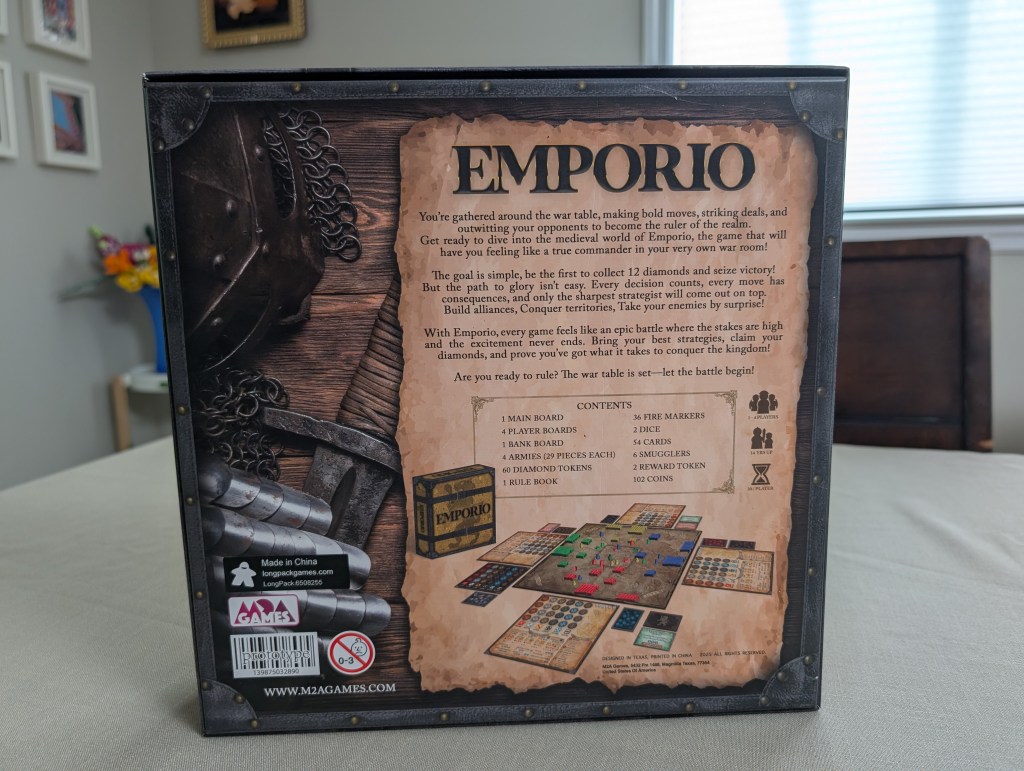
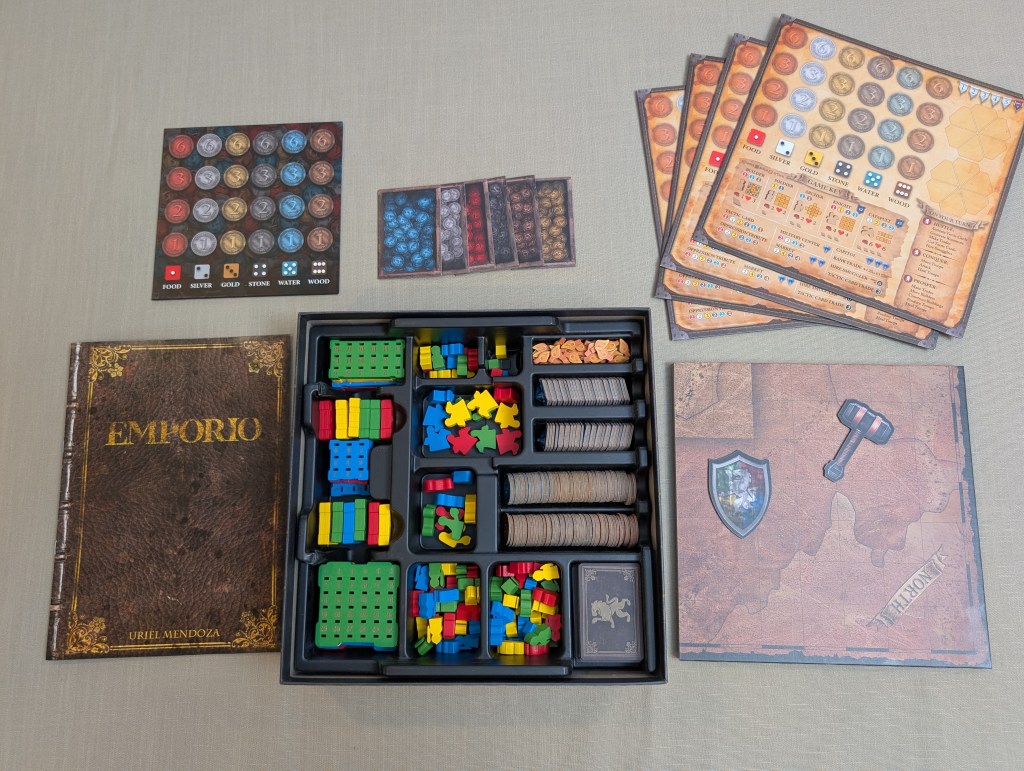
The design of most of the components does an excellent job at setting the theme; the box, although cardboard, has a very eye-catching leather-and-metal look to it that really makes you want to pull it off and explore the contents within. Even the hefty 24-page rulebook, which is made of nice heavy-weight paper, has a leather-bound journal look to it, complete with a visually aged/torn look to the pages within. Inside the box, you’ll find quite a few components – there are six different colors of cardboard coins, 60 cardboard diamond tokens, various buildings in each player’s color, and then meeples-a-plenty. In each of the four player colors, you’ll find nice wooden (or maybe very nicely molded plastic, it’s hard to tell) builder meeples, soldier meeples, archers, catapults, and knights. There are also tactics cards, cardboard smugglers mats, a separate board for each player, some dice, markers for fire, etc. If I did my math right, there are ~380 total different components in this box – luckily, the designer has given us a box insert that helps neatly organize all of these parts and even shows which components belong in which section (THANK YOU! So many game designers seem to forget this!).
Based on the design and the initial setup, I was somewhat expecting Emporio to play and feel like a typical war game, but after spending some time learning the rules and kicking off my first game, everything was not as I thought it would be – it’s true what they say, don’t judge a book by its cover. This is not intended to be a rehashing of the full rulebook, but a standard 4-player game plays as follows:
- Every player starts with a Capitol building, one soldier meeple, and one building meeple, placed on the board in their quadrant to start. They also each receive one unit of each of the six types of resources (food, silver, gold, stone, water, and wood), as well as 3 diamonds each. Hey, you’re already ¼ of the way to winning!
- On your turn, you’re allowed to perform one of three different phases of actions: Hustle, Conquer, or Prosper. “Hustle” essentially lets you generate more resources; you can acquire/activate cards in your hand, roll dice to gather more resources, make trades, or hire smugglers. “Conquer” is the most straight forward action phase – you’re essentially able to move troops around the board, perform attacks, and heal. And lastly, “Prosper” is where you can construct more buildings, produce more troops, and a few other related actions.
- Players continue taking turns to position themselves to acquire Diamonds, vying to be the first player to have 12 diamonds at once and win the game. There are many different ways to gain diamonds; you can gain them by constructing your own buildings, but also by destroying enemy buildings. You can gain them by area control over the center of the board, or destroying enough enemy troops, or even occasionally by drawing and activating certain tactics cards during the game.

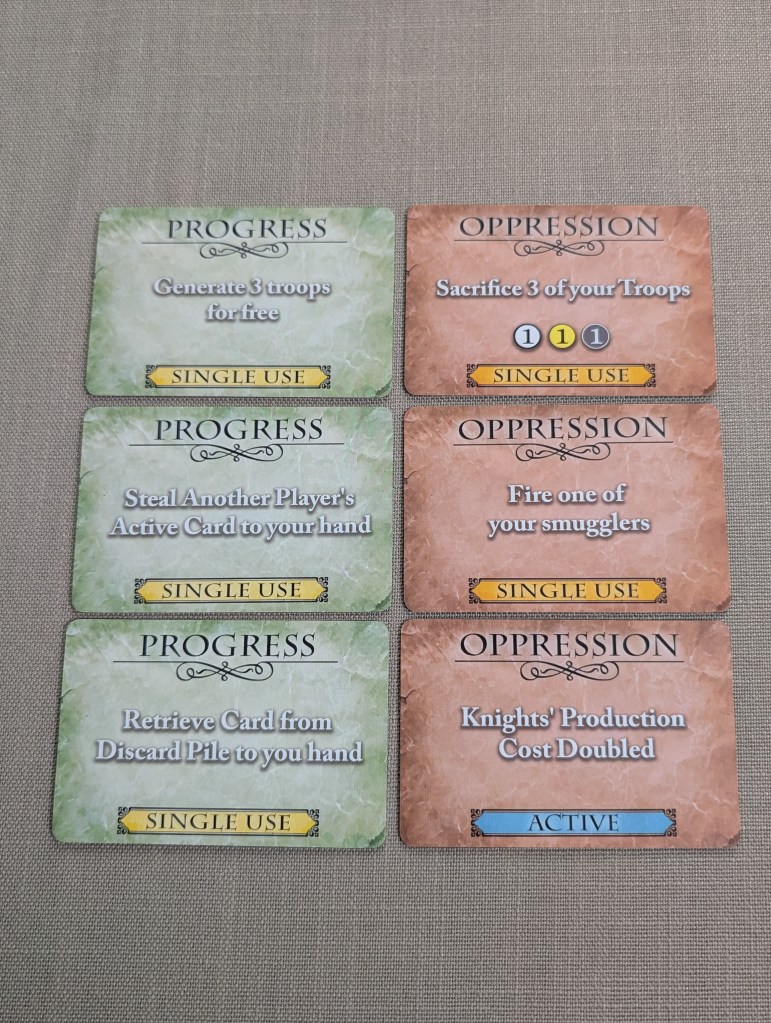
That is an extremely simplified summary of the very lengthy rulebook, which helpfully offers enough detail that it will let your group avoid any uncertainty or misinterpretation of the rules. For example, the game includes tactics cards, which can be either “Progress” cards that benefit you, or “Oppression” cards that you can use to damage your opponents (which, lets be honest, is one of the most enjoyable mechanics in any game like this!). Some of these cards can be single use – for example, activate this card and get an additional diamond; or steal a card from other players hands. You can also get “active” cards, which apply a permanent buff such as gaining additional attack points for your military units, or causing your opponents to pay double the production cost to build certain units. Helpfully, the rulebook covers each and every one of these cards individually to explain exactly how they are applied in the game.

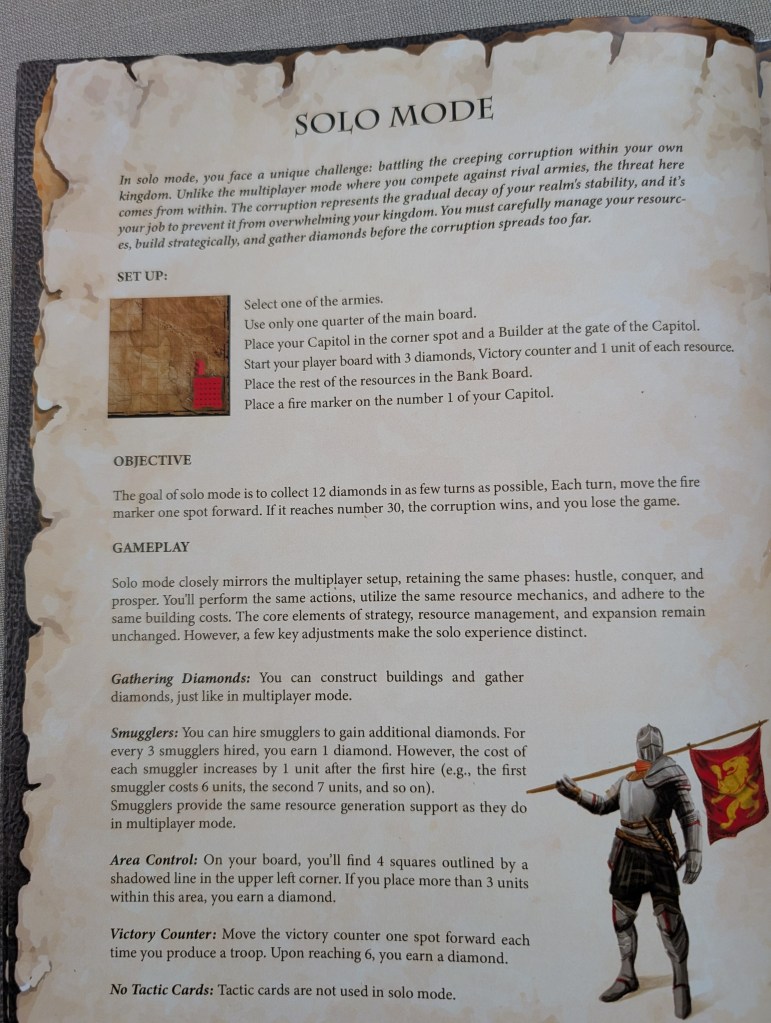
Emporio also offers a solo mode variant, something that I always appreciate seeing included in all games. Instead of battling against a virtual opponent, you’re racing against the clock to try and secure 12 diamonds for yourself in as few turns as possible. Play is tracked by using fire markers (representing corruption) to count out 30 turns; if the game reaches turn 30 without satisfying the 12-diamond victory condition, the corruption has become too great and the player loses the game. There are some adjustments to the rules on how to earn diamonds, and tactics cards are ignored in the solo mode.
My Thoughts
Uriel Mendoza managed to incorporate some design elements into Emporio that really make it stand out with a unique feel. I’ve played enough games over the years that normally I can glance at a game setup on a table and pretty much envision how most of it likely plays; but sometimes, I’m surprised by what I find when I play it, and those are some of the most enjoyable experiences for me. You see this game set up in front of you, and glance at all of the many soldier/archer/catapult/knight meeples, and you expect that you’re about to sit down and play a game where you will just keep taking turns strategically moving and attacking one another over and over until you’ve vanquished everyone else and won the game. But Emporio cleverly works around this by actually having the majority of ways to earn diamonds come from non-combat methods. It also gives players a really wide variety of options on how to tailor their strategy during each play. Sure, if you sat down and really have an itch to build a massive Medieval army and run around the board wreaking havoc on your opponents’ troops and buildings, you’re free to do that, and you can definitely find a path to victory from doing so. But as even the rulebook itself will tell you – there are pacifist paths to victory as well. You could simply dominate from a logistical standpoint of building out all of your buildings, hiring smugglers, and controlling the area in the center of the board, and win that way as well. It’s probably a little unlikely in reality that you’re going to pull off a complete pacifist victory unless your opponents are all asleep at the wheel; but you could in theory still get a win with very minimal combat proficiency.
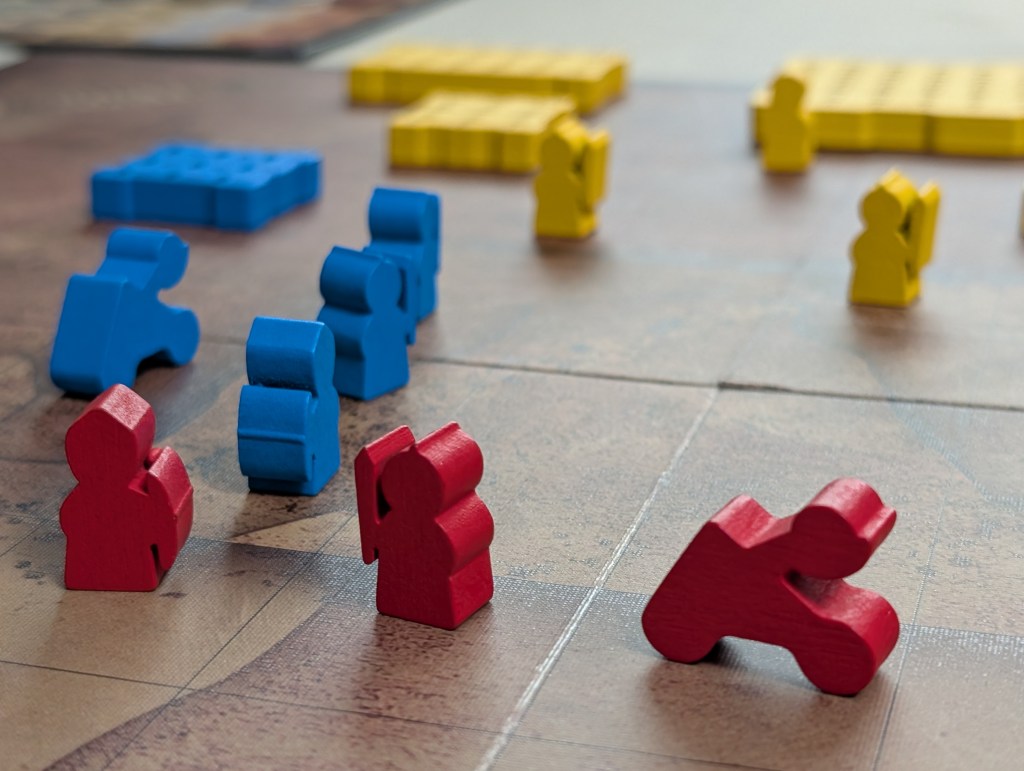
But for me personally, I found a lot of the joy in Emporio did come from the unit production/combat mechanics. Having a marked territory in the center of the board that provides victory diamonds through area control is a really smart design to help draw everyone into a high action battle in the center of the board. I also really enjoyed the Tactics cards, particularly the ones used for oppression. Sure, it’s nice grabbing a rare card that immediately grants you an extra diamond towards victory; but it’s way more fun to instead throw down an active oppression card against a friend, making their unit production costs double instantly and really putting pressure on their military expansion. But wait, there’s more! Your friend can choose to rid themselves of that pesky active oppression…by paying you a tribute of 2 units of every single resource in the game to remove it. For some reason, just phrasing this as a “tribute” leaves a smile on each players face as they accept the payment to undo it.
The whole design of the smuggler system is also ingenious – it’s like a constant auction for the service, but no matter how much you pay, you can never be certain how long you’ll get to keep the smuggler for. You may pay a high price to steal a smuggler away from an opponent, only to have the very next player immediately take the smuggler away from you again. It’s a huge risk/reward element to the game – it’s a massive boon to be able to double production on a given resource at times, and you can even earn yourself a temporary diamond by hoarding 3 smugglers at once.
There are, of course, a few things I think could do with some improvement here. For starters – the lengthy 24-page rulebook offers an endless number of very helpful clarifications of the rules, but I also felt like it could do with a little rewording on explaining some of the basic gameplay mechanics. This game is actually very straight-forward once you start playing it, but it definitely felt a little intimidating having to search through so much verbiage during the first playthrough to try and understand what needed to happen. I can’t help but feel that parts of the rulebook are a little long-winded at times. Also, the game plays at about ~30 minutes per player once everyone knows what they are doing, which is acceptable – but only being able to take actions from one of each of the three phases on every turn can make it drag out a little bit at times. There are plenty of times where I wished I could mix-and-match a little bit between phases – for example, sometimes I want to activate a tactics card, but also move one of my troops a little bit. But instead, I can only do part of that, and then have to wait for 1-3 other players to take a complete turn before I get to continue taking my actions. It would be nice if there was some option that lets you mix and match actions between phases, even if it came at a specific additional cost to do so.
And lastly, I always applaud the inclusion of solo modes in all games for sure – Emporio’s included variant is definitely a good option to get it onto your table for a couple of extra plays, but I wouldn’t recommend the solo mode as the entire reason to purchase the game. It’s a race against a turn counter, and while I enjoyed trying it once or twice, the solo mode is unlikely to get too many more plays. This is a GREAT multiplayer game, and just an OK solo game. And there is nothing wrong with that; I still applaud the designer for including a rule sheet for solo play, because it still adds a little additional value.
Verdict:
Emporio is a great, well-designed game where you get more out of it than meets the eye at first glance – this is an excellent first offering from M2A games. Multiple different strategies/paths to victory lead to a different feel to the game upon each replay, making you want to keep coming back to the table again. Highly recommended as a multi-player game 2-4 player game; solo mode is a nice addition but not strong enough on its own to recommend solely for single meeples.
Likes:
- Multiple paths to victory – win as a violent warlord, or as a complete pacifist, or anything in-between
- Smuggler system to ramp up resource production adds a live auction-mechanic to the game
- “Oppression” tactics cards, as well as a tribute required to remove some of them, add a lot of laughs into the game play
- Area control mechanic in the center of the board keeps player interaction high
Dislikes:
- Rulebook, while mostly well done, could use some consolidation in sections to feel less cumbersome to read through
- Solo mode is a nice inclusion, but not engaging enough to recommend on its own merit (stick to the wonderful multi-player game!)




 Rolling In The Meep
Leave a comment