
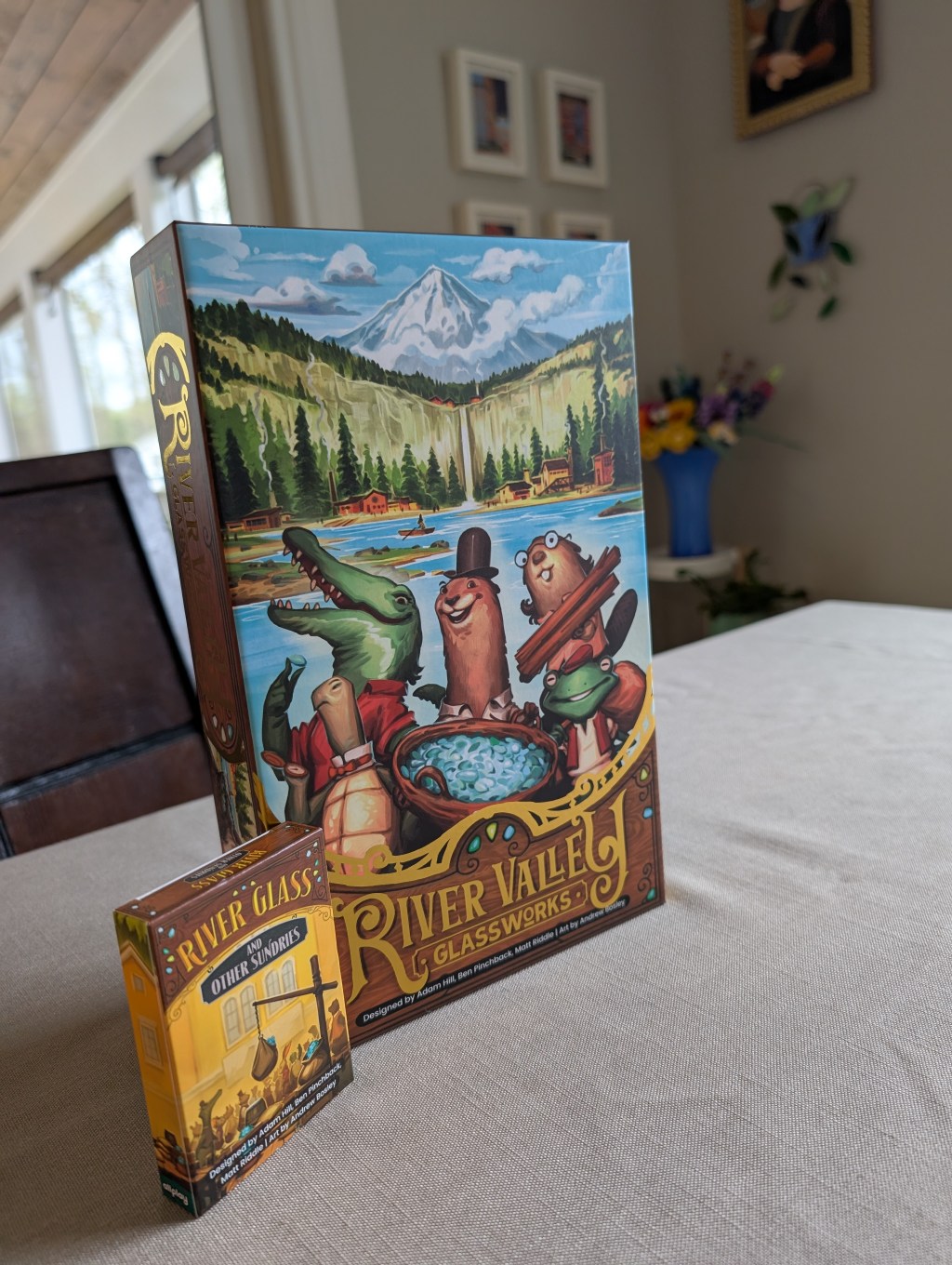
Picture a peaceful flowing river, where beautiful pieces of glass wash up on shore for crafty entrepreneurs to gather up and sell. You can set up shop along the riverbank, vying against your fellow woodland creatures to become the most successful in all the land. Welcome to River Valley Glassworks!
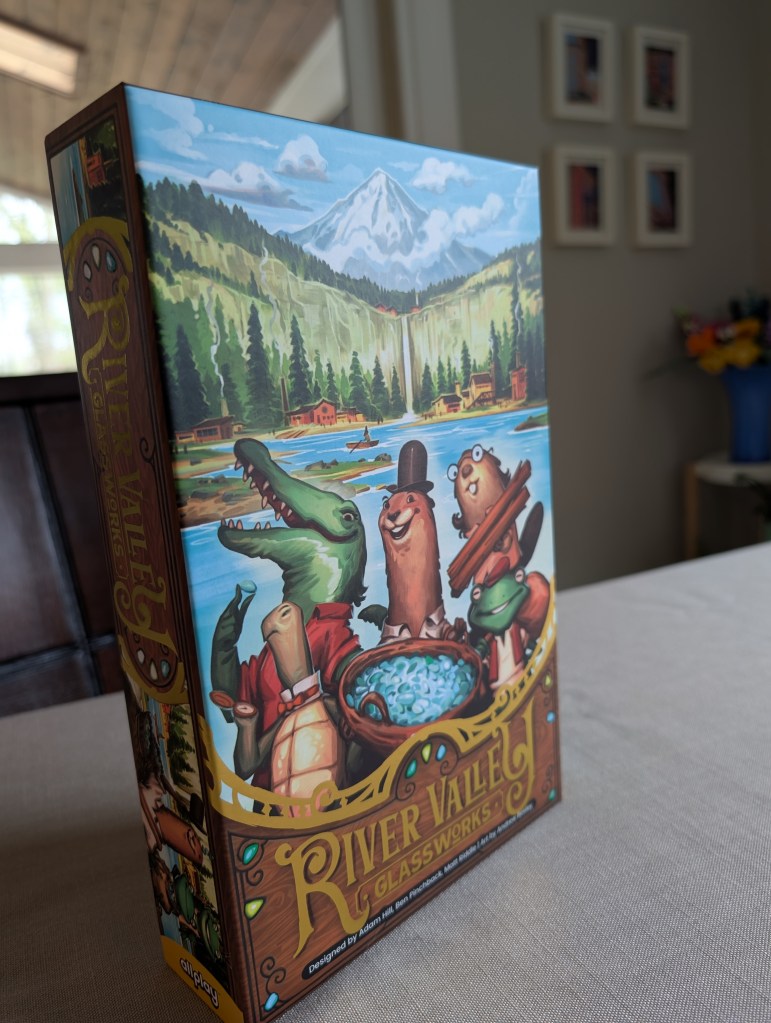
Game Name: River Valley Glassworks (2024)
Designer: Adam Hill, Ben Pinchback, Matt Riddle
Artist: Andrew Bosley
Publisher: Allplay
Player Count: 1-5 Players
Playing Time: 25-45 minutes
Upfront Disclaimer: I purchased my own retail copy of “River Valley Glassworks”. No free copy was provided for review, and I’ve had no contact with the publisher regarding this game. All opinions contained within are my own unbiased thoughts.
Game Overview
This river certainly sounds like a picturesque, lovely place to be for those in the glass trade. Sure, maybe a flowing river full of bits and pieces of glass isn’t the most appealing place to imagine going for a swim – but you can definitely picture a bunch of vendors lined up nearby, peddling their finest prizes from mining the river (and these vendors happen to be woodland creatures for some reason). This pretty much lays out the theme of River Valley Glassworks, which as they say, is a “cozy game of collecting glass”.
I own a bunch of Allplay’s games already (Lure. Switchbacks, Kabuto Sumo, etc.) and my general experience with their games so far is that they tend to be very lightweight games that are quick to teach. While River Valley Glassworks is no exception to this, it does come across as a bit more involved than the other Allplay titles I have tried – still definitely on the lightweight side, but this one might take 5 minutes to teach (as opposed to one minute for their other titles).
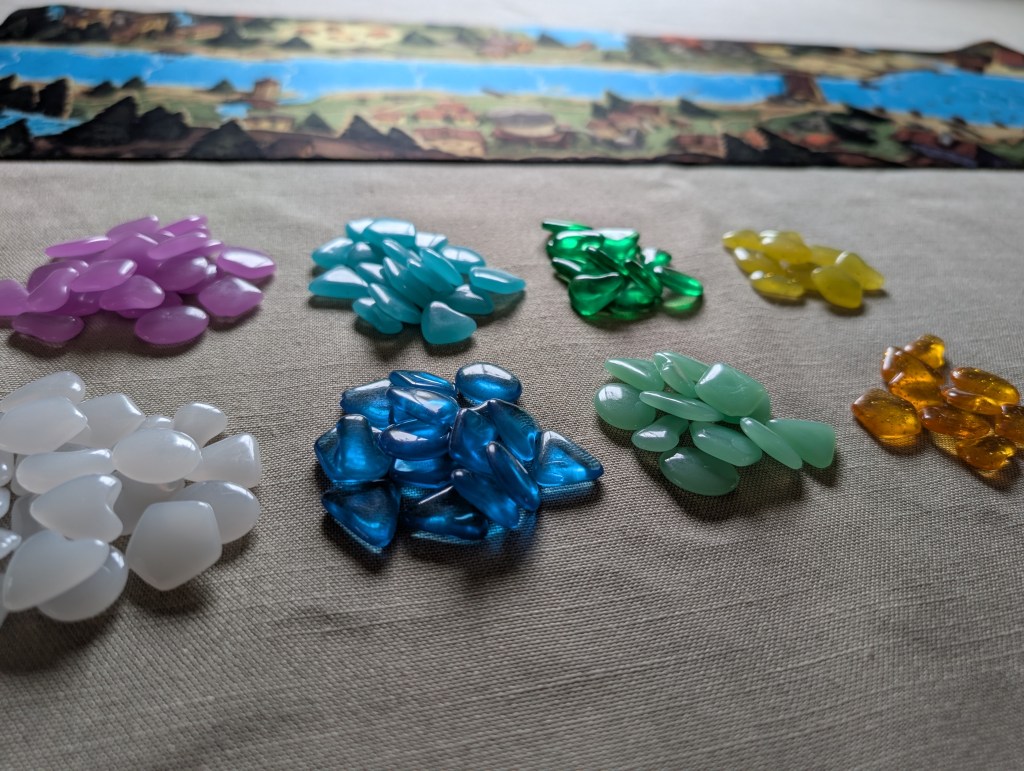
In general, this is a game where you’re going to spend your time carefully drafting glass pieces that come in 8 different colors (9 if you’re playing at the max 5-person player count), and within each of those colors you will find 6 different shapes. With no intention of rehashing the entire rulebook, a game generally goes as follows:
- Each player starts with an inventory of 3 different randomly selected glass pieces, and the character board of their choice (all characters play identically in the 2-5 player game other than in name and visual design).
- On your turn, you take a glass piece from your inventory, and place it on one of the six tiles on the river based on the SHAPE of the tile (not the color, which does not matter during this step). The river consists of six large tiles that each have an icon for one specific shape on them, indicating what color shape you must play on that tile. When you place your glass piece, you then choose either the river tile before or after the one you placed your piece on, and take all of the glass pieces on that tile. Then that river tile is returned to the start of the river, and repopulated with either 1 or 2 new glass pieces, and the river keeps flowing.
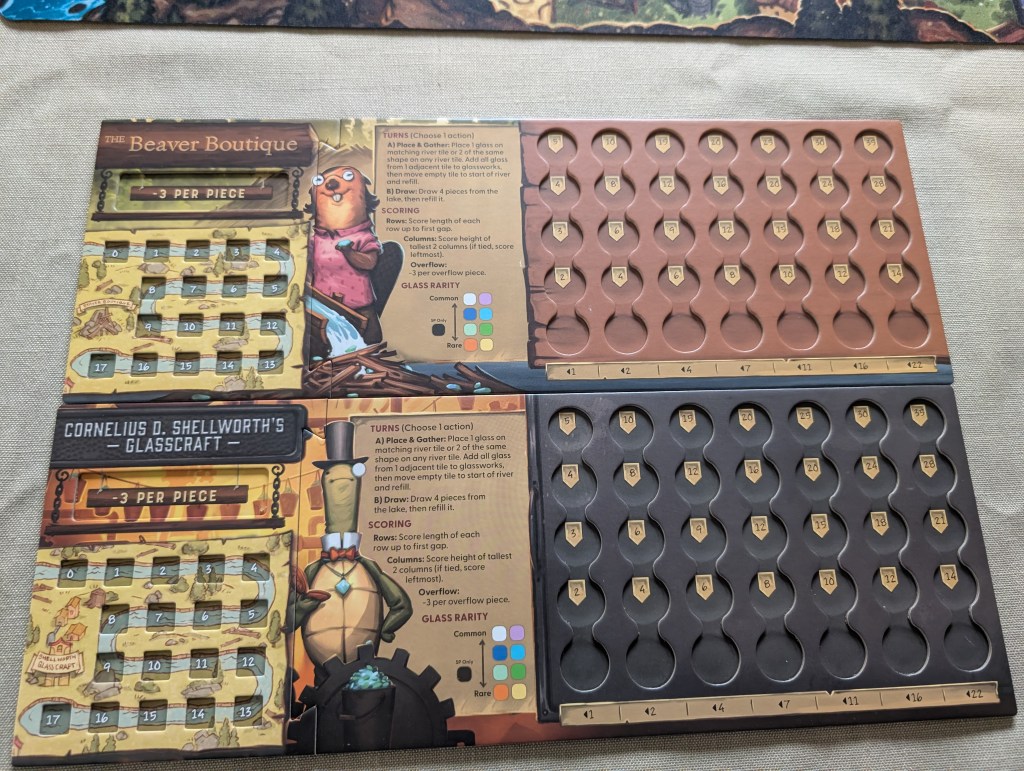
- All of the glass pieces you take get placed on your own Glassworks board based on their COLOR (shape no longer matters). You stack them in columns based on color. It’s important to note that you only have 7 total columns to work with that are each 5 rows tall, but there are 8 different colors (or 9 in a five-player game). Any colors you take that either can’t be placed because you’ve already hit the top of the column, or because you’ve already started 7 color columns and can’t use the 8th color, get placed in an overflow area where they score negative points at the end of the game.
- If it is your turn and you either are completely out of glass pieces in your inventory or have a very low inventory and don’t see anything worth drafting, you can instead choose to spend your turn refilling your inventory by grabbing four of the five tiles showing in the lake at the end of the board to refill (this will cost you your turn).
- Players keep taking turns like this until the first player in the group has 17 or more total pieces of glass placed on their player board. Then each player takes one final turn, and then it proceeds to the scoring phase.
Scoring takes three different things into consideration. First, you get a score by row, starting with your bottom most row, working left to right. Depending on how far out you built the row, you score up to 22 points for that row. Then you move up to each row above that, scoring them the same way – you get the highest score for that row until you have a gap in. So from a strategy perspective, you want to make sure you are building out fairly wide with complete columns, as opposed to having very empty columns to the left most part of your board which cause breaks in your ability to score. You also score points based on your two tallest columns. This works the other way – the further out to the right side of your board, the more points that column will score – but if multiple columns are tied for being in your top two, you’re forced to score off the lower valued of those columns. For example, filling your left most column all the way to the top would only score you 5 points…but filling the right most column that same height would score 35. So the game is really a balancing act of trying to build complete rows out from left to right as much as possible, but still focusing on creating two really tall columns as far out to the right as you can manage. And lastly, you score negative points by any glass pieces that make their way into your overflow area – ideally you want to end the game with nothing there.
The main twist to this strategy comes into play by all players having the knowledge that certain colors are far rarer than others – each player board actually has a guide reminding you of the rarity of each color. White and purple are the two most common colors in the game, with 22 glass pieces each somewhere in play. Whereas yellow and orange only have 9 pieces each in the game, so they are much harder to come by (and likely more fiercely drafted in the game). You most likely do not wat to use a super rare color to start the columns on the left most side of your board, because you’ll have an extremely hard time stacking that column up more than 2-3 spots, which really affects your ability to score on your rows.
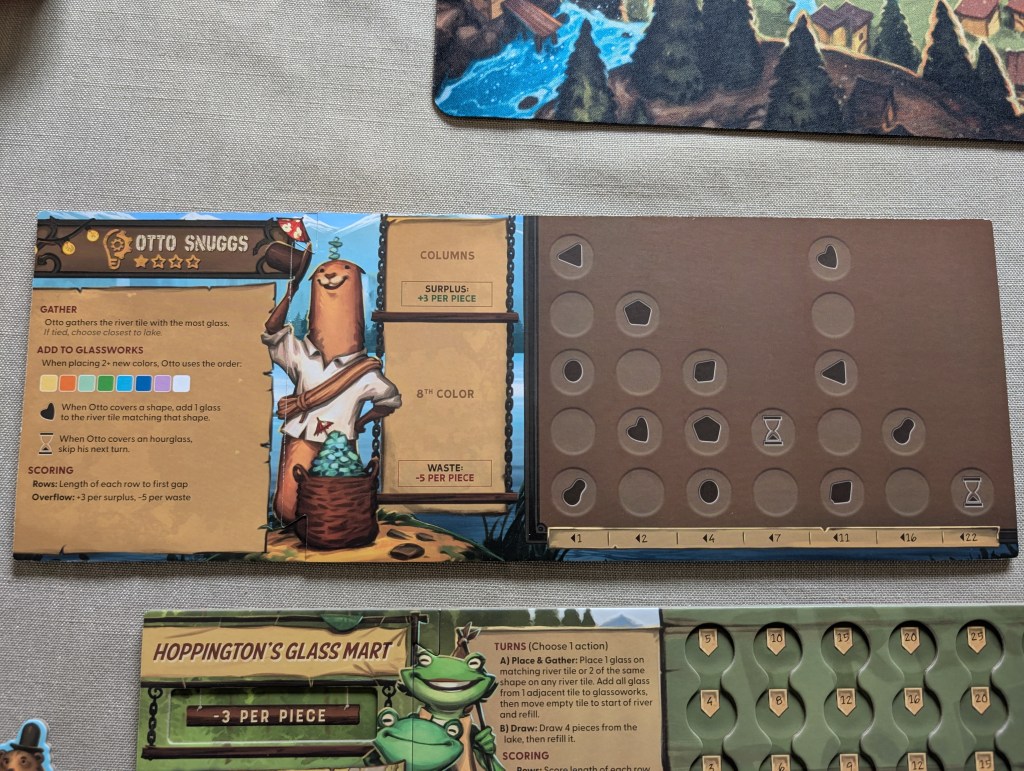
This game also has a Solo mode, which operates a little differently than the main 2-5 player game. The back of each of the 5 included player boards have a different opponent you can face on the back. A solo game is set up just like a two-player game, but on your opponents turn, they have a different specific instruction they will take as far as which river tile they draft from, as well as some other adjustments to the scoring and game play to vary the difficulty of each opponent – they are all rated between 1 and 4 stars of difficulty.
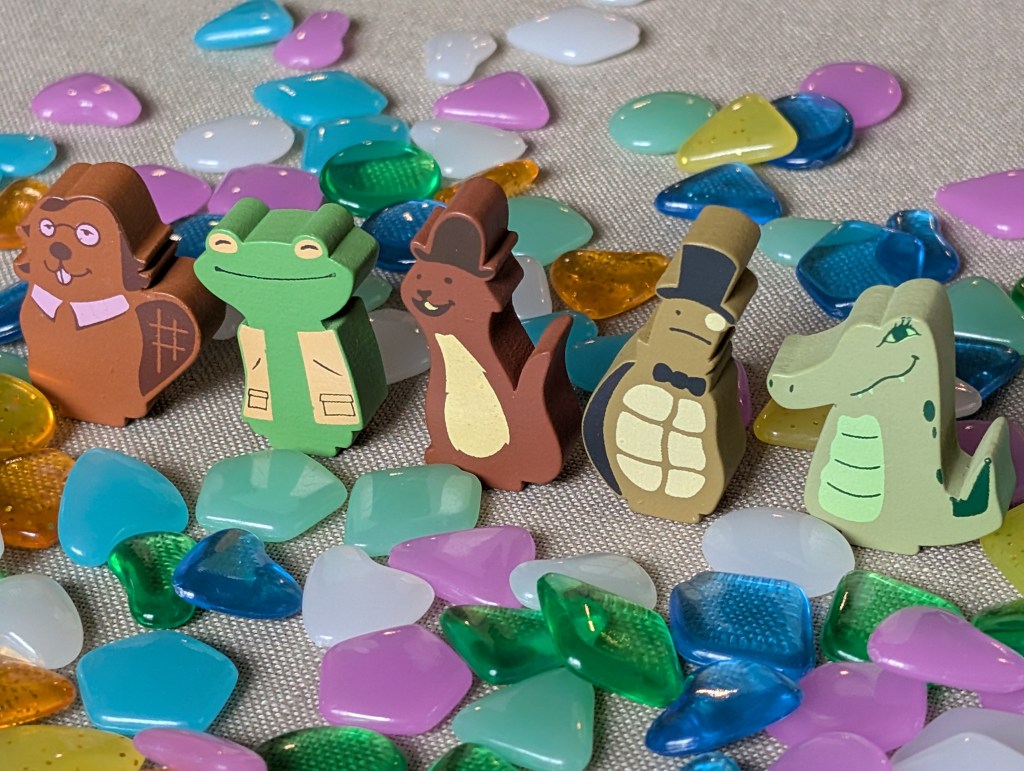
The last thing I’d like to cover in the overview are the included components. The version of the game I own is the “Deluxe version”, which retails for $69 MSRP versus the base games’ $39 MSRP. The base non-deluxe version has cardboard river tiles, a basic canvas bag to blindly draw glass pieces from, and simple flat cardboard player boards. The deluxe version offers a significant upgrade to these components – you get a box with gold foil printing, a fairly large neoprene playmat to depict the river, really nice thick acrylic river tiles to use on the river, an upgraded canvas drawstring bag that stands up on its own, and two-layer cardboard player boards that each have a nice screen-printed wooden meeple to use as an inventory marker. These components are very high quality and impressive; it really gives the game a premium feel (and makes shuffling around the river tiles much easier between turns).
My Thoughts
Allplay has a great game on their hands here, although I’ll be honest, it took me a few plays to really get into the multiplayer game. I definitely consider myself to be a fairly competitive gamer – I certainly don’t mind playing basic, luck driven games in the right game or setting, but I’m the type of person who spends the whole time playing trying to think through optimal playing strategies in my head. Despite being a basic, quick to teach game, River Valley Glassworks had me stumped for the first play or two, where I wasn’t able to really connect the dots between the actions available to me and the best strategy to take to increase my chances of winning. And I still sometimes feel that way when trying this game at a player count of only two people – it just seems like we’re taking turns back and forth drafting pleasing looking glass pieces to stack up, and the game just seems to come down to luck of the draw. But at 3-4 players, and especially the 5-player count, the game starts to shine, and after a few plays I felt like I really did have a good idea of what I needed to do to win. You can see all of the tiles on your own board, and on other players boards, and all over the river itself, to get a really good idea of what’s out there and what still remains in the bag to be drawn. There is a lot of risk/reward to this game, since immediately on your first turn, you’re going to commit to what color to choose for your first (and possibly second and third) columns. If you can be the first person to get one of the rare colors (yellow or orange), sometimes you can take a huge gamble and place them in one of your first two columns. You can then try to place some of the less-rare colors as far out to the right as possible, and really build up a killer column height score.
One thing that I can say for certain though – the theme and general design of this game is spot-on, it’s a genuinely loveable cozy feeling game that probably would be a hit across a wide variety of gaming groups. Make no mistake, this is a fairly lightweight game (BGG has it at a weight of 1.54 at the time of me writing this, which feels fair to me). But at the same time, there is enough oomph behind it that I think it would keep even serious gamers entertained enough to break this out as a good game to start a night off, or occasionally use as a filler game. This also makes a great family game night choice as well – they say this is for ages 8+ but I’m pretty certain that it could be played a little younger than that with no issues. There is no reading involved, and the mechanics are very basic and teachable.
As for the deluxe versus base version – I for one absolutely love the premium feel of the deluxe version, and I have no regrets having purchased it. If you’re the type of gamer who really loves a premium feel to your components, you will be suitably impressed by what the deluxe version gives you. That being said – $69 MSRP makes for a VERY expensive purchase for such a lightweight game, and I think for the overwhelming majority of people, the base version is probably completely fine. With that extra $30 in your pocket, I think most people would be happier putting it towards another game to add to the collection, rather than upscaling the components in this one.
The last thing worth mentioning here is the Solo mode. I’ll be honest – when I picked up my copy of this game from the Allplay stand at PAX Unplugged, I didn’t even notice at the time that this game had a solo mode at all. I was very impressed with it though! They did a really good job of designing five opponents that act sufficiently different from one another to really vary the playing. I had a blast (and honestly, some really good challenge) working my way through them from the easiest 1-star opponent to the most difficult 4-star option. Are you going to get 100+ plays out of the solo mode? Probably not, but I was thoroughly engaged with it for about 5 hours’ worth of playing it, and I could definitely see myself breaking it back out in the future a handful of times more just for fun. I wouldn’t recommend someone buying this entirely just for the solo mode, but they did a GREAT job with it and I think most players will feel like it adds a lot of value to the game.
Verdict:
A thoroughly enjoyable lightweight experience that will probably appeal to a very wide variety of gaming groups, from family game nights to even some more experienced gamer groups. Plays best at the 3-5 player count. Probably about right in the middle on the luck/strategy scale, and it includes a surprisingly competent solo mode as well.
Likes:
- The theme and component design makes for a beautiful, relaxing, cozy gaming experience
- Quick setup, quick to teach, will appeal to a wide variety of gaming groups
- Surprisingly smart solo mode will bring this game to the table more than expected
- Deluxe version has some seriously premium components
Dislikes:
- Feels a little too luck-heavy at lower player counts
- $69 for the Deluxe version feels very expensive for a lightweight gaming experience (most people should stick with the base game)


 Rolling In The Meep
Leave a comment