

The city council is calling, and they need your help in transforming an entire neighborhood. You’ll have your work cut out for you – proper urban planning is required to lay out the parks, waterfront, buildings, and special features to meet all of their requirements. Is “Cities” a magnificent work of game design, or will it leave a haphazard mess? Let’s find out!
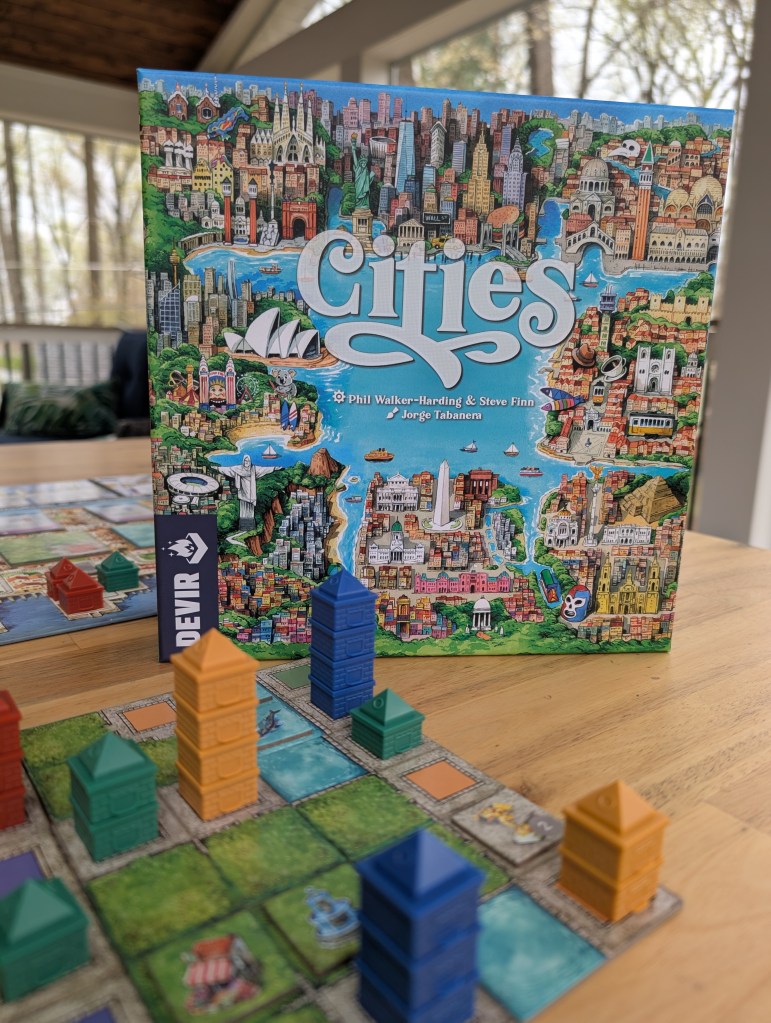
Game Name: Cities (2024)
Designer: Steve Finn, Phil Walker-Harding
Artist: Jorge Tabanera Redondo
Publisher: Devir
Player Count: 2-4 Players
Playing Time: 30-40 minutes
Upfront Disclaimer: I purchased my own retail copy of “Cities”. No free copy was provided for review, and I’ve had no contact with the publisher regarding this game. All opinions contained within are my own unbiased thoughts.
Game Overview
There are some games out there where I hear some really good word-of-mouth recommendations for them and I immediately seek out a copy; or I come across a well-written review that makes it sound right up my alley and I know I need to go try it out. Cities, for me, was not one of these cases. I was wandering around PAX Unplugged 2024 with a group of friends, and after a long day of walking around and trying to see everything, we really just wanted to find an open table in the demo area where we could just all sit down and play a game together without waiting. A group had just finished playing a game and stood up, so we quickly scooted into the open seats without even really knowing what we sat down for. And there in front of us was…Cities, a game none of us had ever heard about before sitting down.
Now, if you’re going to sit down at a table to play an unknown board game and someone is going to randomly throw a box in front of you, you’re probably not doing so bad if you look forward and see Phil Walker-Harding’s name on the box. He has dozens of game designs under his belt, including a slew of well-known and well-rated titles such as Sushi Go, Gizmos, Imhotep, and many others. So, our gamble to just sit at a random table to relax for a bit was already looking like it may down out better than we had planned.
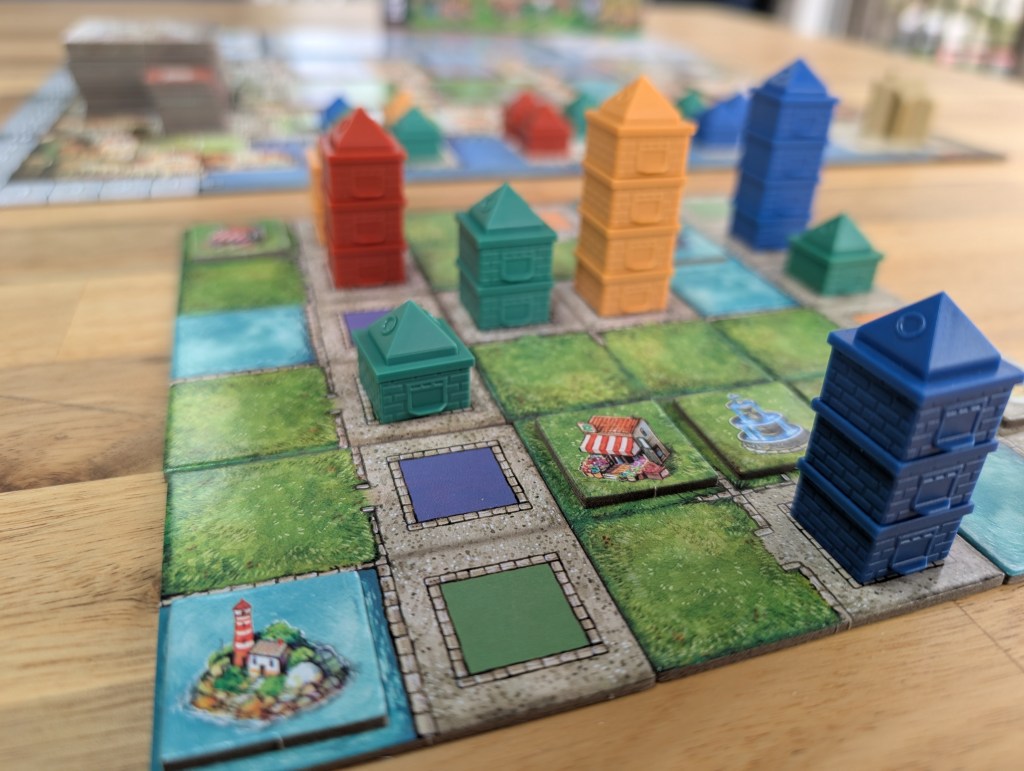
Released in 2024, Cities is PWH’s most recent game as of the time of me writing this review. As you may suspect from the start of my review or the picture on the cover of the box, the theme of this one has you acting as an urban planner, where you and your fellow opponents are each designing your own 3×3 tile landscape, and placing different components on top to help achieve the highest final score. The main way you will achieve this is by taking turns drafting different city tiles, scoring cards, building pieces, and feature tiles, and then strategically placing them on your own personal city landscape. The game also comes with 8 different “cities” to play in; each game you will choose one city to play (randomly or by choice), and depending on which one you select, there will be different bonuses you can earn for adding certain design elements. For example, if you choose New York City, one of the bonus design elements is being the first person to build a very large park (think Central Park) or multiple very tall buildings. Likewise, if you choose Rio De Janeiro, you’re rewarded for building an outstanding waterfront, along with very colorful buildings of varied heights.
I won’t rehash all of the details of the full rulebook, but a typical 4-player game plays like this:
- Each player starts with one randomly selected starting city tile. Each city tile in the game has four spaces on it, which provide either parks, waterfront, or a space to construct buildings or other special features.
- The board is set up so that there are four different rows of items. The top row contains four rule cards, the next row contains four city tiles, followed by a row that contains 4 groups of feature tiles, and then lastly a row containing four groups of various numbers of building pieces.
- Players take turns drafting these items one by one as play moves clockwise. The catch is, in each round, you can only draft ONE item from each of the four rows. So once a player has chosen the city tile they want, for example, you know that they can not choose another item in that column for the rest of this turn. This helps players adjust their priorities for the items they want to draft the most as play moves onwards. Drafting continues until all 16 groups of items are gone (meaning each player has chosen four times). Items that are drafted must be played IMMEDIATELY – you cannot save an item to be placed later, or move anything after the fact. So for example, if you draft a red building piece, but have no proper spot to play it – it is just discarded from the game.
- After this, the game board is reset with new randomly drawn groups of tiles/cards/etc, and the player who chose the star token (which comes along with the least valuable building piece spot each turn) gets to go first on the next round.
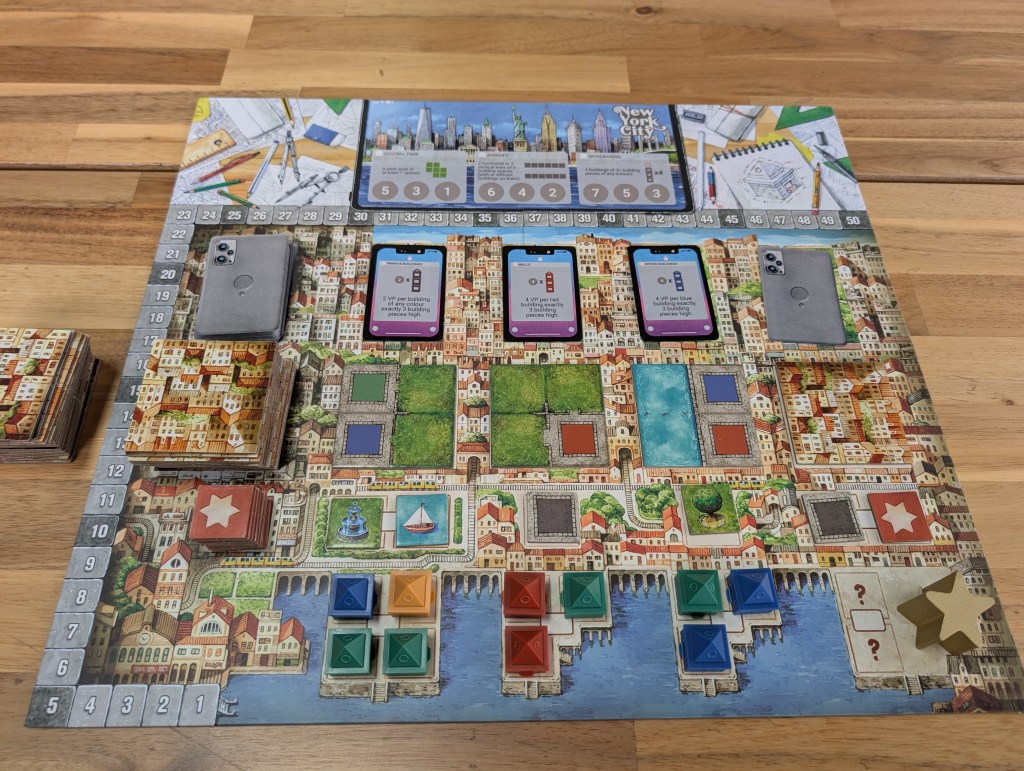
There are 8 rounds played in total in a 3 or 4 player game, ending with each player having exactly a 3×3 grid of city tiles in front of them as the game ends (it is required to build in this shape). Scoring happens in four different ways – you can complete the “city achievements” specific to whichever city scenario you are playing, you can build combinations of certain features in your water or park spaces, you can build monuments in your city that score points, and lastly you score based on the rules in the scoring cards you drafted during the game and how they apply to your specific city design.
My Thoughts
I’ll start off right up front by saying that I love this game, and I’ve also found that everyone I have shared it with has loved it as well. You know those games where every time they hit your table, someone is pulling out their phone by the end of it to order their own copy of the game? Cities is one of those for my gaming group.
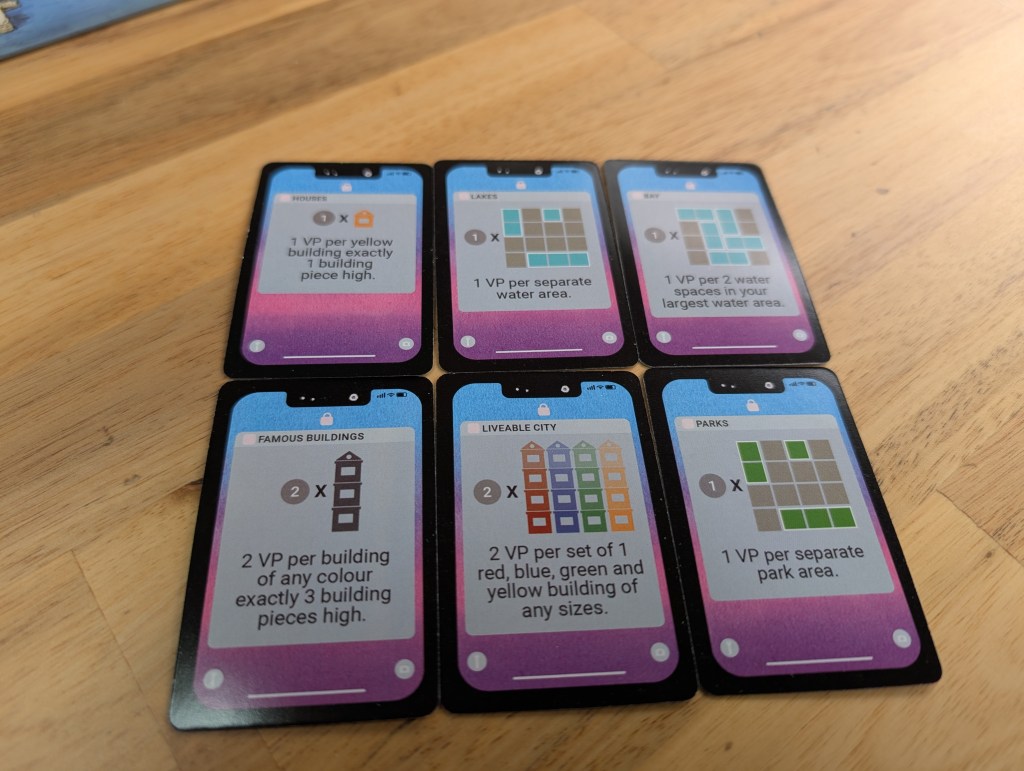
One of the coolest parts about Cities is the design of the scoring system. Part of the scoring is defined by fixed parameters shared by all players – you are racing to see who can complete the city achievements first (the earlier you satisfy the requirements for each achievement, the more points you get from it). Everyone is also competing on the same playing field to set up different features in their parks and waterfront areas. But the majority of points come from the rule cards you draft along the way. Sometimes you get lucky and draft a rule card that fits your current build very well, but other times you can find yourself getting stuck with one that doesn’t score you any points yet, and you have to make some adjustments in future rounds to help make the rule card score. This system gives the game a very asymmetric feeling, where every player is working to alter their own scoring system to give themselves the best chance to win. It also creates an additional layer of depth to the game by forcing you to think about playing defense; sometimes you draft a rule card because it denies an opponent more points than a different card may have gained you.
From the standpoint of the components themselves, Cities is more than adequate. The building pieces (which never stack more than 4 units high) are made out of very sturdy plastic, and are designed in a way that they are very stable when stacked; if an energetic friend bumps into the table a little too hard, it’s still very unlikely that these will topple over or go flying anywhere. It comes with a nice drawstring canvas bag to blind draw the building components out of, and everything else in the game that is made of cardboard is more than ample thickness and unlikely to cause any problems. There’s nothing overly premium anywhere, but they did find the right balance of quality to the point that no one will have any complaints.
I’ve played Cities at all 3 possible player counts. It plays best at the 4-player count, but that being said it’s still a great game at both 2 and 3 players (I do wish they had included a solo mode though!). One recommendation I have – if you play this game at a 2-player count, you can optionally alter the rules to build out a 3×5 grid instead of a 3×3 grid – I’d highly recommend this at 2 players, otherwise the game is far too short for anyone to really see through any complex strategy decisions.
There aren’t many things about this game I dislike, but if I had to pick something, it’s that there is a *slight* issue in the balance of the scoring options. After registering about 20 plays on this game with varied groups of opponents, I think I can confidently say that score gained by the rule cards you draft really overpowers the other avenues of scoring in the game. If you’re ever in a tight spot where drafting one thing would get you closer to a city achievement, but another item would benefit you more based on the rule cards you’ve picked, it almost always makes sense to go with the rule card option. With near 100% consistency, we’ve seen the player that does the best from their own sets of rules emerge as the winner, even if they ignored most of the city achievements. The other thing I’d point out – while I love the 8 included cities to play with, I do wish they either included more, or would make an expansion for this with some new cities to use. It seems like it would be really simple to do, and might add a ton of additional replayability to this title.
Verdict:
Honestly, this is my favorite Phil Walker-Harding game to date (although I’ve yet to play Gizmos, which I plan to get to soon). PWH and Devir have a winner on their hands with this game – I’d highly recommend this to anyone who loves drafting games, it’s just overall a clever, smooth game design.
Likes:
- “Rule Card” scoring system adds a ton of depth and a great asymmetric feel
- Super smooth gameplay, very easy to teach
- Great design to the city building pieces to make them very stable to stack
- Includes 8 different “cities” to use for different building guidelines; adds a ton of replayability
- Seriously, I think nearly every single person I’ve shown this game to in person has ended up buying it
Dislikes:
- Scoring methods could use a little better balancing (rule cards seem to outscore everything else)
- Would be a great candidate for an expansion involving more cities to use!




 Rolling In The Meep
Leave a comment