
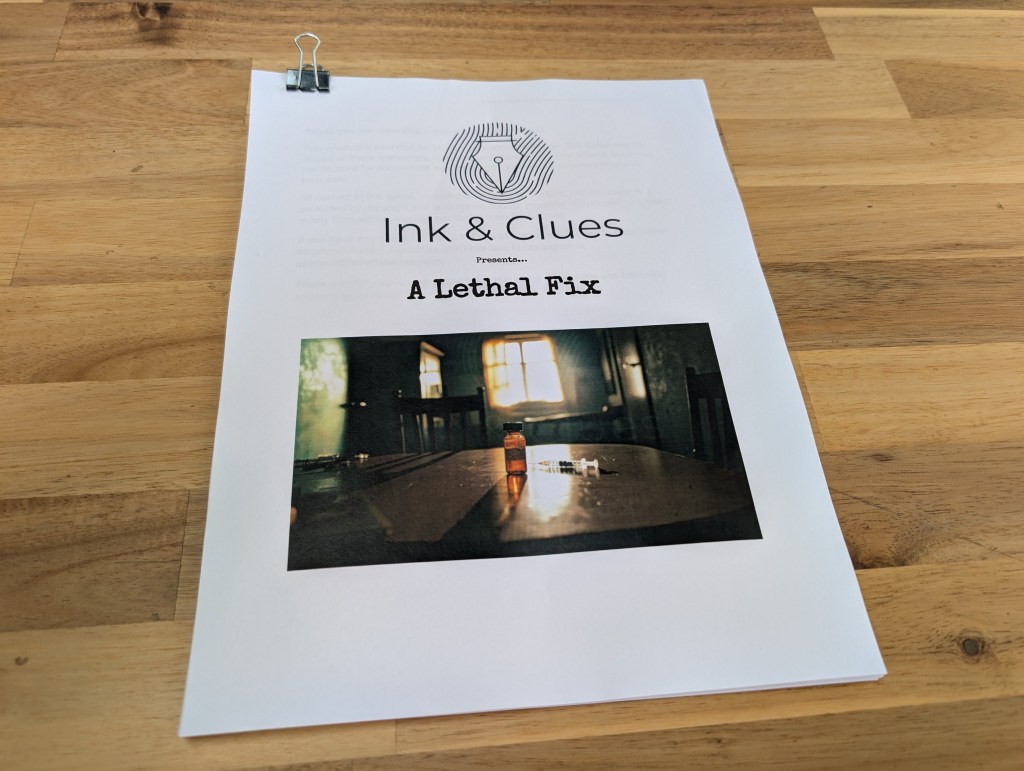
A woman comes home to find her roommate dead on the floor of their apartment with immediately apparent signs of intravenous drug use. It seems like an incident that is very easy to explain, but things aren’t always what they seem. Is this an open and shut case, or will taking a deeper dive into the evidence lead us to a different conclusion?
Game Name: A Lethal Fix (a digital Print & Play game)
Designer: Alexander Warsi
Publisher: Ink & Clues
Player Count: 1-4 Players (but could be played with as large of a group as you’d like)
Playing Time: 60-90 minutes
Upfront Disclaimer: I was provided complimentary access to two of “Ink & Clues” games for purposes of testing/reviewing, and had the opportunity to ask the designer some questions about the game. I was not otherwise compensated for this, and the entirety of this review reflects my own unbiased opinions.
Game Overview
I suspect that a lot of the people reading this review are in a similar position to me – you have a bookcase (or two, or three, or four, or…ok I may have a problem, DON’T JUDGE ME) full of board games in giant boxes. Some of them are nice and tiny and fit right into my pocket, and others are 20+ pound monstrosities in gigantic boxes that take up way too much space (*cough* Gloomhaven *cough*).
When Alexander Warsi reached out to me to see if I was interested in trying one of the print-and-play mystery games he has designed, I was fairly excited by the prospect, but also a little nervous. Alexander is the designer and creative mind behind Ink & Clues, a publisher that makes “print and play” mystery games – not a genre that I have any past experience with, so I felt anxious not really knowing what to expect.
Ink & Clues operates as a website where you can find a selection of various murder mystery games that you can download immediately and play at home – at the time of me writing this, there are five different mysteries to choose from, ranging in price from $14 to $16 each (as well as an assortment of kids’ mystery games, although I didn’t have the opportunity to review any of those). Giving this some more thought, and staring over at my unnecessarily large physical board game collection, I have to say that the idea of a print-and-play game is starting to seem better and better as I run out of space in my house. Fact is, you could actually avoid printing this all together, and instead play it directly from a laptop or tablet, or cast it to a TV for a whole room full of people to read through at once in a larger social situation. The games are all quoted as being between 1-2 hours playtime, and they are also rated in terms of difficulty on a scale from 1 thru 5.
I had the opportunity to review two of the mysteries – “A Lethal Fix” and “Unknown Identity”. I will mainly focus on “A Lethal Fix” for this review, a game which is rated as difficulty 3 out of 5, and quoted as having a playtime of between 1 to 1.5 hours. I played both of these games solo. A general review of how the game works:
- You are sent digital files (in my case PDFs) for the scenario you choose. For “A Lethal Fix”, this consists of one 28-page (single sided) case file, as well as one separate 4-page solution/scoring file. You can choose to print these files out, play them from a tablet, cast them to a TV…whatever you choose. (For my own solo purposes, I chose to print them out). Just a note – they are in color, and I was able to print them in color; but had only a black and white printer been available, I still think it would have been fine to play, just slightly less immersive.
- The case file PDF starts off with a guide explaining what you need to do – in general, the main goal is to determine who committed the crime, the motive behind why the crime was committed, and exactly how the crime was carried out (weapon, method, etc). You go about this by reviewing all of the evidence provided to you – in the case of this game, you start off with a summary of who your character is (a detective) and an explanation of how the scene of the crime was found. Then you have a multitude of other things to review – transcripts of interviews with suspects, screenshots of text messages, news articles, medical information, autopsy reports, legal documents, etc. The list goes on and on.
- Once you’ve read through all the documentation, you can flip back and forth to start working the case however you’d like to approach it. The game guide even references that you should treat this like a real case, and use Google/internet searching to help you if needed (for example, if the case mentions locations of places, you can google search the distance between those places in the real world to see how long it would take to get from one to the other; or maybe the case uses medical/scientific/criminal terms you’re unaware of, and you can google to find out what they mean). Simply put – aside from reading the solutions pages ahead of time, there is nothing you can do to “cheat” – feel free to look things up.
- Once you’ve decided you know enough, you can write down the primary suspect, motive, and probable method – and then it’s time to switch to the solutions pages to see how well you did!
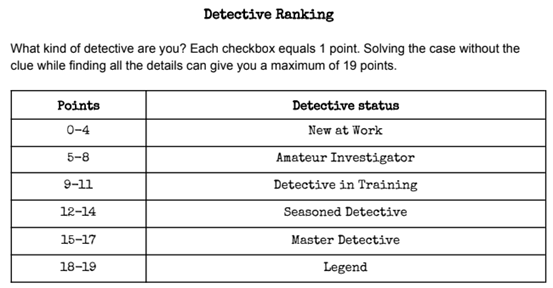
Once you’ve come up with your hypothesis, the solution packet runs through each suspect one by one and tells you exactly what you could have learned from the evidence, and what may have cleared them each of suspicion (or proved their guilt). One of the neat things about the game design here, is that you aren’t just being judged simply on a yes/no for three separate questions; Alexander Warsi has also included a scoring metric that will truly test how much you were able to deduce while reading the case. I can’t go into too much detail about what the scoring metric specifically contains because it would involve massive spoilers for the game, it’s not something you can really glance at until after you’re done playing. But in “A Lethal Fix” for example, there are roughly 15 different details it mentions from the case that you should have deduced, and you earn a point for each one you had figured out on your own prior to using the scoring packet. You also get an additional five points if you managed to identify the correct killer. Then you can check your score on the provided rubric and figure out how solid your detective work really was – maybe you got it wrong, but still did a great job uncovering the majority of the information, or maybe you got it right but just a lucky guess and missed a whole lot along the way.
My Thoughts
I really had no idea what to expect going into this. The night I received the game I was exhausted from a long day, so I printed my copy out, got it all set to go, and sat it on top of stack of upcoming games to review so that it would be ready for me to start when the time came. Well, curiosity got the better of me and I picked it up to read the first page or two, just to see what it was going to be like. Fast forward an hour later, and there I was still sitting at my desk flipping back and forth through the evidence, pencil in hand, making notes of all the connections/information I was uncovering from the case. If you’re like me, and really love to work logic puzzles or use the power of deduction to figure things out, this style of game is probably going to be a winner for you.
“A Lethal Fix” was rated at 3/5 difficulty, and I’ll be honest – I was able to figure out who the killer was and how the crime was committed a little easier than I had expected, without using the provided hint on the final page for people who are feeling stuck. But somehow, I got the motive wrong, and when I finally read through the solutions, had one of those “OHHHHHHH” moments as a tiny piece of the puzzle I had missed hit me. And this is where I think the design choice of providing and using a scoring system to rate your performance really added a ton of depth to the game. You really need to dive deep into these things – I don’t think a group of average adults is going to find the general outline of this case too puzzling, but I think a lot of the fun is in really being able to concretely lay out every single thing you can determine for sure about each of the six potential suspects involved in the case.
If the goal here was to make me feel like a detective, then I’d call this a success – I really felt like the facts and situations presented to me were detailed enough that I got to really know everyone involved. I think the quoted playtime was about correct – I finished it in about an hour myself, but I think it would move a little slower in a large group with some external discussion taking place.
And trust me, if you’re thinking that maybe this sounds too easy and you’d like more challenge…I was also able to try the “Unknown Identity” case, which is rated at 4/5 on the difficulty scale, and I can confirm that it is quite a bit more difficult and would probably provide a decent challenge even for a group of fairly intelligent adults. I won’t rehash the whole review again just to cover another story, but at that level, it requires not only a lot of deductive reasoning, but also some really strict attention to detail.
In the end, there was a ton to love about these mystery games from Ink & Clue. One thing that’s wonderful – you can decide on a whim to play one of these, and it’s in your hands ready to go the second you hit the order button, with no need to wait for shipping or driving out to buy something. Having a group of people over and want to experience something really different for an evening? It’s a pretty decent value proposition to get 1-2 hours of really social fun for about $15 USD – but also, I can confirm, it’s extremely fun solo as well.
No game is perfect though, and there are a few minor things worth mentioning here. For starters, for the most part, there isn’t a lot of replay value here – once you know the solution and the reasoning, there isn’t really any way to go back and try the same case again. Not too big of a deal since I do feel like you get a good value out of paying about $15 for a fun evening activity for a whole group of people. The second thing is – I actually found the evidence presented to be a little bit TOO helpful, especially in the “A Lethal Fix” case. Put a different way – every single page provided, in some way, was extremely relevant to the case. I actually think it would be a little more realistic/interesting to also throw in a few “red herrings” here and there that just exist to provide a little distraction or misdirection, that aren’t fully relevant to the case.
Verdict:
With stories that kept me captivated from the very first page, I recommend these print-and-play mysteries from Ink & Clues to anyone who really enjoys deductive reasoning – I think most people will find the stories very interesting and fun to work through. Alexander Warsi and team have a winner on their hands, and I can’t wait to see what they come up with next.
Likes:
- Well-written, creative stories with a good set of characters
- Scoring system adds a level of intrigue and challenge beyond a simple “who, why, how”
- Variable level of challenge between cases allows you to pick the perfect difficulty for your group
- Works well with pretty much any group size; will be fun solo, for a date night, or even in a big group
Dislikes:
- Not a ton of replay value to each story after revealing the solutions
- Evidence is a little too useful sometimes – needs to mix in a few red herrings




 Rolling In The Meep
Leave a comment