
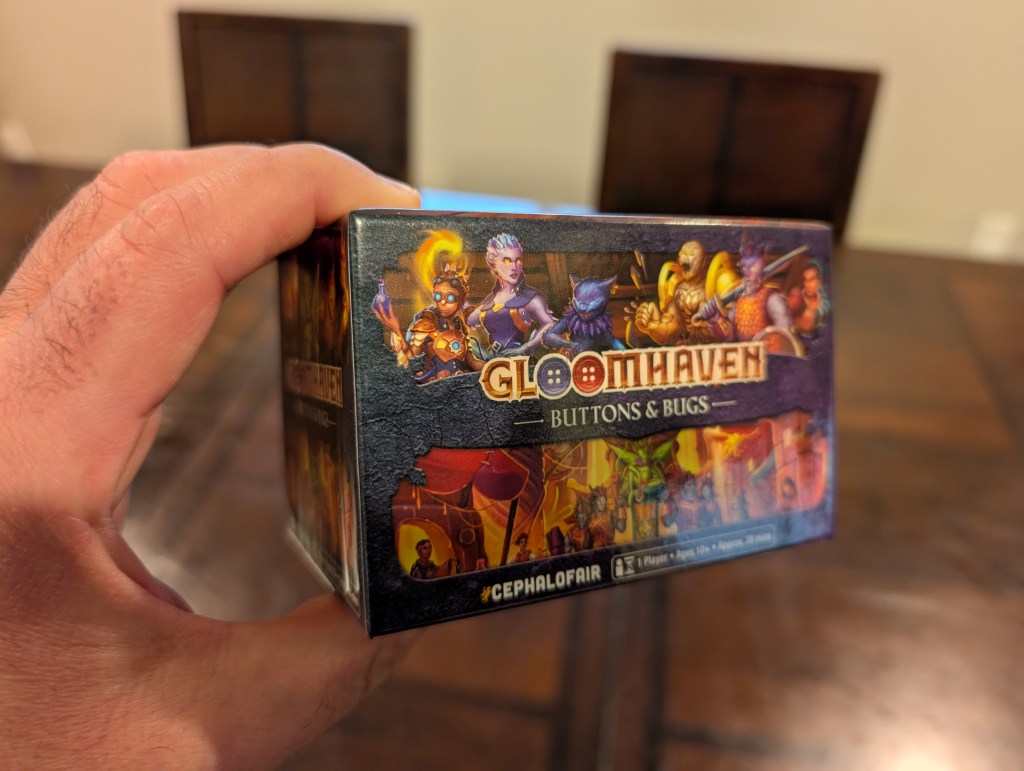
The original Gloomhaven, undoubtedly one of the most beloved tabletop games of all time, was a massive hit. And it was also…massive. Weighing in at over 20 pounds, and containing over 2,500 different cards/tokens/components, it isn’t known for being a very simple game to take out and get going – and certainly not something you’d want to travel with often. So, what happens if you take a similar concept, change it to a solo-only game, and cram it into a box that you can hold in the palm of your hand – are you left with something just as legendary, or have they taken too much away? Let’s find out!
Game Name: Gloomhaven: Buttons & Bugs
Designer: Joe Klipfel, Nikki Valens
Artist: Yanis Cardin, Mofei Wang
Publisher: Cephalofair Games
Player Count: 1 Player
Playing Time: 20 minutes
Upfront Disclaimer: I purchased my own retail copy of “Gloomhaven: Buttons and Bugs”. No free copy was provided for review, and I’ve had no contact with the publisher regarding this game. All opinions contained within are my own unbiased thoughts.
Honey, I Shrunk The Gloomhaven!
“Gloomhaven: Buttons & Bugs” is a miniaturized, nearly-pocket-sized solo-only version of the gaming classic Gloomhaven. I already touched on this in the opening paragraph of this review, but it really bears repeating just how far the miniaturization went. The initial game’s box comes in at a whopping 17.64” x 9.13” x 13.03”, which comes out to 2,096 cubic inches in size. The new solo version we’re reviewing here? About 4.25” x 3.25” x 3” by my measurements, which is a mere 42 cubic inches rounded up – meaning it would take nearly 50 copies of the Buttons and Bugs game to occupy the same amount of space as the original Gloomhaven.
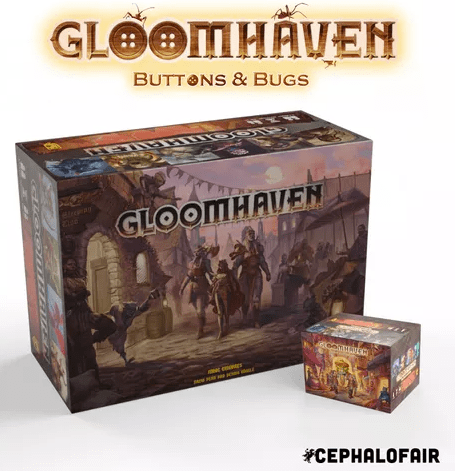
And yet, the game box itself promises us, in its own words, “all the strategy and adventure of the original Gloomhaven in a unique stand-alone single-player adventure!”. So OK – we’ve established that “Buttons and Bugs” is sufficiently reduced in size enough that I can safely call it a miniature version, but what exactly is it, how does it play, who was it made for, and can it live up to this promise?
Despite the small stature, this new game is no slouch when it comes to quantity of components. Including cards, tokens, and even 6 super cute micro-miniatures, there are around 150 components in this tiny box. You’re immediately greeted inside the box by a tiny booklet titled “Learn to Play”, which is 36 pages long and is designed more to act as a tutorial for your first scenario playthrough, than it is an actual rulebook. In fact, reading the very first page, you may be surprised to find out that a) they recommend not using the book at all and instead using a free interactive digital tutorial through an app called “Dized”, and b) that the ACTUAL full rulebook for the game is only found digitally online (again, for free).
This is a story-based campaign, so I am going to be very general in describing the gameplay so as not to provide any kind of spoilers. But to sum up how the game generally plays as briefly as possible (and believe me, this is VERY high level compared to the actual gameplay):
- You select one of six characters available in the game – Bruiser, Cragheart, Spellweaver, Tinkerer, Mindthief, or Silent Knife, and set your tableau up accordingly with your characters’ 4 particular action cards (which can be upgraded/altered as you progress in the game). You also take a dial to track your own characters remaining hit points.
- The game is played out in 20 different scenarios (though you may skip some of them depending on your character choice), each of which have a story component before/after playing them. You read the story, find out your objective for success, and then on the back of the card are given the map in which the scenario takes place as well as what type/quantity of enemies you are facing. Each enemy also gets a hit point dial so you can keep track of their health and how close you are to vanquishing them.
- The game is played out in a series of different turns, where either the player character or the enemies get to act according to a measure of “initiative” – which is a rating from 1 to 99 on when each character gets to act, with the lower number going first. The player chooses 2 of their possible 4 action cards to use each turn, and then either flips them over to their other side after using, or else discards/trashes the card depending on what the action requires.
- The scenario continues on until either the player achieves their goal for victory, the player gets exhausted (uses up all their cards with no remaining ability to rest), or the enemies manage to knock the players’ hit points down to zero.
- If the player is successful in completing the scenario, great! Now they get to read the outcome portion of that scenario, followed by unlocking some new story content in the next scenario after that.
Sound simple enough? Well…
My Thoughts
Gloomhaven: Buttons & Bugs is kind of a tricky one to write a review for, since there are going to be two different types of people reading this: people who have played the original Gloomhaven, and people who have not. When I initially saw the announcement for this game, the concept was really intriguing, but I was really wondering what kind of value they could possibly provide for an MSRP (at the time of me writing this) of $19.99 USD. And in my head, I definitely conflated the smaller dimensions of the game with an expectation that it would also be a much lighter playing experience – and something I could maybe stick in a backpack and play on fold down tray table while on a long flight, for example. As it turns out, neither of these two things are really fully true here.
In terms of complexity, while I personally found the game to be manageable, this is NOT a light weight playing experience – I’d actually classify it to be on the upper-end of medium weight, if not maybe even encroaching into heavyweight territory. The first playthrough is very manageable when you’re using the free Dized app, and being walked through an interactive tutorial of how to play the game. But that’s about as basic as the playing gets, and already, there is a lot going on with the game. You have to keep track of various different statuses, different ways that each double-sided action card gets played depending on what else is happening around you. You have to be diligent about re-rolling dice to adjust the modifiers on every turn and every attack. The app gives you a constant reminder of exactly when to do all of these things – but without the app, I had more than one round where I finished a series of turns only to remember that I completely forget to move tracking cube down a slot in my modifier tray, and therefore was valuing my attacks incorrectly the whole time. And then after you finish scenario 1, you learn that there are “items” added into the game (as well as a few other things I won’t spoil that come later), and you have to download the digital rulebook to learn exactly how to handle these items. In the end, I found myself CONSTANTLY needing to consult the digital rulebook for my first few scenarios. I’m sure others out there who have more experience with heavyweight games will chime in and say differently, but I was never able to replicate the quoted “20 minute” scenario play time quoted by the designers; my average scenario attempt has probably been closer to 40 minutes.
And to my second expectation given the small size of the game – that I could travel with this tiny little box and get in a round anywhere I felt like it, that didn’t really match reality either. Remember how much time I spent talking about how miniature the game box is? Well, many of the components are SUPER tiny too – the enemy/hit point/modifier tracking cubes, the player miniatures, and even the status symbols are SMALL. You could probably get this game set up on an airline tray table if you tried, but one accidental bump and you’d never find half these components again. And the “map” you play each scenario on, is printed on the back of a standard sized card – not something you can really jostle around at all without potentially losing your place in the game.
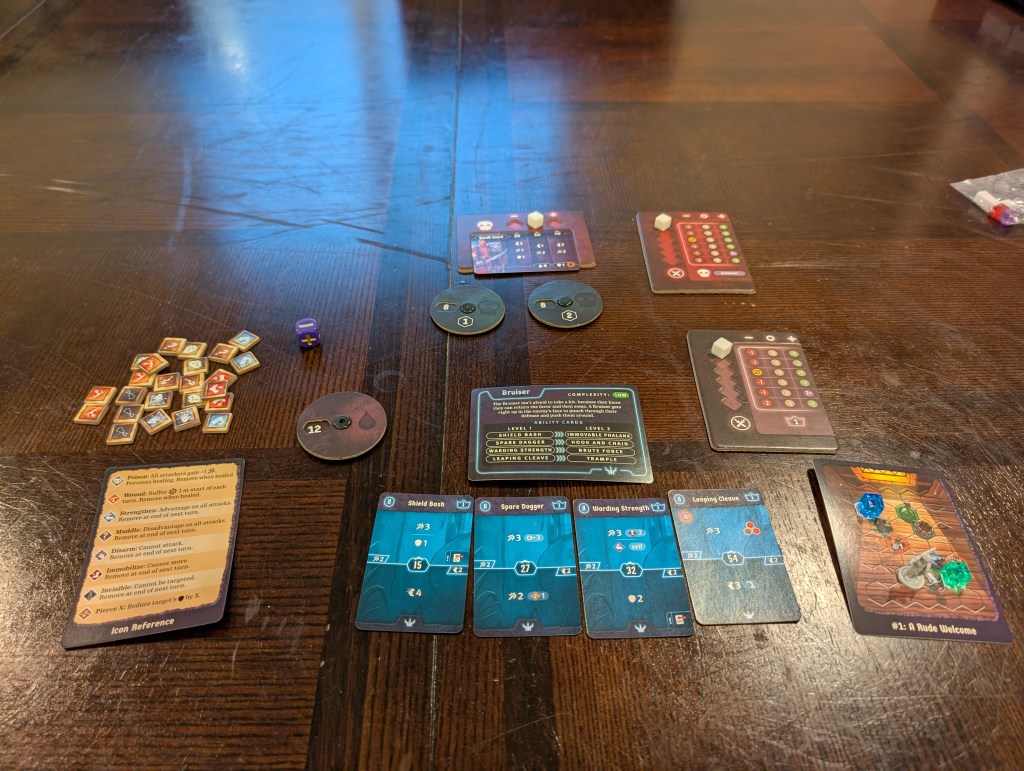
I’d also like to talk a little bit about the components found in this $19.99 MSRP game. They feel…like they belong in a $19.99 game, and that’s not necessarily a good thing or a bad thing, just a statement. The smaller enemy/action cards feel sufficiently sturdy for their size, but the card stock itself starts to show its thinness on the full-size player/scenario cards. I REALLY loved that they had teeny tiny actual miniatures for the player characters, though – I would have expected just a general character token or something, so this was an incredible touch that brought in some of the feeling of the real Gloomhaven game. So, I think you’ll get about the level of quality you’re probably expecting – not more, but not less either. And that’s more than fine!

I know this sounds like a lot of complaints piled on at once, but despite my warnings about the high learning curve and difficulties in playing this game on the road, I was a little blown away by how closely the feeling of the actual gameplay really nailed the original. It doesn’t feel like a simplified, made-for-the-masses-and-dumbed-down version of the original – this is an impressive feat of game design. For only twenty bucks, you get 20 great scenarios to play through, and you will definitely feel like you got an extraordinary amount of value out of the game. I was always eager to see where the story would go – I’m not going to give away any spoilers there, as the best part of this game is uncovering each new bit of the story on your own as you play. Additionally, I mainly found the level of difficulty to be fair, although I had a few times where I ended up losing to exhaustion and felt like I wish there were more ways to extend the playing time before reaching that point.
Verdict:
I’ll have to call this one a split recommendation, depending on what type of gamer you are. I would recommend this game to any fan of the original Gloomhaven, or people who know they are OK with medium/heavyweight gaming mechanics. There are six characters to choose from, and if you’re the type to replay the game again and again to experience them all, you’re about to get a tremendous value out of a $20 box. At the same time, if you’re a very casual gamer, I’d recommend avoiding this one entirely – don’t let the small box and price tag fool you into thinking that this game will be simple to pick up.



 Rolling In The Meep
Leave a comment