
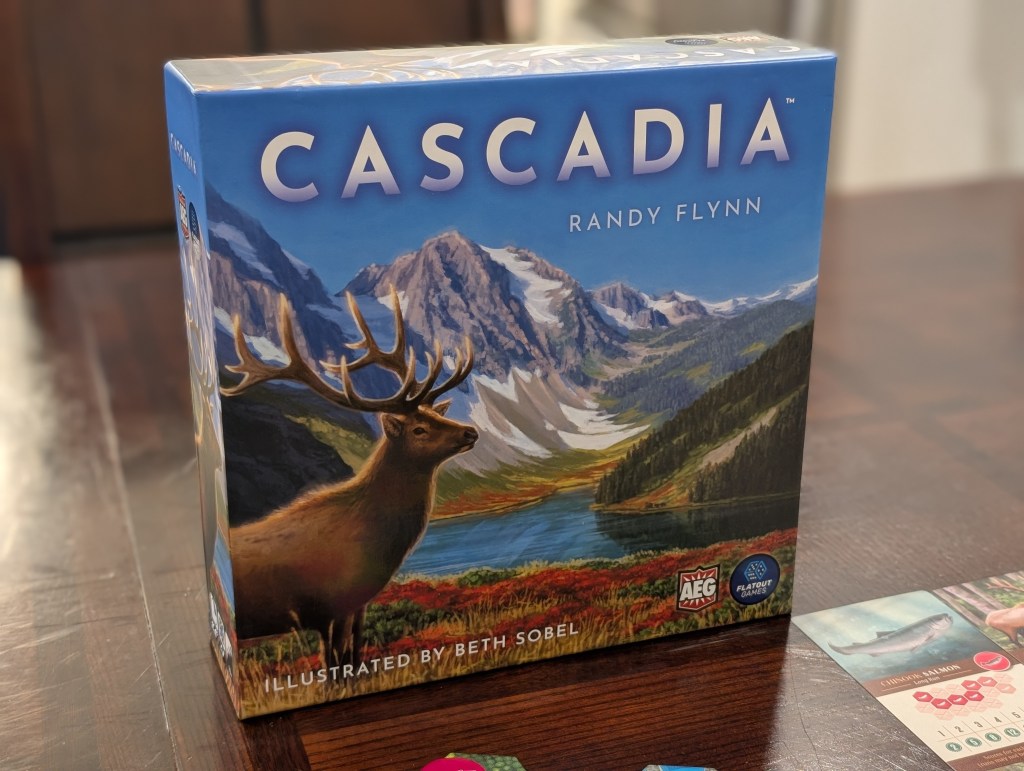
The Pacific Northwest is a beautiful place. Welcome to the region known as Cascadia, where you will be challenged with creating a diverse landscape, all the while managing how different animal habitats mesh with one another. Can you successfully create the most harmonious ecosystem, or will you fail to achieve the proper balance?
Game Name: Cascadia
Designer: Randy Flynn
Artist: Beth Sobel
Publisher: Flatout Games
Player Count: 1-4 Players
Playing Time: 30-45 minutes
Upfront Disclaimer: I purchased my own retail copy of Cascadia. No free copy was provided for review, and I’ve had no contact with the publisher regarding this game. All opinions contained within are my own unbiased thoughts.
Welcome to…the Pacific Northwest?!
I’m going to be completely honest with you here – before turning to page one of the rulebook for this game, I had no idea that the name Cascadia referred to the region of the Pacific Northwest of the United States, as well as the western coast of Canada up through the Yukon Territory (thanks for this, American public school system!). OK, in my defense, I also live on the East Coast but anyways…back to discussing the game.
In their own words, the designer writes that this game is a “puzzly tile-laying and token-drafting game” – and that description about sums it up as accurately and concisely as anything I would write myself, so no need to restate that. Here’s a brief overview of how a game of Cascadia is setup and played:
- Each player is given a “starter habitat tile”, which is a 3-tile section of environment. No matter which one you get, they all contain all five types of habitat (Mountains, Forests, Praries, Wetlands, and Rivers). They all also contain all five types of wildlife (Bear, Elk, Salmon, Hawk, and Fox). So no matter which one you get, for the most part the game starts in a fairly even balance.
- A certain number of habitat tiles are randomly drawn to be used in the game and placed face down in a pile in the center (20 tiles per player, plus 3 – so for example, 43 tiles in a 2 player game, 63 in a 3 player game, etc). This method ensures that the game will end when each player has played exactly 20 turns.
- Gameplay on each turn is simple: There are four habitat tiles shown face up in the center, and they are each randomly paired with four different randomly chosen wildlife tokens from the draw bag. These are paired together with each other as a group for drafting (although, there are ways you can earn “nature tokens” that allow you to mix and match whichever wildlife token you want with whichever habitat tile). Each turn, a player drafts one of the four groups, then places the habitat tile anywhere they want in their own ecosystem (provided it must connect to at least one side of any existing tile they have). Then they take the wildlife token they drafted and place it on top of any unoccupied habitat tile in their ecosystem, so long as it shows the icon of that animal to allow it to be placed.
- Lastly, a new random habitat tile is turned over, pairing it with a new randomly chosen wildlife token from the draw bag, to replenish the center of the play area back up to four choices, and the next player takes their turn. This will continue until each player finishes with a total of 23 habitat tiles in front of them (the 3-tile starter piece plus 20 selections made during the game). Scores are tallied, and the player with the most points wins!
Scoring in Cascadia happens in a few basic ways, which dictates the strategy behind where to place your habitat tiles and wildlife tokens, and what you might need to stop your opponents from grabbing. For the habitat tiles, they are scored by measuring how large of a “habitat corridor” you build for each of the five types. You score 1 point per habitat tiles in your LARGEST group of each type. For example, I may have two separate Forests in my environment, with one being 5 tiles in size and the other being 3 tiles in size. I would score 5 points here for my largest forest (and nothing for any of the other smaller forests). Additionally, there is a bonus that varies based on player count, but the person who has the single largest of each habitat tile corridor receives bonus points – incentivizing you to keep track of what your opponents are doing and try to always stay one step ahead.
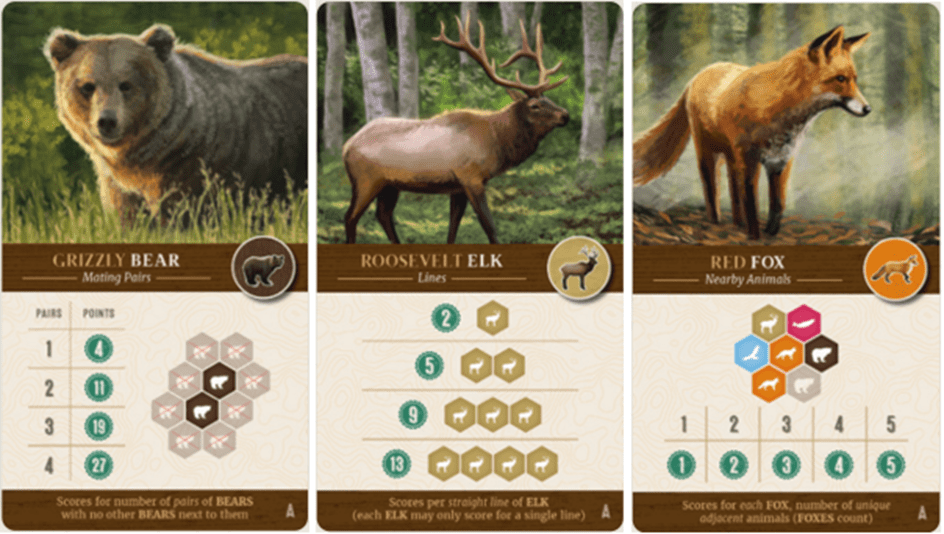
And then of course, you also score based on the wildlife tokens you’ve placed, and this is where the game gets really interesting, and changes each time you play. Each play you choose one rule for how each of the five wildlife types get scored – the game provides you with four different options for each animal, so if you draw randomly and mix/match, that means there are 1,024 different combinations of scoring systems you could come up with (my math is better than my geography apparently). For your first game, the designer recommends using a specific set of the five rules to keep it simple. Bears, for example, like to be placed in pairs, but with no other bears around them – and you score based on how many isolated pairs of bears you can place. Foxes on the other hand, absolutely LOVE a diversity of wildlife – you score one point for each unique type of animal is directly adjacent to any fox you place (including other foxes). And those crazy elk? They demand to be placed in straight lines, and your score grows depending on how long those lines get!
My Thoughts
I feel like nature-themed board games have been having a moment recently, and I must say – I don’t mind it at all. Just staring at the beautiful artwork by Beth Sobel on the front of the Cascadia box really sets the mood for the experience on which you’re about to embark. There is something so satisfying about watching the environment unfold in front of you as you build it out over the course of the game. It’s a pretty rare find to have a game so deeply embedded with strategic thinking, that also somehow just feels…relaxing to play. But that is what Randy Flynn has managed to achieve here.
It’s quick to teach, and just a graceful, fluid experience to play each time. Theme just overflows in this game, and you get a sense of exactly what they were going for even if you haven’t read the rulebook. The fact that you need to balance growing your habitat in the right design and shape, but all the while plotting out ways to keep your wildlife grouped the way it needs to be, means you have to be strategic with every single turn. And yet, leaves open so many possibilities – sometimes you just want to focus on building something visually pleasing in front of you, and you can still find a way to be very rewarded for doing so. Cascadia really thought of everything here – the rulebook is short and efficient, but goes on to include different achievements/scenarios you can play, which will keep the game coming back to your table over and over again. They even included a special “Family” rule card you can use, if you want to play the game with young children and reduce the complexity even further – although I found that even my 8-year-old was able to pick the full normal rules up in no time, and even told me that this was his “favorite game of all time” when we finished our first round!
Gosh, it’s hard to really find very much here that I didn’t like. One very minor gripe for me revolves around the wildlife tokens. They are small wooden discs with a separate color for each animal. No issue with the quality of the wood, but they somehow feel…cheap. The animals are only printed on one side of the token, and at least on my copy, the printing doesn’t seem to be perfectly centered on all of them. It would have been nice to find a design to print that embellished the look of the tokens a little more. The other thing, also minor, that feels a little off, are those times when you are able to place wildlife tokens into habitat tiles that just make you chuckle a little bit. Occasionally, you’re going to draft a salmon and then place it…in the middle of a prairie. Or grab yourself that Elk and drop it in its new home…the middle of a wetland. While I totally get why the game is designed this way, that’s about the only very minor thing that sometimes breaks you out of the theme for a minute. Neither of these two complaints affect the gameplay at all though, which is fortunate. Overall, just a really well thought out experience.
Solo Mode – Sometimes it’s great to wander alone
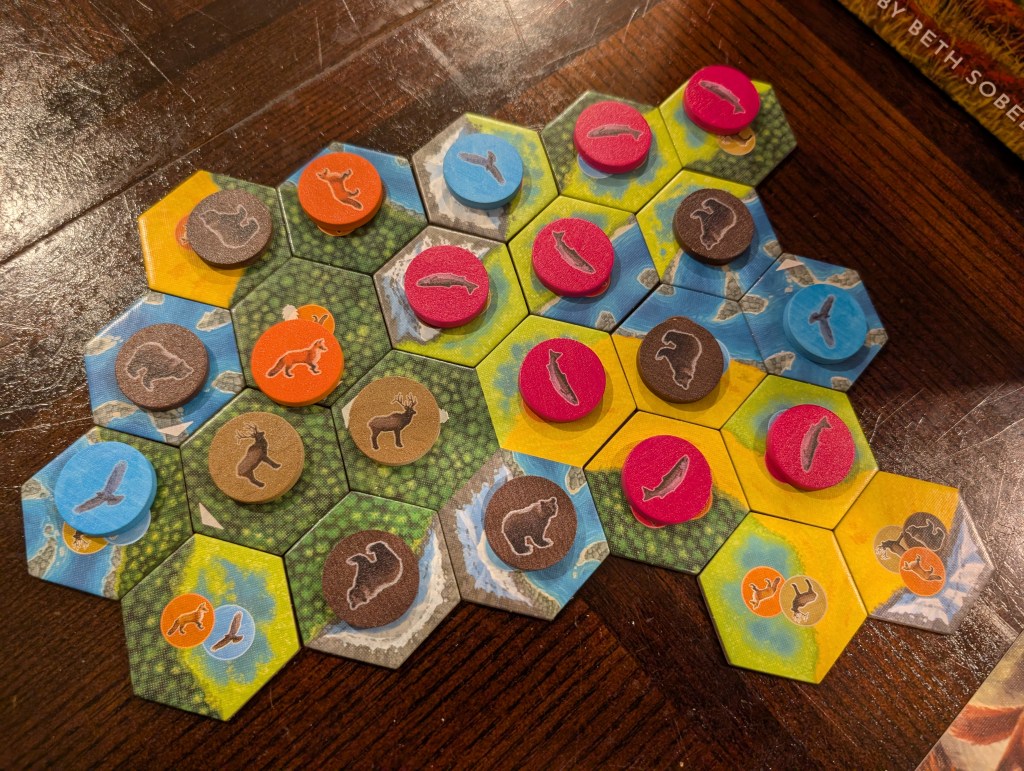
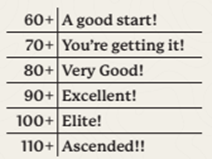
Solo mode, very pleasingly, plays almost identical to the normal 2-4 player Cascadia game. You set everything up the same way you would as if playing a 2-player game. The only difference – each time you draft your selection, you take remaining habitat tile/wildlife token that is furthest to the right, and discard it from the game completely (imagine an invisible second player just drafting those before your next turn). You build out your environment the same way, and play for the same 20 turns you would in any other game. At the end, you score yourself against a rubric provided in the rule book to see how you did:
And if that was all there was to it, they would have a half decent Solo mode on their hands that I could see someone enjoying for a few plays before moving on. I guess I shouldn’t be surprised based on how well the rest of the game was designed, but it turns out that they found a way to make this far more enjoyable than expected: through the inclusion of the above-mentioned “scenarios” you can play through. These scenarios frankly work BEST in solo mode – there are 15 to play through, and they involve playing your game with 5 specific rule cards for the wildlife, and then incorporating different designs into your environment all while trying to score over a certain minimum point threshold. These scenarios turned this solo game into something that I LOVE bringing back out to the table time and time again. It’s a quick setup and plays on the lower end of the suggested play time – I’d say about 30 mins for a solo game if I put in an average amount of thought to my strategy. And if you want to ignore the scenarios and just play – that’s still fun, and you’ll probably get your monies worth either way. But the scenarios, for me at least, are where this experience shined in solo play.
Final Verdict (using the BGG scoring system):
Core 2-4 Player Mode: 9/10 (Excellent – Very Much Enjoy Playing)
Solo Mode: 8/10 (Very Good – Enjoy Playing and Would Suggest It)



 Rolling In The Meep
Leave a comment