
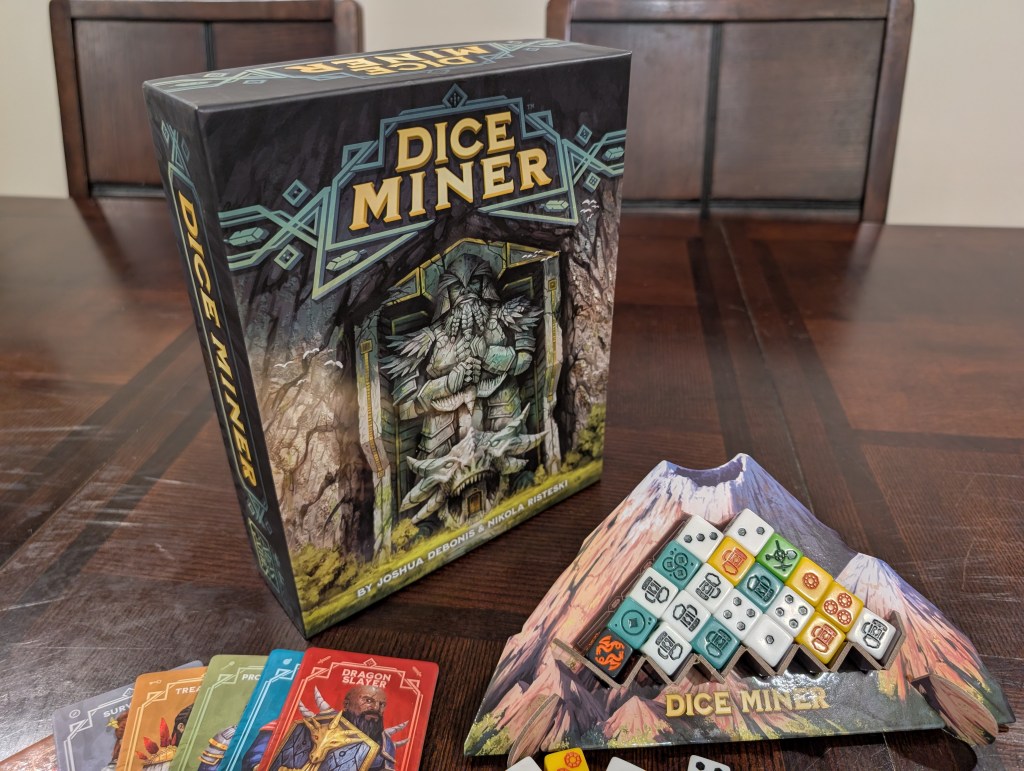
After defeating their mortal enemies (the dragons), the dwarves have emerged from their time underneath the mighty mountain to once again repopulate the surface. Cities emerge across the lands, the cheer spreads everywhere, the beer flows freely – what could possibly go wrong? But the dragons have once again returned to pillage and plunder, and the dwarves must go back to the mountains to once again mine for resources and save their settlements. Will they find the treasures they seek, or should they plan on returning to centuries beneath the surface?
Game Name: Dice Miner
Designer: Joshua DeBonis, Nikola Risteski
Publisher: Atlas Games
Player Count: 1-4 Players
Playing Time: 20-30 minutes (though, the solo mode plays far shorter than this)
Upfront Disclaimer: I purchased my own retail copy of Dice Miner. No free copy was provided for review, and I’ve had no contact with the publisher regarding this game. All opinions contained within are my own unbiased thoughts.
“The Mountains are calling and I must go” – John Muir
A legendary battle between dwarves and dragons sounds like a mighty fun way to spend an evening at the board game table. Unfortunately, if “theme” was your goal here, then you can stop reading this review now and move on to something else. The fun theme described in the opening of my review? That’s all conveyed in the first paragraph of the rule book, and that’s about as far as the concept of “theme” extends to this game.
On the other hand, if you love dice…and I mean LOTS of dice (60 of them to be exact), then put on your hard hat and pull up a chair, because the mountain is calling, and it’s time for us to go mine some dice. This is not a complex game – it’s unashamedly a dice rolling-and-drafting game with a tiny smidge of variable player powers from a very basic character selection process.
To quickly summarize the game, the normal 2-4 player mode plays like this, with a fairly quick setup:
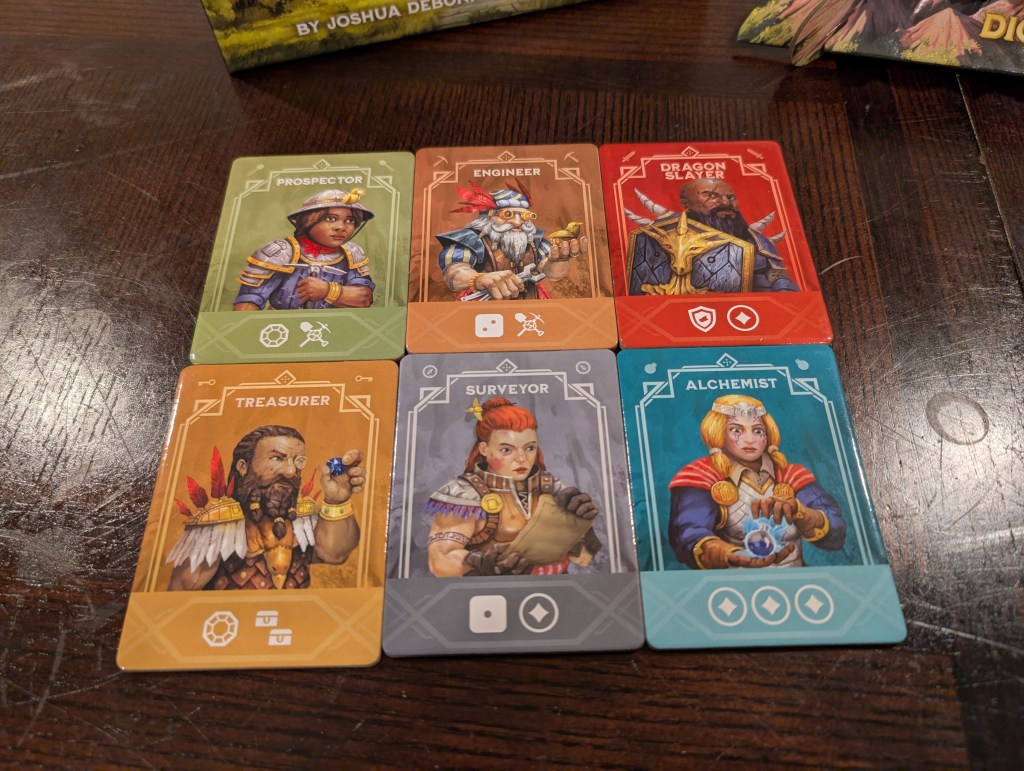
- Everyone chooses from one of six characters in the game, each of which has a set of bonus abilities that get used throughout the game
- Fill a 3D cardboard “mountain” with 20 randomly selected dice from a bag containing 60 total
- “Excavation Phase”: Take turns going clockwise around the table drafting any dice of your choosing from the top of the mountain (or, potentially, from the sides of the mountain too if you have a “beer” symbol on any of your previously-drafted die). These dice go into your personal trove and remain there for the rest of the game
- “Magic Phase”: After the mountain has been emptied, players potentially have a chance to reroll a few dice of their choosing within their trove, if they don’t like the sides they currently have showing; though this requires specially drafted “magic dice”, or choosing a character that allows for a certain number of rerolls each round.
- “Scoring Phase” and “Replenish Phase”: After the rerolling is finished, the round is scored according to various dice combinations. Then all players reroll all of the dice they drafted (though you can earn a special ability to lock in a few dice each round without needing to reroll them), the mountain is refilled to the top with 20 randomly drawn new dice, and the drafting continues.
The game ends once three mountains full of dice (60 in total!) have been drafted, the final scores are tallied, and the player with the most points is your Dice Miner champion. The scoring is, for the most part, extremely simple to figure out. There are white “tunnel dice” which have a 1 to 5 on each side, and you’re trying to organize those into as many straights from 1-5 as possible, scoring one point for each consecutive number in the straight (so a 1-2-3 would score 6 points, but a full 1-2-3-4-5 would score 15). Then there are yellow “treasure dice” which show either 1,2, or 3 gemstones on each side – you score one point for each gemstone you have showing, but the player in each of the three rounds with the MOST gemstones in that round gets 2x their score, a huge bonus. And lastly, there are black “hazard dice”- these can potentially give you negative points depending on how many dragon or landslide symbols they have showing on each side, but you can turn them into a positive score by pairing them with the proper green “tool dice” that protects you against the hazard.
So, that’s Dice Miner in a very simplified nutshell. If you’ve made it this far, you’ve suffered through me already typing the word “dice” 23 times, which means I can safely say you don’t suffer from Cubophobia (ChatGPT tells me that this word means a fear of cubes. Does it? I suspect it’s completely made-up, but here at Rolling In The Meep, I have no editor to fact check and scream at me, so let’s just pretend this is a real word and move on). I’ll see how far I can go for the rest of this review without needing to type the dreaded cubical D-word again.
I have a mountain-full of thoughts
There is plenty to like here. For starters, if you’re looking for something really quick to get to the table, and easy to teach, this game might be for you. I can get it from the shelf to fully set up and ready to go for a 4-player game in about 60 seconds flat. And apart from a little bit of confusion on how the scoring goes for the black “hazard dice” (DANGGG I only made it 3.5 sentences before needing to use that word again), the rules are very straight forward. The game says for ages 10+, but I was able to explain it to my 8-year old very quickly and there is no reason why people younger than 10 couldn’t enjoy this game alongside adults (I should probably add though, that with 60 dice, maybe a bit of a choking hazard for kids under 3 or those who have developed a taste preference for molded plastic cubes). In the year or so I’ve owned Dice Miner, it’s found a way to the gaming table 30+ times, which is a lot. It makes a great game to start a night off, or a filler game, but there have also been plenty of occasions where my gaming group has played 2-3 rounds in a row just because of how quick it plays and how much we all enjoy it. It’s also very satisfying between each round when you get to pick up huge handfuls of dice and reroll them all at once, likely scattering dice all over the place and laying waste to anything in their wake. And for the most part, the components to this game are fine – quality dice with easy to read symbols on each side (and very bright colors to make the different types stand out easily), a nice cloth dice bag with a draw string, and a fairly huge pad for scoring that will likely last you the lifetime of the game (but Atlas Games also published a downloadable template if you need to print more). And the overall best compliment I could give this game – it just plays so, so smoothly. It has a short rulebook that is clear and precise, covers everything you need to know, and never ends in you needing to google any rule clarifications. Joshua DeBonis and Nikola Ristecki really did a wonderful job of putting together a well-polished product.
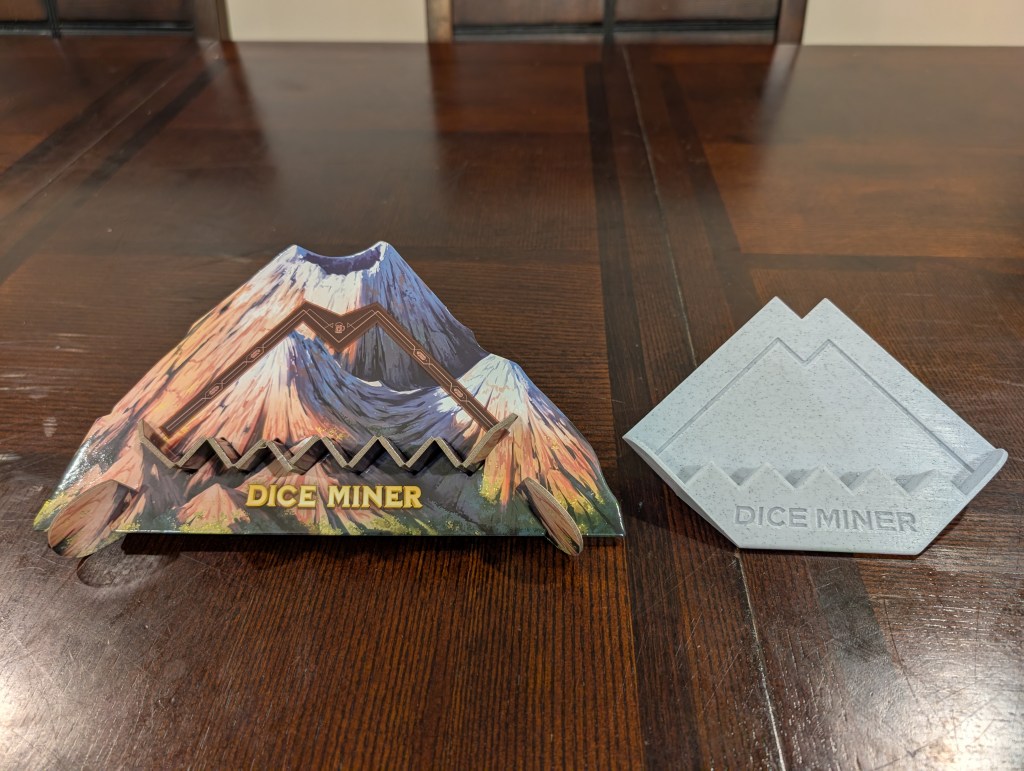
That all being said, there are plenty of issues to point out here that any potential buyer should know. Remember how I said that the components were nice “for the most part”? There is one component that I find sorely lacking in the Standard Edition of the game – the 3D cardboard mountain itself. Sure, the mountain is made out of nice thick punchboard that you assemble yourself in four different pieces but – this is going to be the first (and likely only) part of the game that will eventually fail you. It’s way larger than it needs to be when assembled, which means you need to take the “stand’ off the back of it each time to fit it in the box. You can buy a “Deluxe Edition” of the game that comes with a molded plastic mountain and a plastic dice cup, but even that version of it is WAY bigger than it needs to be, and grows the box size considerably to fit those new components. The very first thing I did when buying this game, was find a nice 3D printable mountain to use with the game, and it’s a HUGE improvement over either the standard or deluxe edition version. It’s sturdy, it’s compact, it’s perfectly designed, and it fits right in the standard edition box with no modification. Huge miss by the game designers to not use something like this fan-made version instead of the version they came up with.
Components aside, you should also definitely be forewarned that this game leans extremely heavily towards the “luck” side of the spectrum, rather than skill. The game gives you six characters to pick from that each have different unique abilities, but they do very little to actually separate the game strategy you might use. You can draft quickly, or you can spend a long time plotting out your strategy – and at the end of the day, you’re going to be super reliant on luck. Between each round, you reroll your entire trove of dice, and may take a great plan from “hero to zero” instantly based on how they happen to fall. I don’t necessarily think this is a bad thing, just something that anyone wanting to play should be aware.
Solo Mode – The mines are a lonely place to be
Here at Rolling In The Meep, I really love a game that offers a solo mode option, and I always applaud designers for including one even if it differs greatly from the normal game. In solo play here, you find yourself still filling the mountain with 20 dice and drafting them, but now you’re competing on score against……a predefined table of outcomes that quite frankly will eventually lead you to pull your own hair out a bit (more on this in a second).
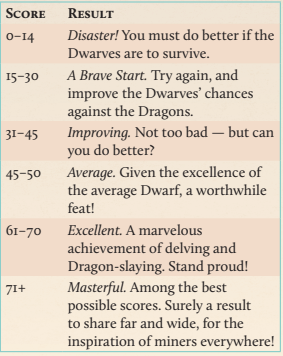
So how is single player different? Here, you must draft dice from the top of the mountain like usual, but you’re limited to only being able to draft certain dice. The player starts with 3 randomly rolled “magic dice” that allow you to remove certain dice from the mountain at will throughout the game. You can always grab any magic dice, treasure dice, or tool dice that appear on top. But you can only grab the white tunnel dice if it lets you continue building a straight – for example, I can’t grab a 4 if I don’t have a 1-2-3 going to already place it on. And for the black hazard dice, you can only grab those if you have already picked the right tool dice showing the proper symbol to neutralize it. Eventually, you’ll find yourself in a situation where you are unable to take any of the dice off the top of the mountain at all – here, you can “spend” any magic dice you have to pull 1,2, or 3 dice off the mountain and throw them back in the draw bag for later. And twice during the game, you are allowed to refill the mountain back up to 20 dice at will, but have to choose carefully when to do so. Scoring works as follows at the end of the game:
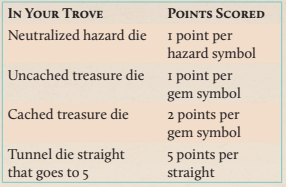
The solo mode plays VERY quickly in this game – you can set it up in seconds and get drafting, and a full playthrough only takes 5-15 minutes or so depending on how much time you spend planning out your drafting strategy. In testing this game, I played over 50 solo rounds. It was very nice to be able to quickly reset and play another round, and for a while, I found joy in that. But I quickly started to notice a problem – no matter what I did, no matter how much thought I put into it, my scores always fell into the same thin range from lowest to highest – a range that the rulebook tells me is either “Improving” or “Excellent”. Try as I might, over 75% of my plays ended with a score in the range of 40-50, and my highest ever score was a 56, which involved literally everything seemingly going my way. But according to the scoring rubric, I need a 61 or higher to break out of “Average”, and a 71+ to be “masterful”. I am convinced that these are both nearly impossible to achieve, and a quick search on BGG and Reddit tells me that other folks suffer from the same frustrating issue.
So, while it’s still fun to occasionally break this out for a solo round if I need something SUPER lightweight and fast to fill a few bored minutes of time, this probably isn’t the solo experience you’ve been dreaming about, and I definitely would not recommend that someone buy this game solely for the Solo mode.
Final Verdict (using the BGG scoring system):
Core 2-4 Player Mode: 7/10 (Good – Usually Willing To Play)
Solo Mode: 4/10 (Not So Good – But Could Play Again)


 Rolling In The Meep
Leave a comment